
ADVERTORIAL
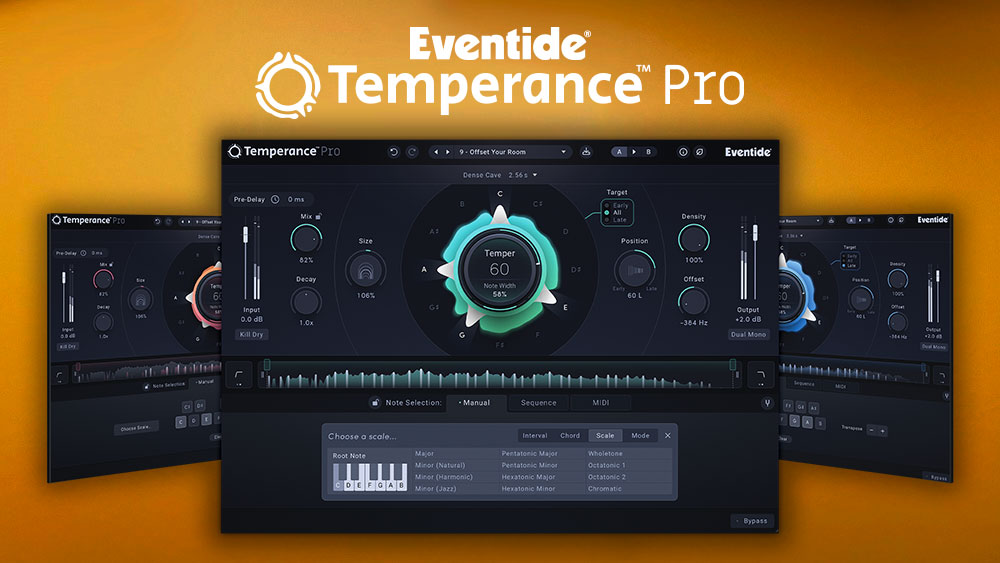
Typically, reverb plug-ins are familiar audio tools that get familiar results, replicating the real-world ambiance of sound resonating in a space. Eventide’s new Temperance plug-in, available in Pro and Lite editions, sidesteps the familiar, however, and breaks new ground as a Modal reverb. By taking a radically different—and far more musical—approach to reverberation, yes, it can serve up conventional ambiances, but it can actually do far more as well.
Temperance’s Modal approach models reverberant spaces as thousands of independent resonances—modes—and then, guided by the 12-note chromatic scale, it allows users to pick and choose which specific notes resonate and which ones die off quickly, changing the sound of notes by emphasizing the level and decay of each resonance.
“It’s literally like having thousands of tuning forks, big and small, all ringing at the same time,” explains Pete Bischoff, Product Owner at Eventide. “If you ring a tuning fork, it rings at one frequency, it has level and it decays. Now imagine thousands of them ringing in concert—some are going to get excited differently depending on your source. And that’s literally what Temperance is: thousands of tuning forks working in parallel, recreating the exact resonances of a reverb.”
By adhering to the 12-note scale, Temperance can control modes in intriguing ways. For example, what’s the sound of an acoustic guitar passing through a theoretical space where, say, A, C and G notes resonate more—or conversely, resonate less—than other notes? That’s what Temperance can serve up—and you can push those results to be anything from familiar reverberations to dreamlike blooms of harmonically friendly sound, to aural experiences that are not quite so amiable. Hear them for yourself and you’ll understand why Temperance’s name is a portmanteau of “tempered ambiance.”
Controlling ambiances in Temperance is simple, too. Instead of making you dig through thousands of modes individually, the plug-in has a powerful user interface that lets you manipulate them all simultaneously.
“Eventide has gone through all of the work and R&D to determine the groupings to control tempering, modifying the early and late fields, and more, to make controlling a modal reverb possible,” says Bischoff.
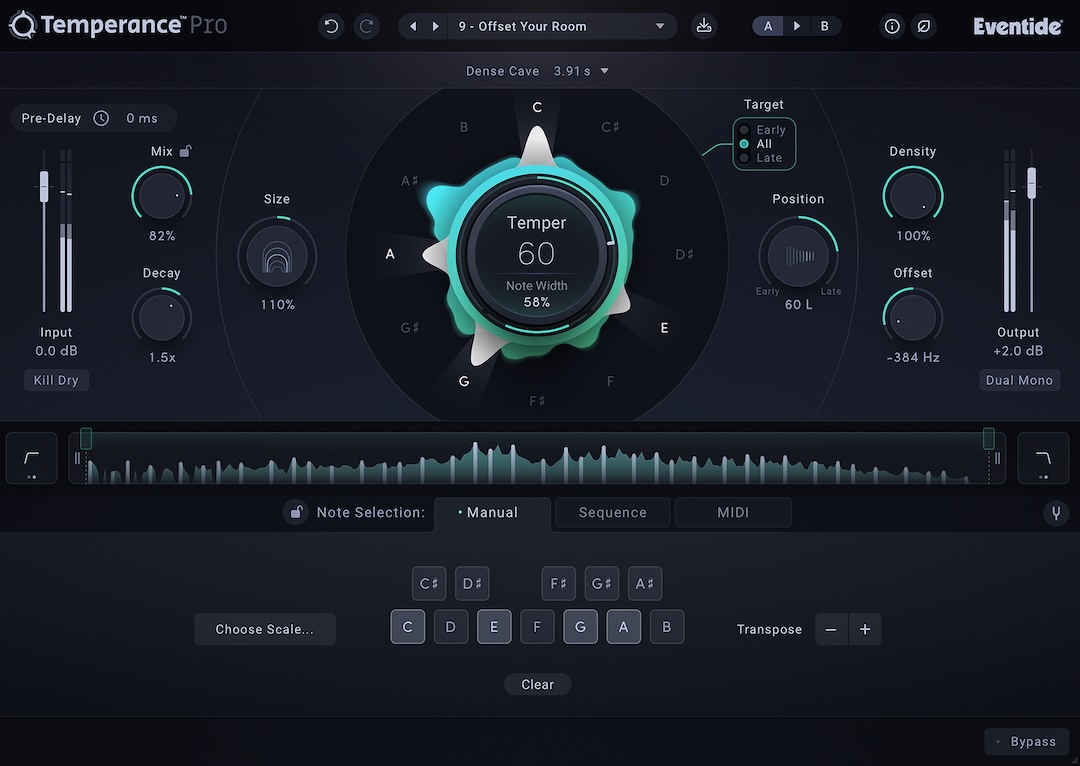
Each control wrangles multiple complex parameters in clear and understandable ways. Both editions of Temperance feature intuitive Mix, Decay and Size controls, but the main focus is the Temper Knob, which emphasizes—or de-emphasizes—user-selected notes, adjusting how much tempering is applied. Surrounding the Temper Knob is the NoteScape Visualizer, which shows notes as they sustain and decay, providing a visual reference point as you work.
Temperance Pro brings additional controls to the table, like Range, which lets you choose which octaves get tempered; Target, which allows you to choose when tempering happens; and Note Width. While the Lite edition comes with 15 presets and three reverberant Modal spaces (Bright Room, Large Studio and an experimental Synthetic Space), the Pro version ups the ante with 120 presets and 29 spaces, including small rooms, large halls, more experimental examples and even a few favorite Algorithmic and Convolution reverbs translated into modal models.
Temperance Pro also provides multiple ways to select notes—while we’ve been discussing Manual Mode, users can also opt for MIDI, where they connect a MIDI device to get hands-on selecting notes, or Sequence.
“Sequence is a way for people to have quick access to tempering their reverb in a song-related, musical fashion, all in one package,” Bischoff explains. “You don’t need to have extensive musical knowledge or to know what a Cmaj7 chord consists of; you can just pop it in and see what happens. Sequence is a way to fast-track that for everyone—it makes people’s lives easier and it’s pretty handy, too.”
Being able to create and control truly musical reverberance opens up a raft of creative possibilities—so where have Modal reverbs been all this time? On paper as a concept; that’s as far as they could get due to technological limitations. Eventide Managing Director, Co-Owner and Resident Fossil Tony Agnello began exploring the idea of a modal reverb back in the 1980s, but the computational processing power required to generate so many modes that quickly simply wasn’t there. Fast-forward four decades, and Temperance has now brought the Modal reverb to life, ready to be used for studio or live applications, as both the Lite and Pro editions feature latency under 1 ms.
By taking a unique, new approach to creating and manipulating reverb, Temperance allows you to not just add ambiance, but musical modal ambiance derived from the sound itself. The results support and embellish the music, giving you a bevy of new options and, quite likely, new sounds, too.