
I can’t remember the name of the composer, the conductor or the piece, but back in the late 1990s, I was invited to sit in and observe an orchestral recording session at the famed Skywalker Sound Scoring Stage in Marin County, California, just north of San Francisco. There were between 90 and 100 musicians on the floor, I recall, with another 20 people in the control room. Sitting alone at the 80-channel Neve console, at the center of all the bustle, was my host for the day, Leslie Ann Jones.
It sounded sooooooo good from my spot on the couch along the back wall. The musicians were beyond phenomenal. The playback through the B&W monitors was as close to being in the room as you could get. At that point in my life, I had been to more than a few big concerts and had visited dub stages as they final-mixed a hit movie, but I had no real references for the level of quality music and sound I heard that afternoon. It blew me away.
And then, about a half-hour into the session, I saw Leslie take her hands off the faders, lean to the right, press a talkback button, and say to the conductor, “Let’s stop here and go back. One of the third violins hit a clam on Bar 13, second beat. We can pick up from Bar 8, when the violins come in.” Then she went back to the faders, solo’d the channel to confirm, nodded to her Pro Tools assistant, and was ready to roll. The entire moment took about 10 seconds. I remember thinking, “How the f-#% did she hear that?!”
• Discover more great stories—get a free Mix SmartBrief subscription!
Flash forward to 2011. Leslie and I are now friends, and over time, I’ve learned that she is an excellent home cook, with a chef-level knowledge and appreciation of food and wine. That year, she won the Grammy for Best Engineered Album, Classical, and to celebrate, a small group of East Bay music and recording friends took her out to Chez Panisse, Alice Waters’ world-renowned Berkeley restaurant.
The starter was being served, second drinks were ordered, and conversations were bouncing around the table. After a couple of minutes, the talk stopped rather suddenly and we all found ourselves looking at Leslie, who was sitting at the head of the table with her head bowed over the bowl of asparagus soup. After a pause, she looked up and said, “Oh, I’m sorry. Sometimes a dish is so good that it makes me want to either cry or give thanks.” We all nodded, smiled, then I raised my martini and shouted, “To great food and great music!”
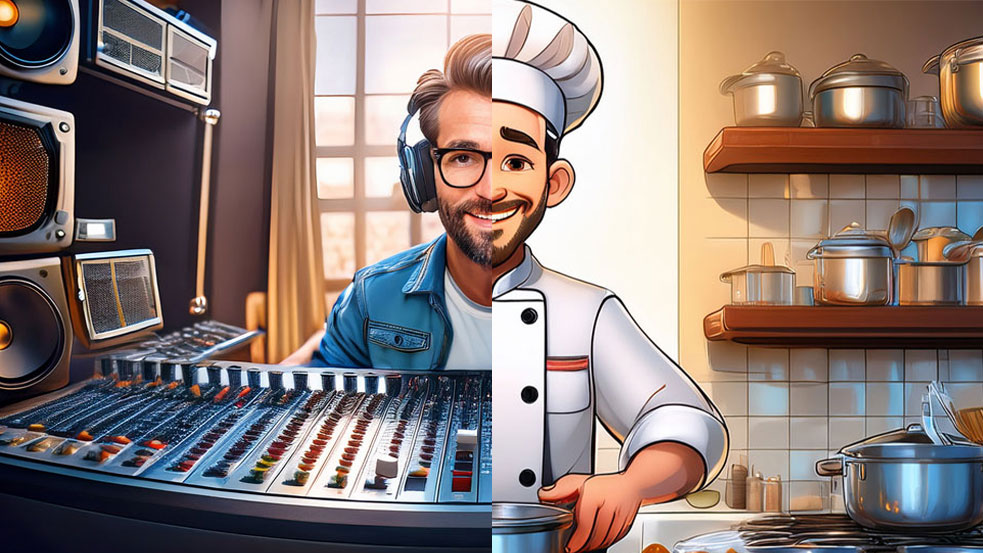
The rest of the night was wonderful and the food was truly delicious. Looking back, it was likely the night I began forming a hypothesis, based purely on anecdotal evidence, that there seemed to be an unusually high correlation between the recording industry and the “foodie” industry. There must be something unique, I thought, in the way those types of brains break down and process incoming information, something that allows them to listen to the orchestra as a whole while still hearing the single violin, or having an emotional response to the asparagus soup while being able to taste each ingredient that went into it. My brain just doesn’t work that way. Neither do my ears or nose. I grew up in small-town Indiana, where the Red Lobster an hour away in West Lafayette was considered “fancy.” Still, my hypothesis has only strengthened over the years.
• Discover more great stories—get a free Mix SmartBrief subscription!
One example? Just a few years after Chez Panisse, I was invited by John and Helen Meyer to Oliveto, the “second best restaurant in Berkeley,” to experience the first installation of a Meyer Sound Constellation system in a restaurant. You could hear the piano in exquisite detail while having a normal conversation at the table, at a normal level. John and Helen love fine food and they love music. They don’t like noise. It was an ear-opening experience.
Another example? In late 2013, I flew down to Los Angeles to write a cover story on Manny Marroquin, an 18-time Grammy-winning mix engineer who had just become owner of Larrabee Studios. During a session break, we had lunch in the restaurant next door and he told me how much he loved the place, that he came there nearly every day. He was thinking of buying it, he said, and turning it into a high-end supper club, with a small stage and high-end cuisine. A few years later, he did buy the spot—Verse LA—and it re-opened to rave reviews. Soon after, he added a 47-speaker Constellation system.
I could list a couple dozen more examples off the top of my head, from Troy Germano, owner of The Hit Factory, taking me out in New York City for the best sushi I’ve ever had, to a night with Dan Zimbelman at Valter’s Osteria in Salt Lake City. Just a few days ago, while editing this month’s cover story, I learned that producer/engineer Will Yip comes from a food industry family and is thrilled that his new four-room facility in South Philadelphia is in the same building as a Michelin-recognized eatery.
As my daughters were fond of saying in their teen years, “They don’t pay you enough, dad, but the perks are sure good.” And they’re right. The music is fantastic, and, occasionally, you get to sit down for some of the finest food you’ll ever eat, shared with some of the most creative and interesting people you’ll ever meet.
There has to be a correlation in there somewhere.
—Tom Kenny, Co-Editor