
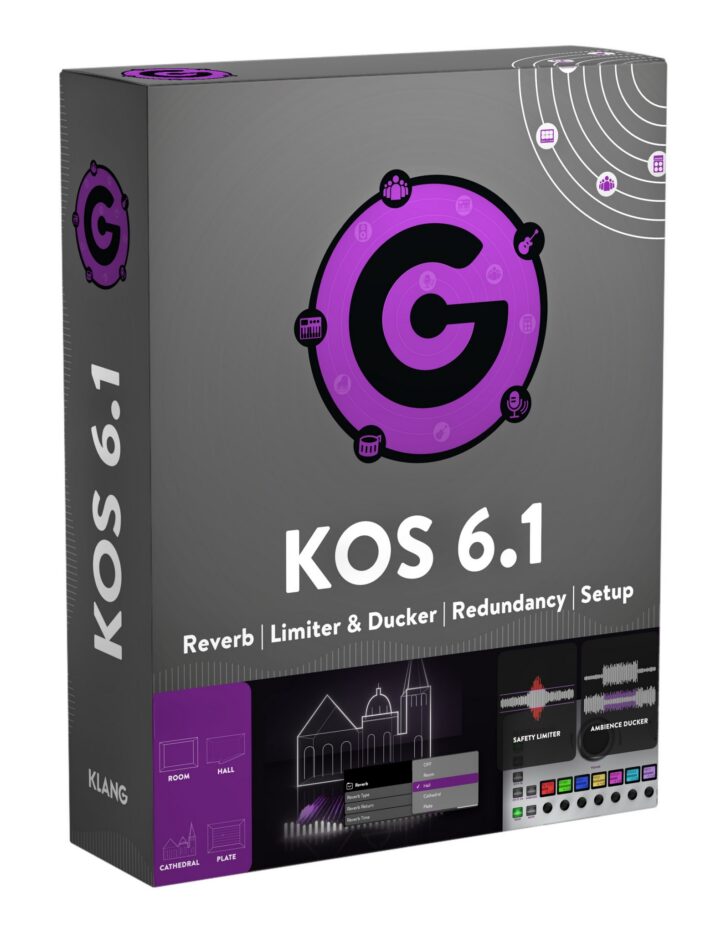
Aachen, Germany (November 4, 2026)—KLANG:technologies has released KOS 6.1, the latest update to its operating system and KLANG:app, which gives every mix its own reverb and adds a safety limiter and an ambience ducker to KLANG:kontroller.
“Reverb has long been one of the most requested features from musicians and monitor engineers,” says KLANG co-founder Dr. Pascal Dietrich. “Immersive mixing has already taken away the isolation musicians used to feel on stage, and spatial positioning has let them turn their in-ears down without losing detail. Now, with KOS 6.1, every mix gets a room of its own, running directly on the processor: a singer can hear their voice in a cathedral while the drummer keeps a tight room around the kit. Add a safety limiter that is on before anyone has to think about it, and you get exactly what KLANG has always stood for: lower levels, better mixes.”
Free of charge, the new reverb runs directly on the KLANG:konductor, KLANG:vokal, DMI-KLANG and KLANG:1pro processors. Every mix can choose from four reverb types—Room, Hall, Cathedral, or Plate—each with its own adjustable time, return level and four-band EQ. A reverb send on every channel lets the vocal sit in the room while kick drum and bass stay dry.
Monitor engineers set up each mix’s reverb in KLANG:app, and musicians can adjust their own reverbs on KLANG:kontroller or in KLANG:app. Existing shows load with the reverb off, so updating never changes a mix that’s already signed off.
• Discover more great stories—get a free Mix SmartBrief subscription!
Immersive mixing already lets musicians hear every source clearly at a lower volume, because instruments no longer mask each other in the middle of the head. A room around the mix makes it sound even more like a real stage, so there’s less reason to push the level up to feel the music.
KOS 6.1 also brings a new safety limiter and an ambience ducker to KLANG:kontroller. The safety limiter is on by default and protects the musician’s ears by catching sudden full-scale bursts, such as a dropped cable or a feedback spike, before they reach the in-ears. The ambience ducker lowers the audience mics while the band plays and brings the crowd back between songs.