
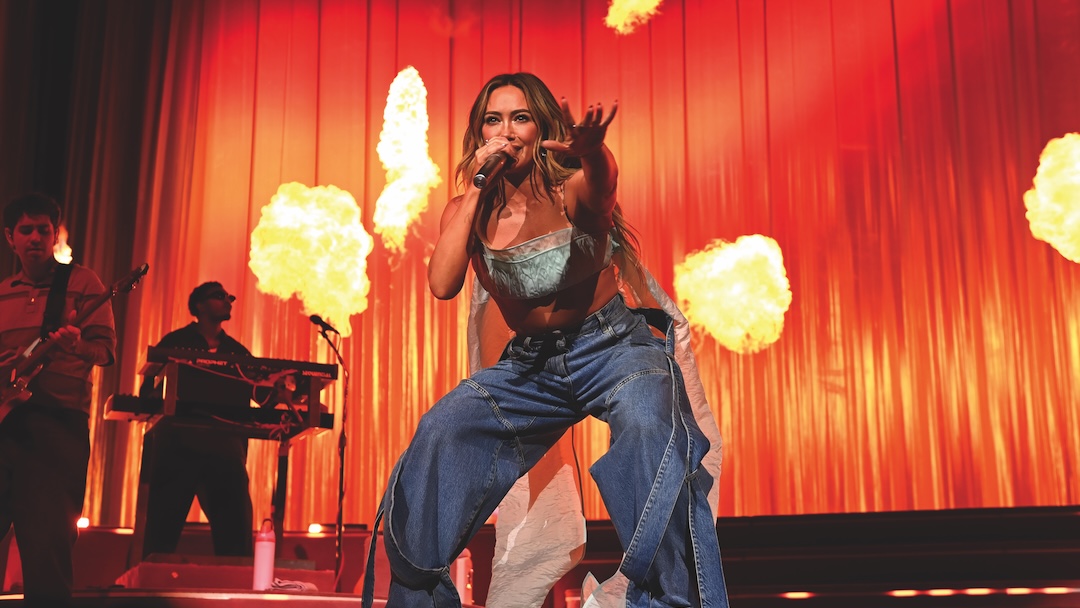
New York, NY (November 18, 2026)—The old adage goes “Luck is when preparation meets opportunity”—and that’s exactly what transpired with the current Hilary Duff Lucky Me tour.
Duff spent most of the 2000s as a teen idol thanks to Disney Channel’s Lizzie McGuire sitcom and a string of movies. Building on that momentum, she hit the recording studio, had a bevy of hits, toured and sold more than 10 million records during that era. But while she grew up and continued working as an actress, Duff largely left music behind after her last tour in 2007. By 2025, it was time for a comeback‚ and what happened next was the stuff of Disney movies.
• Subscribe to Mix Magazine and our Weekday Newsletter for free!
“I started with her a year ago in September, getting things organized,” said John Bruce Affleck, tour manager/FOH engineer. “We did rehearsals from October til January this year, when we did four underplays in London, Toronto, New York and L.A. That was her testing the waters—they were 2,000-ish capacity rooms, but each show had about a quarter-million people sign up to try and get tickets. Once that happened, Live Nation and her management said, ‘Oh my God, there’s insane demand here.’”
The production was quickly upscaled, and Duff’s tour has been packing arenas and amphitheaters since its kickoff in June, including selling out multiple nights at Madison Square Garden and The O2.
Affleck attributes much of that success to the first song of the first underplay: “We prepped like it was going to be a sold-out show at MSG, because we knew there would be so many eyes on it. Whatever the first song was, it would be on social media 10 minutes later. Thousands of hours went into making sure that went well.”
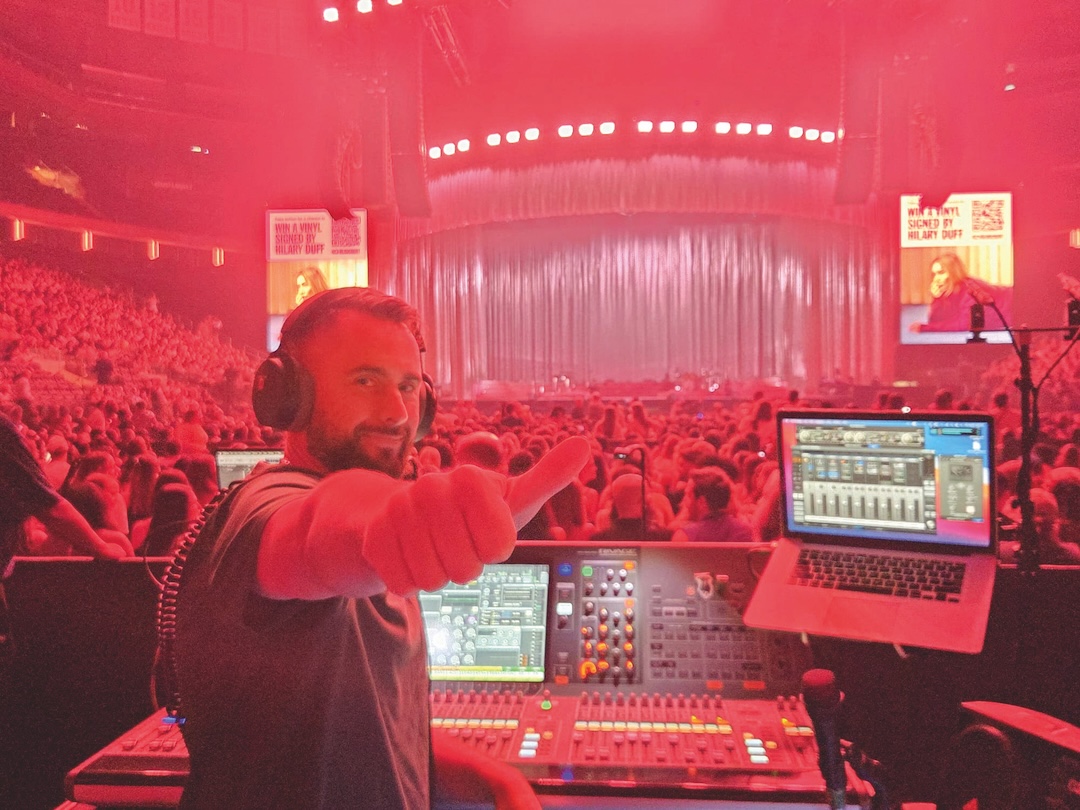
From the first hour, Affleck, monitor engineer Nathan Bond and system engineer/FOH tech Ken Ryan were on hand. “We were there before the band was even hired—there wasn’t a cable or anything,” he chuckled. “We were ordering backline and doing all the rehearsals and budgeting and advancing. Originally, I was going to be production manager and front of house, and then Hilary asked me to be tour manager, so I’m tour managing and mixing. I’ve been involved from it being a 30-person team to an 80-person team now.”
Throughout the extended rehearsal period, Affleck, a Canadian native, headed to Los Angeles for three-week stretches, working in a studio/rehearsal facility owned by Duff’s husband, Grammy-winning songwriter/producer Matthew Koma: “We had an input list that we did with the MD, Jacob Harelick, which we sent down before we even did a day of rehearsal, and it stayed 99% the same [to the arena tour]. I was amazed by how close we got it before doing anything.”
Control gear was sent to L.A. from Ontario-based Soundbox Productions, and Affleck assembled a double-wide rack of outboard gear, much of it from his own collection. Central to his front-of-house mix position, however, is a Yamaha Rivage PM3 desk. “It’s one of the most stable platforms and it just feels like music to me,” he said. “It doesn’t sound clinical; it just sounds interesting. I’m a big fan of Dante and integrating devices into a Dante network; obviously, the Rivage ecosystem does that really well. Also, I like to have a small footprint but a big sound—being a tour manager, size, weight and cost factor into every element of touring for me.”
• Foo Fighters Honor Retiring Monitor Engineer Ian Beveridge
Over in the analog racks, his drum group passes through an API 2500+ stereo bus compressor, while playback tracks hit a Gainlab Audio Wizard. “It’s a tube saturator, so it compresses a bit, and I felt that added some weight and glue, which I find keeps it consistent,” he noted.
Also in the racks are a Sonic Farm Creamliner, Manley VoxBox, a Distressor and a string of 500 Series units, including an SPL TDx Transient Designer; an API 560 10-band graphic EQ and a 550A 3-band EQ; a Neve 545 Primary Source Enhancer; Maag EQ4; an Empirical Labs DerrEsser and a Pump Compressor; an IGS Rubber Bands EQ; and more.