
The Bruce Springsteen biopic Springsteen: Deliver Me From Nowhere focuses on The Boss recording both at home and in the studio in 1981 as he struggles to create the songs that will become his stark landmark album Nebraska. Painstakingly recreating the sound of those situations required an army of audio professionals, and over the course of this unprecedented, five-part, 11,000-plus word article, they all weigh in on how they made that happen. Don’t pass up Parts 1 and 2!
LIVE IN THE STUDIO
There are two scenes in which Springsteen takes a break from being in the limelight, opting instead to join friends—a band called Cats on a Smooth Surface—at the now-historic The Stone Pony club in downtown Asbury Park. They play two songs together, on separate visits—Little Richard’s “Lucille” and John Lee Hooker’s “Boom Boom.”
A full pre-recording of the two songs was tracked in mid-December, 2024 in Power Station Studio A. “There was quite a lot going on when we were recording,” Koller recalls. “The film crew was coming in to begin blocking the ‘Born in the U.S.A.’ scene there, so we had to get finished so they could come in and do their work.”
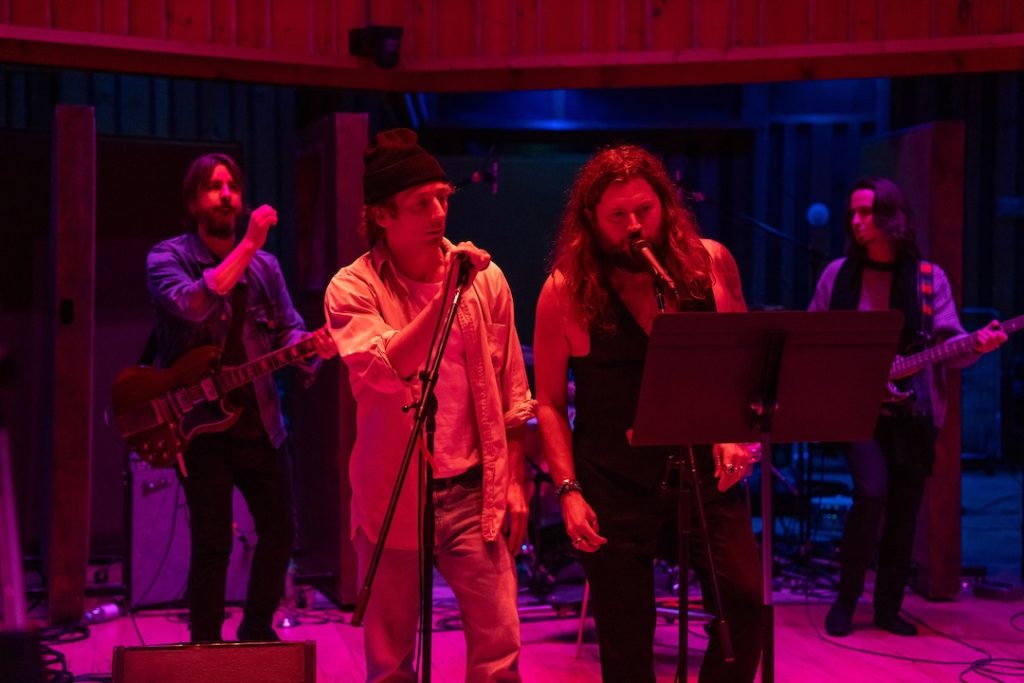
Cobb brought in a handful of strong players to make the recordings, with White joining them on guitar and some miscellaneous vocals, as seen in the final sequences. The producer had worked previously with Greta Van Fleet, so brother members Jake and Sam F. Kiszka played guitar and bass, respectively, joined by drummer Aksel Coe and Detroit session keyboardist Bobby Emmett, all led by Rival Sons singer Jay Buchanan. “There was no click,” Jason Ruder says. “It was just getting them all in a room and letting the band rip, and running everything hot across the console. Dave got them really live-sounding.”
![Pre-record session for the Stone Pony performances, recorded at Power Station. [L-R]: Greta Van Fleet guitarist Jake Kiszka, Jeremy Allen White, Rival Sons singer Jay Buchanan and Greta bass player Sam Kiszka. Photo: Macall Polay/20th Century Studio.](https://gingertim.com/wp-content/uploads/2025/12/2025-12-17-Springsteen-Day-3-1.jpg)
Koller did two things, specifically, to get that live club sound. “The idea was for it to sound live and raucous,” he describes. “We actually set up a P.A. system in the studio, with wedge monitor speakers as you would see onstage. Those had a lot to do with it sounding like a live show. It’s something Dave Cobb does often on records he’s recording.” The monitors were set up and operated by Power Station staff engineer Matthew Soares, who had experience doing monitor mixes. The team had spotted Soares earlier, sitting by the tape machine, and, notes Ruder, “We simply asked him, ‘Hey, can we get you to be in the movie?’” which the engineer gladly did. He is seen doing a similar role, in the film, acting as Chuck Plotkin’s assistant engineer, back at the tape machine.
Along with the wedges, Koller also placed PZM mics on the control room windows. “Dave said, ‘I want it to sound like the walls are shaking,’” he remembers. “I put those PZMs on the windows and placed some other mics close to the walls to get some reflections. Those PZMs are the source of most of the ambience; that makes it sound raucous.” And it truly was, he reports: “Everybody was jumping up and down in the studio; Scott Cooper was having a great time. It was like being at a live show. The Greta Van Fleet guys and Jay are so energetic and so much fun to watch.”
AUTHENTICITY ONSCREEN
If there was ever a group of fans that knows its subject’s work backwards and forwards in specific detail (other than Beatles fans), it is Springsteen fans. They know and expect a story about him to look and sound like the history and reality they know. The person in charge of delivering that, with respect to instruments and gear, on Deliver Me From Nowhere, was music gear consultant Joshua Lutz.
Lutz first impressed prop master David Gulick on A Complete Unknown (where he also worked alongside Tod Maitland) by identifying and reconstructing an RCA 77 yoke mount with a radiator clamp on it. The two, like many others on that crew, ended up on this film as well, Lutz filling it with stuff that Springsteen fans—and engineers—all expect to see.
“Our No. 1 priority on set is authenticity,” he states. “Not just for telling the story, but for the fans—and for all the gearheads out there like myself. When I watch a film like this, we are all ogling over the gear, and we also want to see the story told accurately.” Adds Cooper, “This is a real gear movie—there’s lots of gear.”
Lutz was able to take advantage of homework that had already been done, particularly by author Zanes. “He had done a massive amount of research and was always available on set to answer any questions,” said Lutz, “but there are a lot of historical documentaries that already exist, of what exactly was used and how it was used.”
On set, Lutz would keep an eye open for anything that was amiss, looking over Tod Maitland’s shoulder at his 7-inch monitor. “If I saw an XLR cable with a modern Neutrik jack on it, I’d say, “Stop, lemme run in there quick,’ and I’d solder on an old Switchcraft or a Canon jack—and it all had to function.”
There was another great resource regularly on set—Springsteen himself. “He was typically seated at video village, next to Scott, and the two of them would talk,” Lutz recalls. “Scott might ask, ‘Where were you in this scene? Were you sitting on the edge of the bed with your guitar or were you on the corner of the bed?’ and then Scott would run in and make a change.”
Adds Maitland, “At first, it’s remarkable that it’s Bruce Springsteen sitting right there. But, after a while, it got to be, ‘’Scuse me, Bruce, I gotta get over here,” he laughs. “He was very interactive; it’s his story we were telling.”
RECREATING THE COLTS NECK BEDROOM STUDIO
There was no place more important—nor more prominent—in the film than the Colts Neck bedroom set, built on a Stage 1 at Steiner Studios in Brooklyn. To help production designer Stefania Cella and the rest of the team get things right, Springsteen actually took them all on a location scouting trip, bringing them to each of the places in the film—including the original, real Colts Neck house (and its bedroom).
“He put us all in his Bronco and took us to Asbury,” says Cooper, “and then, to be able to walk through the Nebraska house with Bruce was an incredible treat. To have him walk us through exactly how it felt, where the bed was, where the chest of drawers was, where Mike Batlan was set up. That’s the gift of having your subject matter not only be alive, but so available and so generous. It’s the most remarkable experience I’ve ever had.”
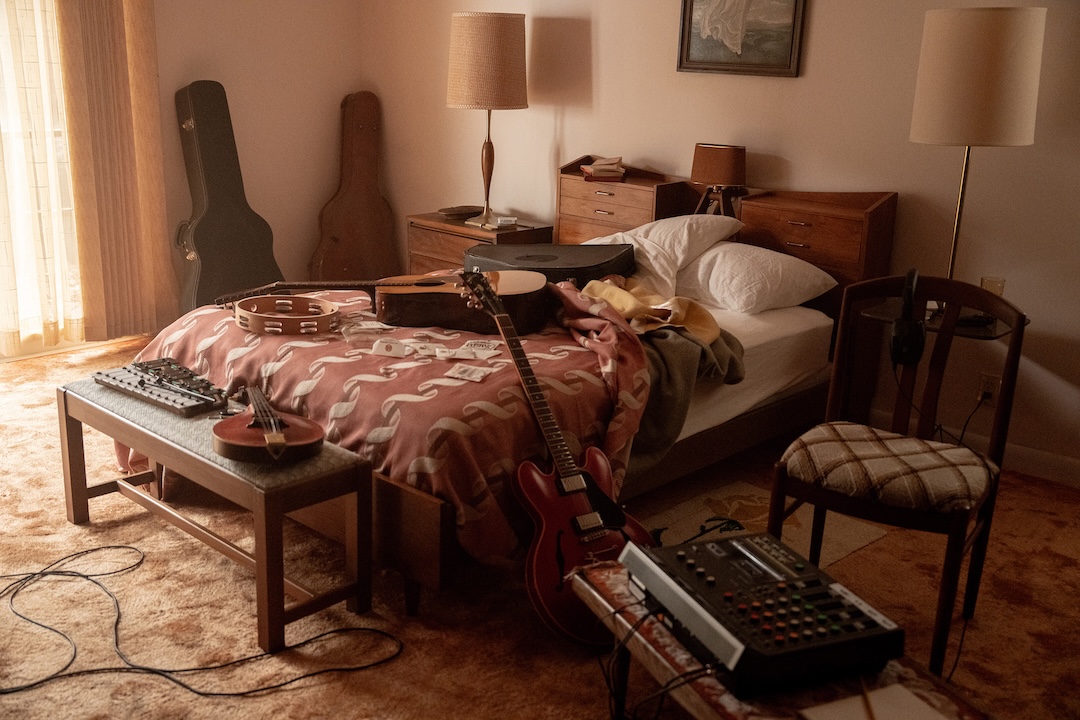
On set, the room was arranged essentially as Springsteen remembered it, with the bed up against the west wall (with a painting hanging over it actually loaned by the man himself, from his own home), a small chest of drawers on the east wall, on which the recording equipment sat, and Springsteen set up to the right side of the bed, on a chair, with a mic on a boom, with Mike Batlan nearby, operating the 4-track.
For most of the recording, White played a Gibson J-200, essentially identical to the one still in Springsteen’s collection. Obtained by Lutz from Gibson, he notes, “The J-200 I brought was too clean, so we ended up getting a couple from Gibson that were nice and distressed. We had the Scenic Dept. knock ’em down a little more, with some faux distressing—in a reversible way, so that we could return them to Gibson in great shape—but there were a few guitars I had to beat the heck out of.”
More importantly, seen mostly in the background in that room, but in play elsewhere, is a replica of Springsteen’s famous Fender Esquire. The original was modified for The Boss long ago by his initial master luthier, Dr. Phil Petillo, and is now kept in perfect condition, along with all his other guitars, by Petillo’s son, Bruce’s current master luthier, Dave Petillo of Petillo Masterpiece Guitars. “The original Esquire, the one my dad sold him, had Petillo Pickups and Petillo Precision Frets,” known as Triangle Frets, “as well as the six-saddle titanium barrel bridge he made, back in the ’80s,” says Petillo.
DISTRESS OVER GUITAR DISTRESS
For the film, while David Gulick had procured an Esquire from Fender, “it didn’t meet our standards for authenticity,” says Lutz. Instead, he went right to the source—Petillo—and asked him for one. While Petillo regularly makes Esquire replicas, and things like replacement necks for Springsteen’s touring Telecasters, he and his father both shied away from making exact copies of the Esquire, simply out of respect for its history, the luthier notes. But when his friend, Josh, called and said, “I need a guitar,” he recalls, “That was a month before filming was to start. The lacquer on a guitar won’t even be dry in a month. I thought, ‘What do I do?’”
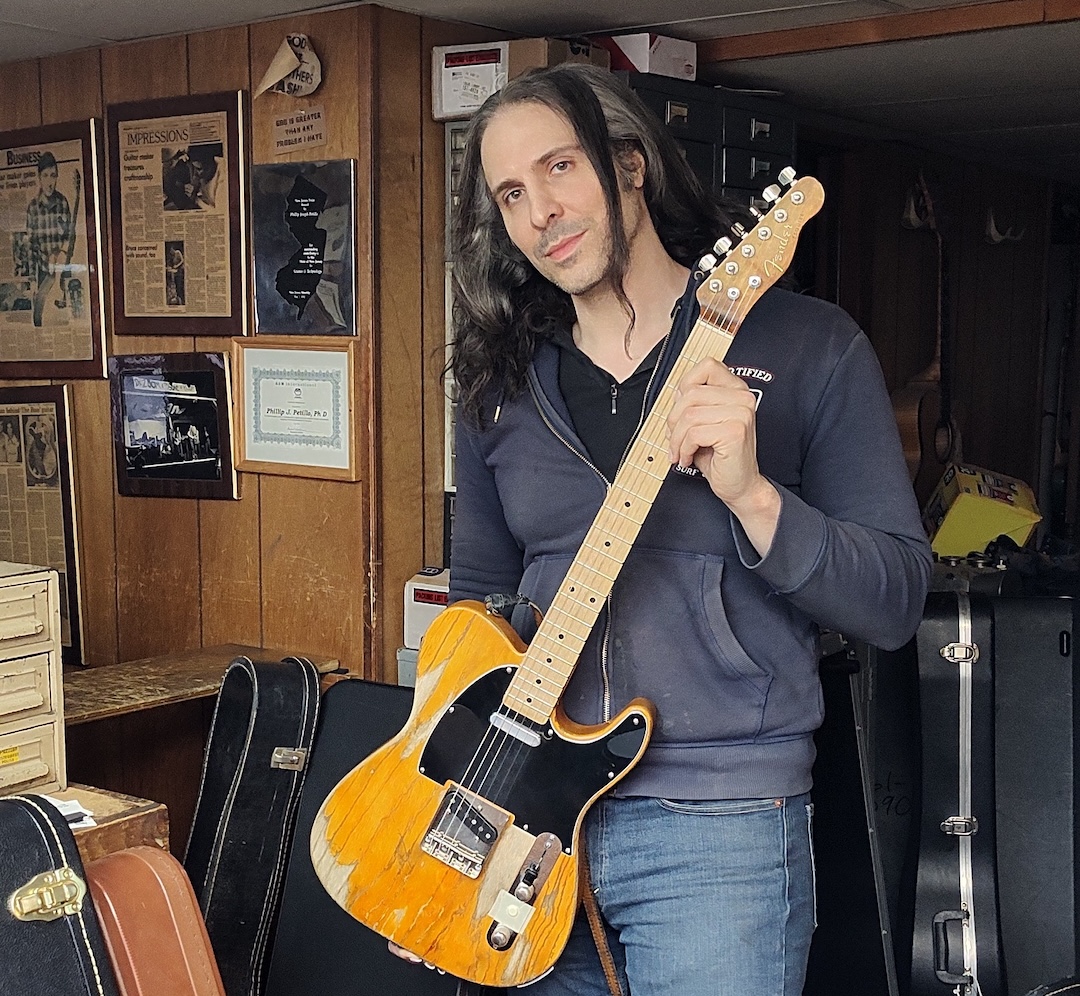
Fortunately, Petillo had made an Esquire replica for a popular French songwriter friend, Olivier Rouquier, who flew to New Jersey to loan it to Petillo, to allow him to modify it to appear precisely as fans remember it—though not precisely to the way it would have appeared in 1981. “The lacquer wasn’t that worn then, and if I made it as it really would have looked then, it would have been obvious it was a replica.” He instead applied some of the lacquering techniques he had learned from his father—who had learned them himself working with D’Angelico Guitars—to distress it in a way that, he says, “is symbolic of the struggles that Bruce put into the instrument,” as fans know it.
Petillo also made a Grade 5 titanium bridge, as his father had done on the original. Diehards will even spot the piece of masking tape between the volume and tone knobs, as on the original, covering the small low/high impedance switch.
“My dad designed that switch with Bruce Jackson of Clair Brothers, to sharpen the clarity of Bruce’s guitar and overall live sound,” Petillo states. “The tape kept the switch locked in place during shows, so Bruce wouldn’t hit it by accident. It also kept water out of the switch—a crucial point, give that Springsteen had a habit of pouring water over himself onstage.
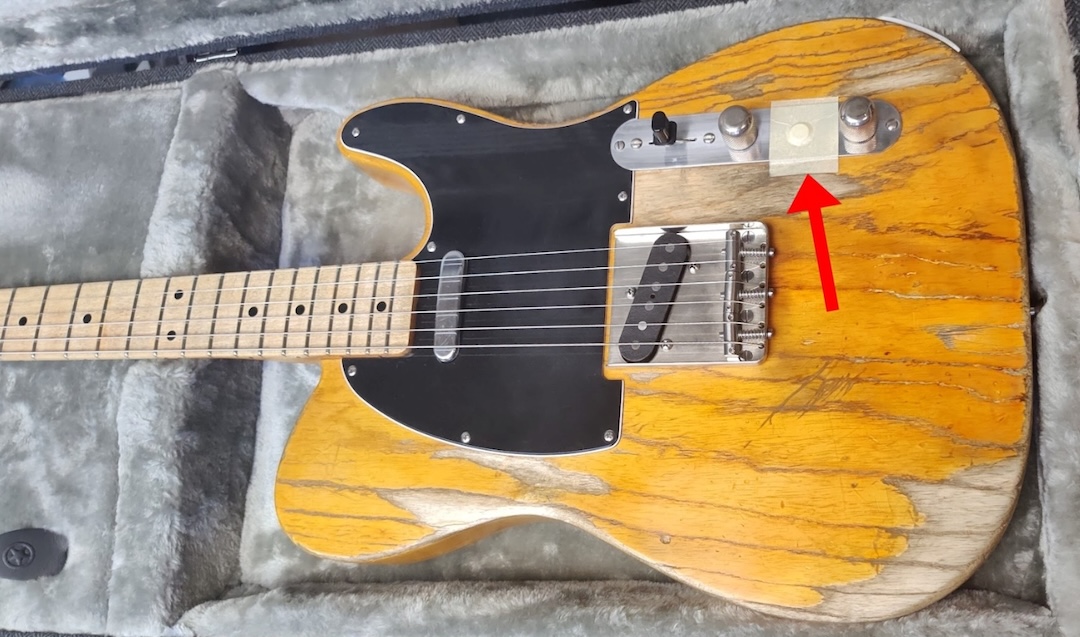
When Lutz showed the replica to Springsteen, on set, he notes, “He went, ‘Oh, so that’s where that thing’s been!’” That response, it turns out, is evidence of Petillo’s good work. “It fooled him,” the luthier says with a smile.
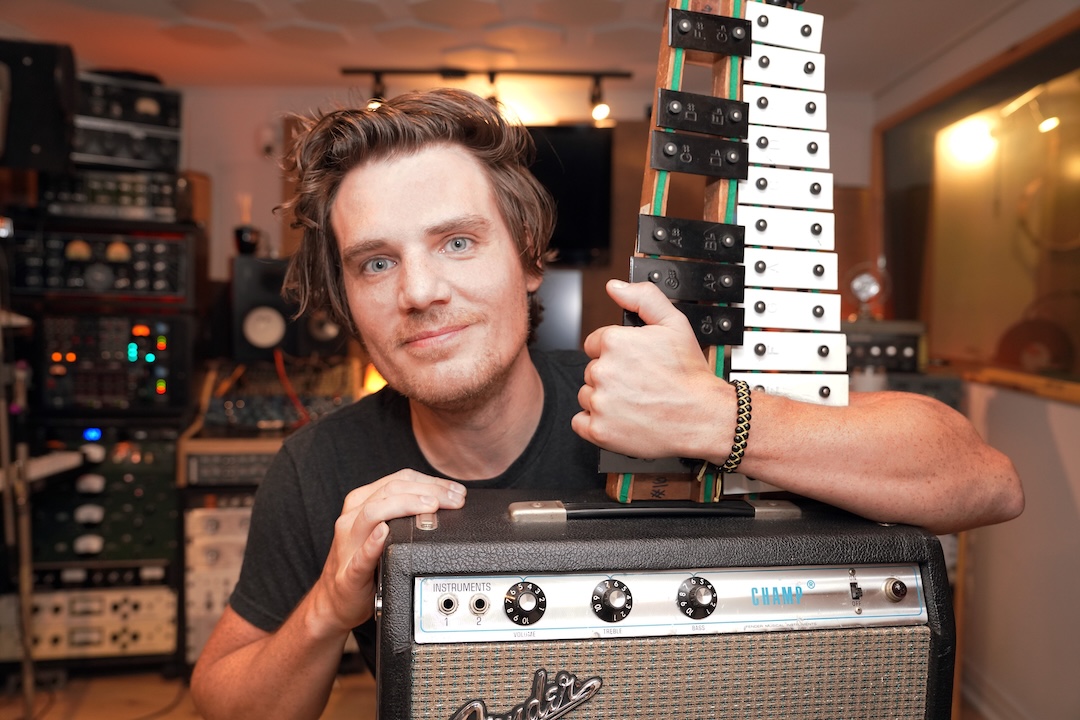
Besides those guitars, Lutz also provided the mandolin seen in the bedroom—a 100-year-old Gibson A2, which he sanded down to raw wood and applied a StewMac finish to, making it look new. Also on hand was Springsteen’s ever-present glockenspiel, as well. Why does a big rocker from New Jersey play a glockenspiel? “When Bruce grew up in the 50s,” Lutz explains, “every kid had a recorder and a glockenspiel—because that’s what mom rented for studying in public school. They were used prominently on the doo-wop groups’ records that Bruce loved, so that was a sound he always had in his head when writing songs.”
PROCURING A PLETHORA OF PORTASTUDIOS
Guitars aside, the most important piece of equipment in the bedroom set was the TEAC 144 4-track Portastudio, first introduced by Tascam (under its TEAC brand) in 1979, and retailing back then for about $900. “Neither of them really knew how to work it,” director Scott Cooper explains, “and Bruce didn’t want a producer in the room, or an engineer. He just wanted to feel like he was singing in the shower.”
Finding authentic 144s in 2024 was possible, though finding ones that actually worked was a bit harder. The Props department went out and sourced roughly a dozen units, but the “hero” TEACs (there were two) had to be clean enough to appear new onscreen. “We actually kept them in wooden boxes with screw-on lids, to protect them from getting even a single scratch,” Lutz informs. “It was a daunting task to find one that worked and was clean.”
Discover more great stories—get a free Mix SmartBrief subscription!
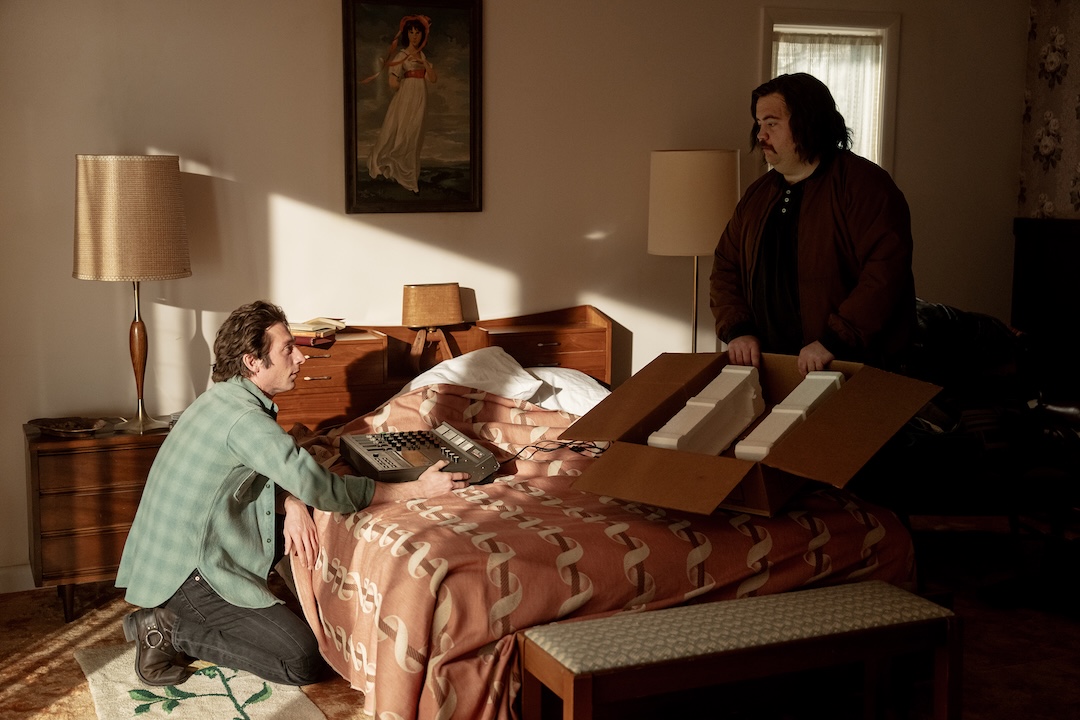
Onscreen, Batlan (portrayed in the film by Paul Walter Hauser) is seen bringing a new one into the bedroom and unpacking it. “David Gulick not only had the original box remade, but the original Styrofoam packaging inside—not just cut with a knife, but actually formed,” Lutz states. “And the original manual’s in there—I hunted one down on eBay, still in its original plastic sleeve.”
Other units were required on the engineering side, mostly for Koller’s use, but a few were needed for Ruder, Cobb and Maitland. “I got one that worked,” says Koller, “but by the time I was done, the transport barely worked, because I used it quite a bit. The transports in those are the weak link—and they’re 45 years old.”
Adds Lutz more pointedly, “They were junk then, and they were junk now,” noting that those particular models had digital transports, the first of their kind. “It was almost impossible to find parts for them and to repair them. I actually had a couple of guys working on them, including Roger Deller at Electric Lady Studios.” Cobb recalls, “We’d get one working, dial it in, and it’d break, and then we’d do another one.”
What kind of cassettes did Bruce use in his four-track? “I tried out different cassettes, but I never found out exactly what he actually used,” Koller states. “I just figured it was normal bias cassette. I tried a Maxell UR, but it was quite noisy, so I ended up with Maxell XLIIs, which are pretty robust. The TEAC transport is hard on tape, so I definitely not only wanted that quality of tape, but also wanted it to be robust.” Though the tapes used to be commonly available in a three-pack at Target for $5, they now show up on Amazon in a five-pack for $80. Assistant prop master Katie Clinebelle procured 30 to 40 of them.