

The Bruce Springsteen biopic Springsteen: Deliver Me From Nowhere focuses on The Boss recording both at home and in the studio in 1981 as he struggles to create the songs that will become his stark landmark album Nebraska. Painstakingly recreating the sound of those situations required an army of audio professionals, and over the course of this unprecedented, five-part, 11,000-plus word article, they all weigh in on how they made that happen. Don’t pass up Parts 1, 2 and 3!
In 1981, Bruce Springsteen was keen to add tape echo to his rudimentary mixes, so he had Batlan bring in one of his Echoplexes—the Maestro Echoplex EP-3, to be exact. The one seen onscreen in the film, however, is from the personal collection of music gear consultant Joshua Lutz and his facility JML Studios. As used in the film ,“it had an original [Echoplex inventor] Mike Battle tape reel inside of it,” says Lutz, replacing the aftermarket reel it had when he first found it, to make it sound identical to what Springsteen would have used.
On set, Lutz, realized the Echoplex didn’t have a functioning red “Record” light, so, in a pinch, the crew’s Electric Dept. opened the case and inserted a bulb and ran 12 volts to it, activated remotely on set; when actor Jeremy Allen White hit “Record,” the red light indeed came on. “Little things, like that, just have to be right,” said Lutz. “Someone will notice.”
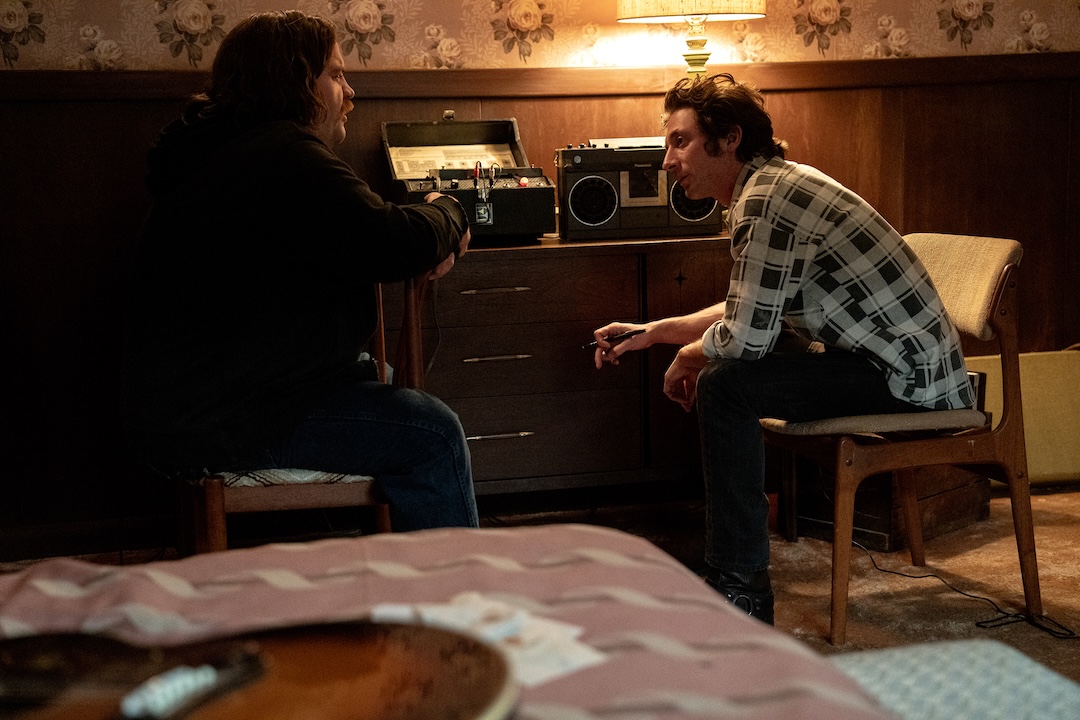
The boom box itself—a 1980 Panasonic RX-5100, according to Lutz—was connected to the output of the Echoplex, and/or the TEAC, via a pair of RCA cables to its stereo inputs. Two or three of them were acquired, “and [prop master] David Gulick and his team distressed the one seen onscreen, so that it looked like it had been in a basement flood,” as Springsteen’s had been.
Also seen on set were Springsteen’s actual lyric notebooks, which he provided from his archive. “We recreated some, too, so there’s a mixture,” says director Scott Cooper.
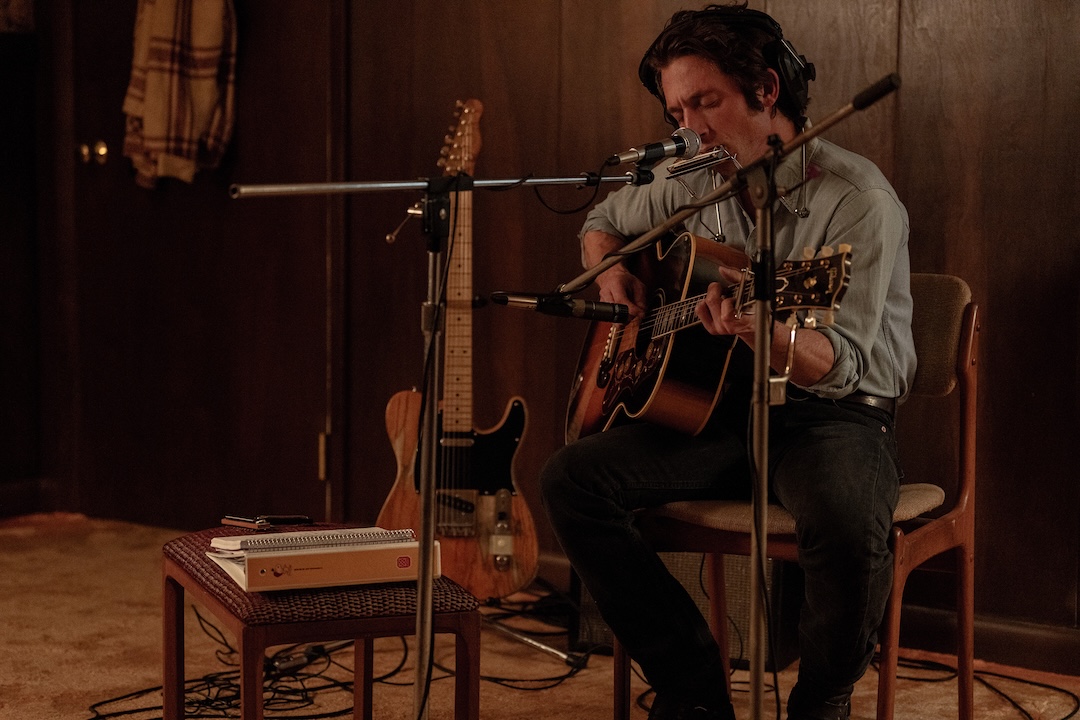
On set with White as Springsteen, sitting in his chair playing the J-200 and singing, Lutz miked him with a pair of microphones—vocal and acoustic guitar—as the artist himself would have done. Both mics went live to production sound mixer Tod Maitland to record each camera take.
MIKING THE MASTER
Although Springsteen almost exclusively used an Electro-Voice DS35 from 1980 through 1990 for vocals, for the film, Cooper preferred the look of an older Shure Unisphere PE54D (also known as the PE56 or 565SD). For the guitar, if using just a single mic, Lutz would place a Shure Unidyne 57 around the 12th fret, just as he had done countless times in his work over the years, at studios like Electric Lady and Salt Mine. “Studio guys will see it, and go, ‘Yeah, that’s where I would have put it, too,’” he says.
The mics were sent to Maitland and fed to his recorder, avoiding having to mic the actor separately. Maitland did, however, utilize his Sennheiser 416 boom mic, along with a DPA 660 or 661 wireless mic on White. “He’s wired, not only for those moments when his singing and not in front of that vocal mic, but also to create a little bit of a different sound,” Maitland explains. “If, in the mix, they open up the boom a little bit, it gives you more ambience and more of a real feel. If you have a microphone that’s super close to the mouth, you’re not going to hear much ambience in a room. That’s not how we hear a person when we’re in a room with them, like the camera’s eye is.”
Besides his own digital recorder, Maitland also recorded to a TEAC 144 he had on set with him. “I’d record just the vocal and guitar mics on two tracks and that’s it. They couldn’t sync to film, obviously, but I’d turn those in, just so they’d have that sound to refer to.”
Music editor Ruder joined Maitland on set during these scenes and, Ruder notes, “We played back Bruce’s original 4-track elements we had edited previously, into Jeremy’s headphones,” to which White had sung/recorded to during the pre-record stage. “He was able to use that, really as a kind of a guide track, like an elaborate click, to help get into the spirit.” Adds Cobb, “Jeremy could match his performance from the pre-record, which he had learned so perfectly.”
There were several types of mixes of the Colts Neck material which were created for the film—the on-set recordings, the pre-records, and most importantly, recreations of Springsteen’s original mixes made onto the boom box. “The overall aim was to make it all authentic, and not have the audience for one moment thinking that they’re watching a film that’s not evolving in front of them,” states re-recording mixer Paul Massey. “You don’t want any reproduction of a music track to pull you out of a production track, nor from the original either.”
RECORDING RECREATIONS
For the most part, the recreations fell into the hands of engineer Greg Koller. One of the things he and Cobb discovered, early on, was that the TEAC’s preamps were an important part of the sound of Springsteen’s mixes. “They’re really key to the sound of this,” Koller notes. “It depends on how hard you hit them, but it does have a compression to it that is very unique.” The Portastudio also has simple shelving EQ in each channel, but it, for the most part, went unused. “I maybe boosted a little bit of the highs, just because the tape starts to wear out.”

Initially, he and Cobb tried simply passing the Pro Tools-recorded recordings of White through the TEAC’s electronics, bypassing the transport, and then passing the signal through some plug-ins that would produce tape emulations and so on, “but it just didn’t give you the sound at all.”
Adds Massey, “The initial 4-track recording added a certain analog, semi-pro feel to it. It was this intimacy that Bruce was trying to capture, as he was writing these songs. And then mixing it through the Echoplex and re-recording onto that damaged boom box—it all just added its own characteristic to it that you couldn’t get any other way.”
So that is exactly what Koller did. The Pro Tools tracks of White were recorded to the TEAC, onto the Maxell XL II cassettes, and literally run through Koller’s Echoplex at his studio in Burbank, which has its own original tape cassette. “They’re a little cranky. I call mine the ‘rat race,’ because it sounds like a bunch of rats running around in a circle behind me,” he laughs.
However, before being fed out to that device, Koller had to reproduce the change in pitch, originally the result of the water damage to the Panasonic boom box. “That varispeed issue was something that presented itself throughout the whole movie,” notes Ruder. “It was a little mysterious and unclear how that came into the process.”
Ruder went through each song and catalogued, specifically, to what degree the pitch was off, so that Koller could reproduce it to match the album’s known masters. “We would call that ‘record speed’ and, live on set or from the original 4-track, we’d call ‘real-life speed.’ But the album is, generally a 1/4 of a semitone flat. It’s somewhere between D and D flat, half the time.”
To reproduce that specific sound, Koller says, laughing, “I wasn’t going to pour water onto a boom box.” Instead, he made use of the TEAC’s pitch control knob, which enabled him to create mixes of White’s work that would match whatever pitch was on the original of that same track, along with some other important characteristics the pitch control offered.
“Because the transports on those machines are not truly stable,” Koller says, “they would drift slightly—which is what the boom box did as well. Even an old Scully or Ampex 440 starts to drift as the take-up reels load up more tape. And—think about it—we’re talking about a cassette, a consumer product, with flimsy pieces of plastic and cheap little rollers. It became thoroughly convincing after pitching it down with the TEAC’s pitch control, combined with the wobble of the inconsistency of its transport. We had tried mocking it up digitally a few times, just quickly, just to see what would happen, but it just didn’t produce that sound. It had to be done with the 4-track.”
As for the reverb heard on the released recordings, Springsteen and Batlan did not have or use any kind of reverb device. “It was strictly from the Echoplex,” Springsteen’s longtime studio engineer Rob Lebret explains. “Those devices have a resonance to them, especially based on what’s being input into them, and if you set the repeats just right, it’ll sound like an acoustic space, rather than an echo when it appears in the mix. All of that, combined with the boom box saturation, and then copying the cassette tape to another tape, followed by mastering—it can get blended and glued together in a way that it seems like reverb.”
THAT HAUNTED QUALITY
While, at Colts Neck, we see White singing and playing to camera, there are times in the movie when we are hearing Springsteen’s voice. “This is a film about hauntings,” explains Cooper. “Bruce is haunted by rising fame, he’s haunted by the fact that he’s no longer like the folks he grew up with in Freehold. But most importantly, he’s haunted by his traumatic childhood, and by an emotionally cold and distant father. I thought it was important to have the film haunted by the voice of the man whose story I’m telling. I wanted to weave his voice through, so it felt like memory and myth and regret. Jason and Paul Massey were just masterful with creating that.”
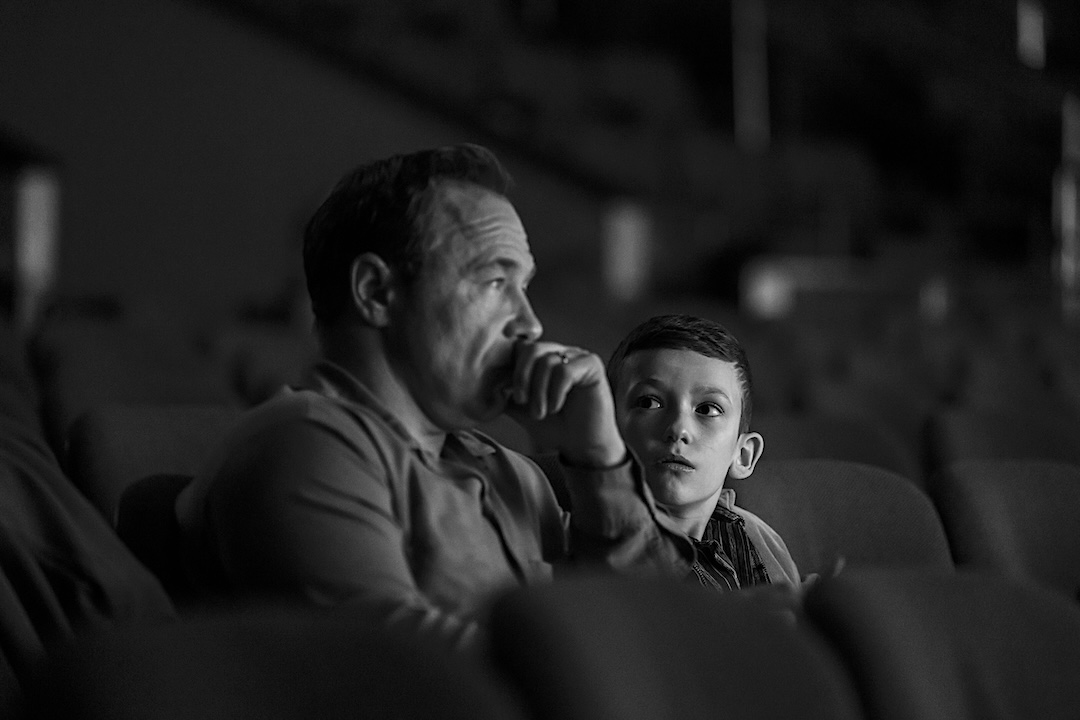
“In general,” Ruder explains, “when the film goes from Jeremy in the bedroom set, playing to camera, to a flashback of Bruce’s childhood, to a young Bruce, that’s when we would bring Bruce’s voice back in, to get that real haunted, nostalgic feel.” The question then became when to use it and when not? “Scott wanted that haunted quality, so it was a question of when to use it, and how to make it feel seamless.”
He and Cooper brought the three components—White’s performance, recorded by Maitland on set, Cobb’s pre-records with White, and Springsteen’s original 4-tracks—to the dub stage, to work with Massey to make and fine tune those choices.
Discover more great stories—get a free Mix SmartBrief subscription!
“We experimented a lot there,” the mixer explains. “We had a lot of Jeremy interjected with Bruce, but in the end, it really didn’t serve a purpose, because Bruce’s performance was so wonderful and, again, haunting. We would always go with Bruce during a flashback.” And because of Maitland’s precision and mic choices, the flow from on-set recording to pre-record (which featured Springsteen’s acoustic, from the 4-track) to Springsteen was indeed seamless. Ruder adds, “When the movie shifts, visually, from watching Jeremy playing on set to Bruce’s original recordings as we know them from the record, we would make varispeed adjustments on those cuts so that every time the picture would change, we would just follow suit, readjust the audio, every time, to track those changes seamlessly.”
Seamless, in fact, to the point that it’s not easy to tell when one is hearing White and when it’s Springsteen. Notes Cobb, “When Bruce heard it, he was asking, ‘Is that me or is that Jeremy?’ And he’d get it wrong quite a bit.” Cooper adds, “He couldn’t tell—and his kids couldn’t tell either. They were shocked.”