

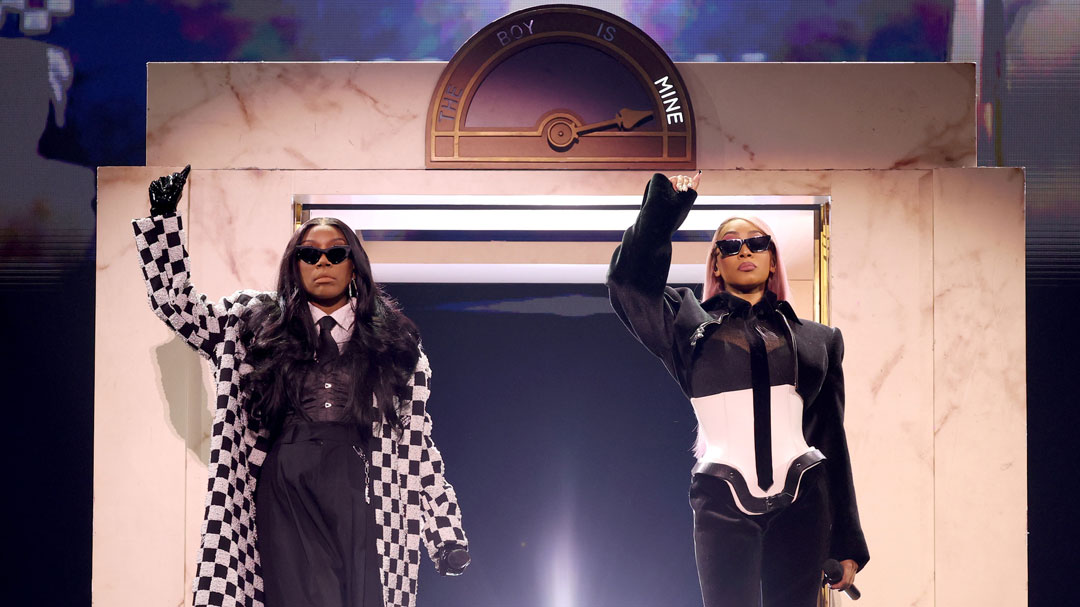
New York, NY (February 12, 2026)—In 1998, Brandy and Monica’s duet, “The Boy Is Mine,” was everywhere. Released that May as the lead-off single from both singers’ second albums, the song was inescapable that summer—a runaway smash that spent 13 weeks atop of the Billboard Hot 100, ultimately nabbing three Grammy nominations and taking home the Best R&B Vocal Performance award. While the single pushed both singers’ careers into overdrive, however, it wasn’t until this past fall—27 years later—that they finally hit the road together for the first time, selling out arenas with a long-awaited co-headlining production.
The appropriately named ‘The Boy Is Mine’ tour crossed the U.S. from October through December, playing 32 shows using audio production from Solotech. Manning the mixers were front-of-house engineer Demetrius Moore and monitor engineer Christopher Lee; while both pros had just finished a European run with Drake, Moore came to the Brandy and Monica tour midway through its run. Both singers have had enviously long careers, accruing hit after hit—so many, in fact, that the setlist ran just shy of 40 songs—so Moore had his work cut out for him when he took over the house mix.
“I came in a couple weeks into the tour, so I missed the rehearsal process,” he said. “I had two-and-a-half days in a studio in S.I.R. Hollywood with a multitrack, a playback console and nearfield monitors to build a show. I watched the show in Vegas, and then I loaded my file and mixed my first show in Oakland the next night. Literally, I didn’t get to hear my mix in the P.A. before the audience did—and then my second show was L.A.”
Complicating matters, the music was 64 channels of playback with no live musicians other than Brandy, Monica, a keyboardist and a few background singers. The biggest challenge for Moore, then, was to give the tracks—which included two different drummers recorded live, one each for Brandy and Monica—a suitably live feel, because it was crucial for the show to work.

Honoring the singers’ highly produced hits while not replicating their mixes outright was a challenge, but a necessary one, said Moore. “You could make it sound just like the mix, but then you think you have achieved something and you haven’t achieved anything. No one comes to a show to hear the record; at that point, they might as well have stayed home. You have to make the song different and better, not worse. So, what is the difference—what are you doing to make it different and give people an experience? They come for an experience, and literally the first, most important thing about a concert is the music, so how are you as an engineer spicing it up?”
The answer for the Brandy and Monica tour was to face that issue head-on. Moore recalled, “Starting the mix at SIR with the multitrack, I begin with the vocals. I unmute the vocals, EQ them, get the vocals. Okay, I see where they are hitting; cool. Now I move on to the live drums and I bring them so that they are right underneath the vocals. Then I bring in the tracks, so that they are slightly underneath the live drums, so it has a live-mix feel, and it’s not just sounding like the record.”
The catch, however, was that the songs couldn’t sound too far removed from the tracks that fans know and love. “That was the challenge, because everybody knew every song on this tour backwards and forwards,” he explained. “I had to find those signature parts in each song that people were going to recognize. As soon as you hear those strings on Monica’s ‘Street Symphony,’ you know what song’s coming up and I had to make sure that people in that crowd knew exactly what the song was before it started. No matter how loud the crowd was, no matter what was happening in the room, they needed to hear those signature parts.”
• Drake Crosses The Continent
Moore mixed all those parts on a DiGiCo Quantum852 console, opting for a mix of plug-ins and onboard effects rather than outboard gear. Reverbs were handled with LiquidSonics’ Seventh Heaven Professional, while SoundToys EchoBoy and TC 2290 plug-ins were used for delays, and drums benefitted from a UAD AMS plug-in.
“I also had the Eventide Harmonizer H3000 Mk2 plug-in, and of course, I use the onboard MSE from DiGiCo,” he reported. “For the vocals, I used my go-to: a UAD Avalon VT-737. I don’t use the Avalon hardware anymore, just the plug-in, because they did a very good job of creating the same sound of the analog piece, and the speed of the compressor is actually faster in the plug-in. You really need that speed sometimes, especially if somebody’s yelling or they get excited.”
Those vocals were captured onstage nightly with Sound Devices Astral HH digital wireless microphones, all outfitted with Sennheiser 9235 capsules: “Me and Christopher Lee, the monitor guy on this tour, we tried it out on Drake and were like, ‘Okay, we’re taking this to every tour we do!’ I literally sold all my receivers and bought my own Sound Devices receiver and microphones, because I was like, ‘I gotta have this always.’”
At the other end of the signal chain was a sizable P.A. comprised of L-Acoustics K1 and K2 line array hangs. While Moore had mixed through K1s on one-offs, the production marked his first time using them on a full tour. “It did the job—went up fast, held up and translated my mix throughout the room well,” he reported. The performers, meanwhile, heard themselves via JH Audio JH16v2 in-ear monitors.
Discover more great stories—get a free Mix SmartBrief subscription!
Moore may have been working with the same musical performances each day, but he made sure to tailor the mix to each audience until everyone was on their feet. “Every venue has a different feel and the crowd is completely different,” he said. “I do a lot of mixing to the room. Sometimes you have to give it a little more pizzazz or else it’s going to be stagnant. I’m going to get bored, the girls are going to get bored and the crowd is going to get bored. If I’m not on my toes, the crowd isn’t getting a good show.”
The result of all that was a night to remember for fans who had waited a lifetime to see Brandy and Monica grace the stage together. “This was such a nostalgic tour,” Moore mused. “Every night, the crowd became the background singers; they sang their hearts out! We all grew up listening to these songs, and it was both these artists that we always wanted to see live together.”