
This article first appeared in the May 1996 issue of Mix.
The year 1970 was when the Grateful Dead went from being a strange little psychedelic cult band with small followings in just a few cities, to a country-folk-rock phenomenon with rabid fans in many cities and most college campuses across the U.S.—and bona fide FM radio hits. In live performance, the Dead still played plenty of their long, twisted and downright weird space jams—1970 gave us some of their finest versions of “Dark Star,” for example—but beginning in the second half of 1969, they began to introduce a body of new, simpler, folk- and country-derived songs written primarily by lead guitarist Jerry Garcia and his writing partner, lyricist Robert Hunter.
The band’s studio album in 1969, Aoxomoxoa, had turned into something of an albatross. Producing themselves for the first time (aided by their trusty technical wizards, Bob Matthews and Betty Cantor), the group spent many months and untold thousands of Warner Bros. Records’ dollars to make an album that was so obtuse even most FM stations largely ignored it (The album did contain Dead standards like “St. Stephen,” “Cosmic Charlie” and “China Cat Sunflower,” but the recorded versions were tame compared to the way the band played those songs live—the perennial Dead dilemma).
When Matthews and the band next went into the studio, in February 1970, they banged out their first true masterpiece, Workingman’s Dead, in just two weeks, recording the album almost entirely live in the studio. Of course, it wasn’t just the recording methodology that made that album work; it was the songs—”Uncle John’s Band,” “Cumberland Blues,” “Black Peter” and even “Casey Jones” found the Hunter-Garcia team mining a rich vein of Americana in their songwriting. “I’ll tell you what affected me,” Hunter told me when I interviewed him and Garcia together a few years ago. “I was so impressed by the songwriting of Robbie Robertson [of The Band], I just said, ‘Oh yeah, this is the direction. This is the way for us, with all our folk roots, our country and bluegrass roots.’”
It was an amazingly prolific period for Hunter and Garcia, who were living together in a redwood-shaded house in southern Marin County. “It was the basic thing of friendship, economics and all that stuff,” Garcia said in the same interview. “We had a nice big house that we could afford to live in together but probably couldn’t have afforded separately at that point.” Hunter added, “I’d be sitting upstairs banging on my typewriter, picking up my guitar, singin’ something, then going back to the typewriter. Jerry would be downstairs practicing guitar, working things out. You could hear fine through the floors there, and by the time I’d come down with a sheet and slap it down in front of him, Jerry already knew how [the tune] should go!”
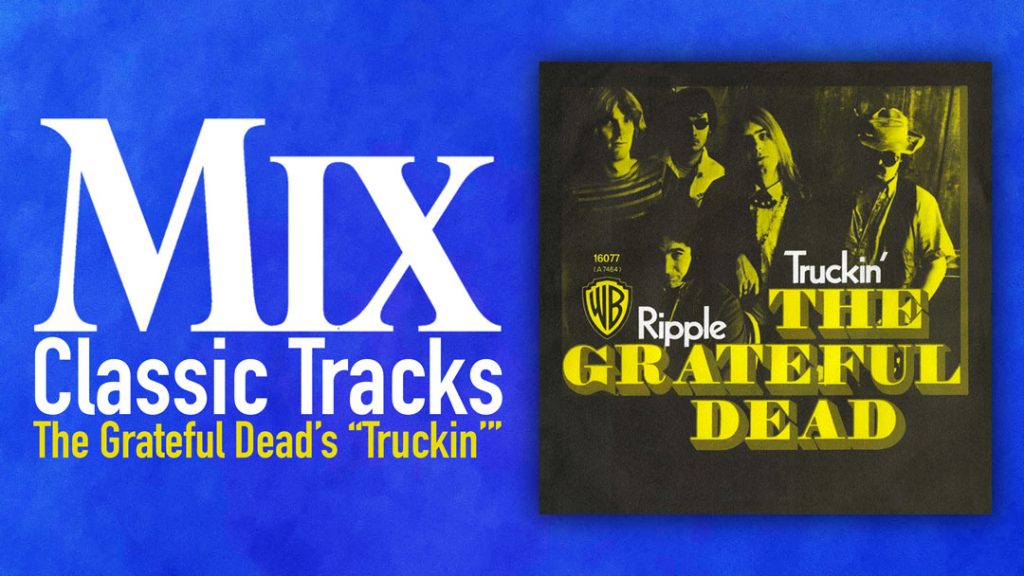
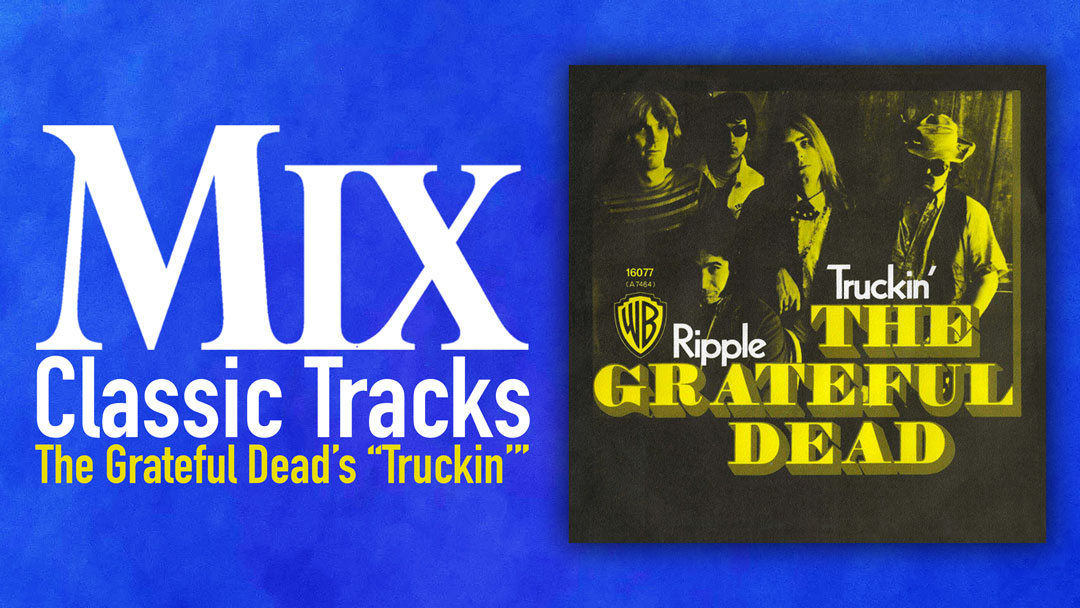
Writing the song “Truckin” was slightly more complicated than the scenario above, however, as it also involved two other writers besides Garcia and Hunter. Rhythm guitarist Bob Weir and bassist Phil Lesh also had a hand in the song’s musical construction, and ultimately it was Weir who became the lead singer on it. It’s one of the few Dead tunes with overtly autobiographical overtones—though most of the lyrics paint a playfully oblique portrait of the band on the road—as one verse refers specifically to the Dead being busted in New Orleans in January of 1970. The bridge of the song closes with what has become Hunter’s most quoted line: “Sometimes the light’s all shining on me/Other times I can barely see/Lately it occurs to me/What a long, strange trip it’s been.” That was true enough when the band had only been together for five years; it had even more resonance when the group hit the 30-year mark in 1995.
The Dead were on such a songwriting tear in 1970 that they returned to the studio just three months after Workingman’s Dead was released in May. Matthews and Cantor were busy on another project when the recording bug bit, so the Dead turned to a relative newcomer on the San Francisco recording scene—an engineer at Wally Heider Recording in San Francisco named Steve Barncard—to cut the tracks, co-produce and mix the album that would become American Beauty, arguably the group’s most beloved work.
A native of Kansas City, where he played in several popular local bands and worked as a radio DJ, Barncard moved to San Francisco on a whim in mid-1969. His first day there, Barncard walked into Heider’s, where the Jefferson Airplane had just finished their Volunteers album, looking for a job. He was not hired on the spot, but Barncard was sufficiently inspired by what he saw to write a long letter to Heider, pitching his skills. In the meantime, he moved to L.A. and took a job wiring speakers and assisting at the Village Recorder. Two months later, Barncard got a call from Heider (whom he describes as “probably the greatest big band engineer of all time”) and an offer to work as assistant engineer at his San Francisco facility. “They needed someone to assist [engineer] Bill Halverson on Crosby, Stills & Nash’s album; this doesn’t happen anymore,” Barncard says. “In those days, people weren’t asking for these jobs. There weren’t all these recording school graduates running around; it was wide open. And the pay was great for that time—$10 an hour, which is more than some assistants get today. Before that, I’d been lucky to get a radio job that paid me $400 a month, and this was like $400 a week.”
At that time, Studios A and D were still under construction, and most of the great work was being done in Studio C, which was equipped with a custom Frank DeMedio console. “He needs to be remembered because he brought a lot of quality to Wally’s studios,” Barncard says. “He used only these massive Switchcraft pushbuttons and telephone-type lever switches and big relays and plug-in amplifiers. It was really an incredibly well-built and simple thing: 24 channels, 8-bus. The path was extremely simple. He would have one amplifier in the chain—this plug-in line amplifier made by UREI—and they would set up the gain in it so it was always set to high, and then for anything coming into it, they would use resistant pads. People frown on this sort of stuff today. Everything was transformer balanced. No op amps. All transformer-isolated, and the EQ modules were just passive UREI EQs on the way to the line amplifier. What they did is switch between line and mic. They just put in more fixed pads for line, so you’re always dealing with the same amplifier, and there was no feedback loop. Everything was calibrated with those losses in mind, and you just switched them in and out, so it was extremely reliable. They had these Gotham faders, which at the time had 2 dB per step, so they were a little clunky to work with—they worked on a dial cord that actually turned a pot inside, but it was a step above rotary pots. At the time, it was very high-tech.”
Though Studio C was only modestly sized, with what Barncard terms a “tiny” control room, “That room was Ground Zero for so many great records,” he notes. “It was the simplicity of the room that made me work with mic placement rather than worry about the kind of mics I was using. I didn’t have a big selection; I didn’t have a lot of European condensers. But they had a lot of [Neumann] 67s, a few 87s, which I still hate to this day—I can’t use them; they’re too harsh. They also had a lot of C-37s. My favorite condenser for acoustic guitars was probably the [AKG] C-60, a lipstick tube condenser. The actual capsule was similar to the 451. We had four or five of those. I’d usually use 67s on overheads. For vocals, I’d use just about anything. I used the [Shure] 547. The 56, 57 and 547s were staples of the remote industry, which may explain why Wally liked them.
“The monitor system was pretty crude, pretty bad,” Barncard continues. ‘[Studio C] had Altec 604s that were in a cabinet that was designed not for its acoustic properties but because you could make it out of a single sheet of plywood. My big complaint about ’70s recording is that there was no standard to monitoring whatsoever, or if there was one, it changed all the time.”
More to Barncard’s liking were the studio’s echo chambers, which he used to greatest effect on David Crosby’s breathtakingly beautiful 1971 solo album, If Only I Could Remember My Name. Though the studio had one of the earliest Ampex MM 1000 16-tracks, “I liked to work on the 3M 16-tracks. I liked them much better, and I used Scotch tape exclusively. Everything I ever recorded on 3M tape is still playable today and sounds great. Every piece of Ampex tape I used in the ’70s turned into glue and stops the tape.”
Barncard made the transition from being an assistant to a first engineer during the sessions for Crosby, Stills, Nash & Young’s Deja Vu album, but to land the Dead’s project, he had to, in essence, audition for the job: “Phil [Lesh] wanted a good bass sound, and that was going to make the difference,” Barncard explains. ” My boss said, ‘Get a good bass sound. Steve, and we’ve got the Grateful Dead.’ Well, Phil was using two amps—he was using the exact same rig as (Jefferson Airplane bassist] Jack Casady, and I was familiar with Jack’s rig. He had a big amp for the low end and the thud, and then a little amp for the buzz that’s in the middle. So between those three inputs [two amps and a DI], I was able to make a bass track that worked for him. We did it in Studio A,” which was equipped with a Quad 8 24-input. 8-bus console.
Like the sessions for Workingman’s Dead, work on American Beauty went quickly and easily, Barncard says: “It’s a very live record, and it was really fun all the way through. I had heard bad stories about engineers’ interactions with the Dead and about how they always had a thousand people in the control room and hippies camping out in the studio and massive acid parties. What I found were a bunch of hard-working guys, a great, tight band who had woodshedded everything, who knew exactly what they wanted to lay down and where they wanted to go with it. The vocals were all ready. There was not a whole lot of experimentation. They had sat around in a circle and rehearsed this record, so they were ready to go when I got them. Some records sort of assemble themselves. You do a take and everybody says, ‘Yeah, that’s it. Let’s move on.’ And everything falls into place.”
Discover more great stories—get a free Mix SmartBrief subscription!
Typically, the basic track would consist only of Garcia, Weir, Lesh and drummer Bill Kreutzmann. Though Mickey Hart was still drumming for the band live, his involvement in the album was minimal—mainly for percussion overdubs. And Ron “Pigpen” McKernan, who played B-3 for the group in concert, didn’t play on the album at all; instead, organist Howard Wales and pianist Commander Cody added the needed keyboard textures.
On “Truckin’,” which was cut in a day in Studio C, the 16 tracks broke down this way: Track 1—Garcia’s electric guitar; 2—piano; 3—kick drum; 4-5— more drums; 6—snare; 7—organ; 8—bass amps; 9—bass direct; 10—Weirs lead vocal; 11—Garcia’s acoustic guitar; 12—Weir’s acoustic guitar; 13—Weir’s electric guitar; 14—Lesh’s backup vocals: 15—Weir’s backup vocals; 16—Garcia’s backup vocals.
The Dead were a notoriously weak vocal band in the late ’60s, but by 1970, the combination of hours of harmony singing practice and the influence of their friends David Crosby and Stephen Stills made it possible for the Dead to put out an album that was tilled with glistening harmonies. I had assumed that this area must have taken a tremendous amount of time in the studio, but Barncard says, “I was skeptical going in, but they were brilliant. They walked in and just did it. People don’t believe me when I say this,” he notes with a laugh. For the harmony parts, “I used three 67s [for Garcia, Lesh and Weir], ran each one through a separate limiter and then doubled it” to make it sound fuller.
American Beauty was a largely acoustic guitar-based album, so it’s not too surprising that the first live versions the band played of “Truckin’” came during the acoustic sets they frequently performed in the summer of ’70. It wasn’t until October of that year that the song made its transition to an electric number, and it would be another year before it really began to blossom and become a jumping-off point for exploratory jamming around that distinctive shuffle beat. “Truckin’” was an instant hit on FM radio in the fall of ’70, and nearly a year later, an edited single version made it to Number 68 on the Billboard charts. The album version has been the fodder of “classic rock” stations ever since. The Grateful Dead never played a version of the song even remotely like the one on American Beauty once the record came out; as was their wont, they were more interested in taking the song someplace it had never been before.
• Classic Tracks: The Band’s “The Night They Drove Old Dixie Down”
A post-script for Deadheads and other interested parties: Keep an eye out for an extraordinary one-hour documentary about the making of American Beauty and the 1968 Dead album Anthem of the Sun, directed by British filmmaker Jeremy Marre and set to debut on PBS television this summer. I was fortunate enough to see a nearly finished version in early March and was blown away. It features never-before seen historic footage of the Dead in the studio and onstage. current interviews with Weir, Lesh, Hunter and Barncard talking about working on those records, and archival interview footage of Garcia, Dead sound ace Dan Healy and others. It’s an illuminating and ultimately touching look at the some of the Dead’s high times. And you recording freaks will be fascinated by the techie aspects of the production.