
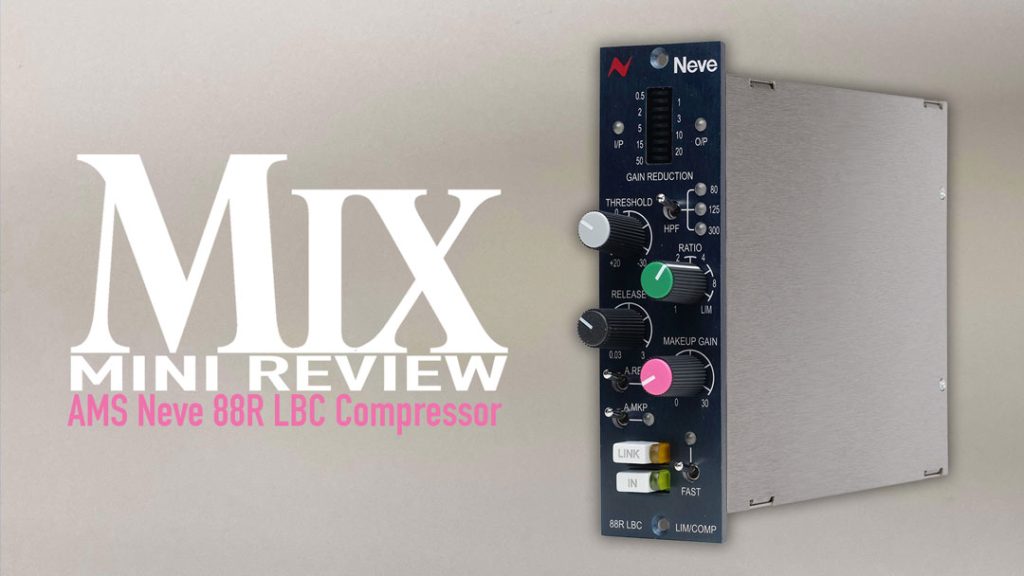
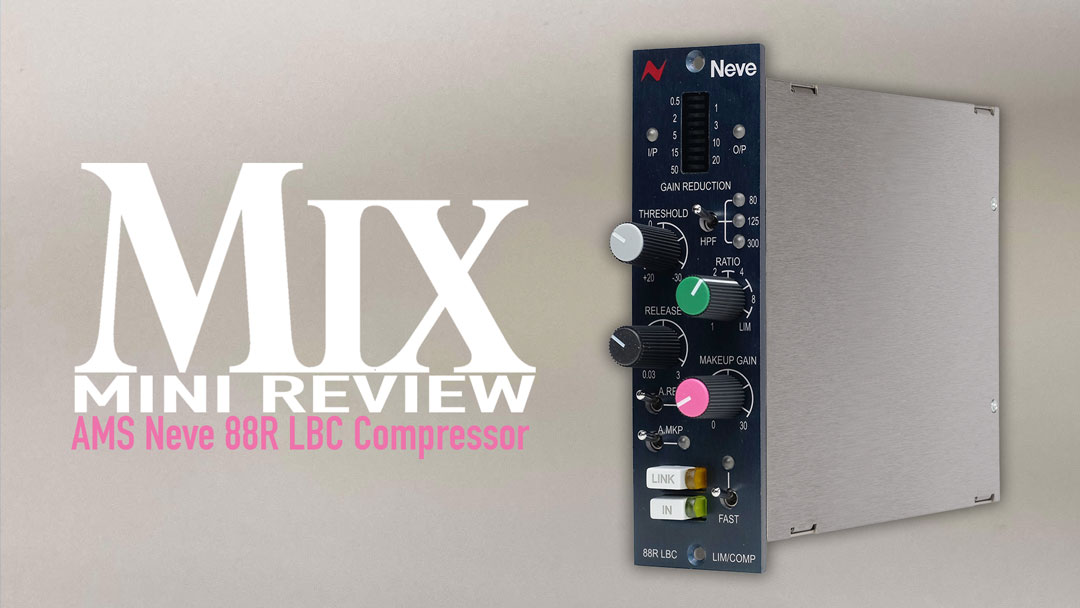
| MIX VERDICT: AMS NEVE 88R LBC COMPRESSOR |
| THE TAKEAWAY: “The 88R LBC combines versatile operation to accommodate any compression style, from complete, strict control to a natural-sounding, gentle lid on dynamics.” |
| COMPANY: AMS Neve • www.ams-neve.com PRICE: $995 MSRP PROS: • Auto Release and Auto Makeup are outstanding modern features. CONS: • The momentary toggle switches are a little fiddly and hard to operate. |
New York, NY (March 30, 2026)—In the early 1970s, Neve-designed VCA (Voltage Controlled amplifiers) compressors were installed in the company’s 50 Series consoles. VCA-based compressors were a nascent technology back then, and compared to the colorful and easy-going Neve 2254E diode bridge compressor, the 88R LBC is clearer, more precise and more flexible. Ever since, VCA dynamics sections are standard kit in the popular Neve VR and 88R consoles.
The new AMS Neve 88R LBC (Lunch Box Compressor) is an updated version of the dynamics section from the Neve 88RS console re-packaged in a single-slot 500 Series unit. It incorporates the same transformerless, balanced I/O and THAT Corp 2181 VCA chip. It is the sixth entry in the company’s LB 500 Series line, joining the 1073LB mic pre, 1073LBEQ, 2264ALB mono compressor, 88R LBEQ (4-band equalizer) and the 88R LB (mic preamp).
The LBC updates include Auto Makeup gain and a switchable sidechain 12dB/octave high-pass filter. The HPF can be cycled through three frequencies using a momentary toggle switch; one of four toggle switches used on the module. Frequency choices are: Off, 80, 125 and 300 Hz. Yellow LEDs indicate and verify which frequency you’ve selected.
At the top of the LBC’s front panel are both Input and Output tri-color LED signal-present indicators. When blinking green, the audio level is above -30 dBu, a yellow LED indicates above +5 dBU, and red for above +18 dBu, indicating possible clip. The input and output LEDs are positioned on either side of the nine segment Gain Reduction meter, with its clever, dual-expanded scaling to read compression of any amount. Up to 50 dB of gain reduction is possible. In operation, the blinking signal-present LEDs and flickering GR meter present a rather glamorous display.
The Threshold control knob has a range of +20 to -30 dBu. These two extremes, at full counterclockwise and clockwise, are easy to find and adjust in low studio light. It’s good that 0 dB is straight-up at 12 noon. Likewise, the compression Ratio knob was easy to set with a variable range of 1:1 up 20:1, or limiting. I found low ratios ideal to bring a track forward without collateral sonic damage. Conversely, ratios of 8:1 or higher clamp any unruly instrument effectively.
ADAPTIVE ATTACK TECHNOLOGY
The LBC incorporates Neve’s Adaptive Attack technology, which was introduced in the 88RS console, so there is no Attack time control knob.
Compressor attack time is program-dependent and automatically adjusted in response to the input signal’s transient rise time. With normal operation, levels up to 4 dB below threshold are instantaneously fixed at 5 milliseconds. On steeper rise times exceeding threshold by 4 dB or more, attack time is variable, ranging from 1.5 to 5 ms.
Another toggle switches to Fast attack mode, making attack times even faster. A fixed 5 ms attack time is maintained for signals up to 4 dB below threshold, but for signals 4 dB or more above threshold, the attack time range speeds up to 0.1 ms to 5 ms. The aim is to deliver precise, dynamic control while remaining musical-sounding, and this system works, providing faster attack times for louder transient peaks and slower attack times for quieter moments.
MANUAL RELEASE, AUTO-RELEASE
In manual mode, Release has a range of 0.03 to 3 seconds. I found manually setting release times on the LBC to be familiar and intuitive. Manual mode is best for predictable audio levels such as stereo mix-bus program. As expected, overly fast release time settings can induce distortion and pumping in the low frequencies of a bass guitar and synth.
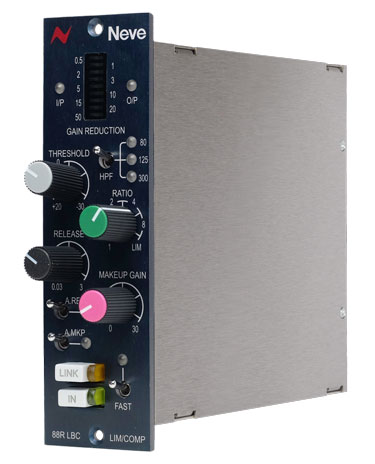
Another toggle switch is for the A.REL, or Auto Release. It enables a program-dependent range of release timings; the longer the signal is above the threshold setting, the longer the release time. A.REL is excellent for dealing with individual instruments or vocals that are unpredictably dynamic. I used A.REL for recording vocals or percussive instruments with good results.
For an effect in a mix, I heavily compressed a lead vocal track (15 dB of GR) and heard less level pumping up on the singer’s breaths in between words. Appropriately named, AMS Anti-Breath Technology is also from the 88RS console, and ameliorates any sudden level drop (30 dB or more) below threshold. I was impressed with Auto Release and Anti-Breath working together. Unlike some plug-ins, both worked immediately and didn’t require a lot of fiddling around, and both sounded more natural. The breaths are still there, just not as accentuated and as loud.
LBC’s Manual Makeup gain ranges from 0 to 30 dB and is for matching the compressor’s output level to the input; it uses a hardware bypass to A/B. Typically, except for heavily compressed audio using higher ratios, full CCW on makeup gain is about the same level as the input signal. Another toggle engages Auto-Makeup gain, a feature unique to the 88R LBC module.
Without any controls to set, A.MKP produces an acceptable output level so as to not distort your DAW interface or the processor(s) following in your recording chain. Manual makeup is disabled with A.MKP, which applies makeup gain based on the LBC’s threshold and ratio settings by adding gain to the output as the input exceeds the compressor threshold setting. A.MKP also takes into account the compression ratio in play.
Mix Book Review: Acoustic Essentials for Architects
This feature can be helpful when tracking a room full of musicians and getting sounds quickly with good, working levels and compressor settings. A.MKP settings may be refined later when more time allows it. In addition, by using A.MKP, the LBC can be added to previously uncompressed channels (in moderation) without a huge level and sonic difference.
Hours into a tracking session, patching in a compressor no longer takes extra time to reset the recording level.
IN THE STUDIO
I had trouble with the low B string of a five-string Music Man bass sometimes distorting the signal chain. Instead of my usual tube compressor/ leveling amp combo, I used the LBC. Threshold was at 0 dB, release at 2 seconds (manual), Auto- Makeup gain off, ratio 8:1, and the 125 Hz HPF sidechain filter on. This musically leveled out the bass with a maximum of 5 dB of gain reduction mostly occurring with the overly loud B string. The B string stood out, but no longer shook my monitors and the room.
A poorly recorded vocal track was dynamically rescued and tamed using the LBC. I was able to use a 1.5:1 compression ratio and kept the vocal level constantly clamped down in gain reduction—I used a 0.5-second release time (manual), 80 Hz HPF, with a 0 dB threshold setting. The vocal was not peaky anymore, but it also didn’t sound squashed. I used the same vocal track to check A.REL and A.MKP. Both worked amazingly well by keeping the singer’s breaths and inhalations at a much lower level. Compared to manual release, the breaths sounded natural and not too loud.
Discover more great stories—get a free Mix SmartBrief subscription!
I used a pair of LBCs on a stereo bus, starting with them unlinked. For my fairly dynamically smooth mixes, I used low ratios of 1.5:1 to 3:1, max. I use a 1 kHz input tone to get unity gain throughput before setting the threshold. With the mix playing and threshold set, I linked up the pair and further refined my settings. It is easy to get the average mix loudness up and sounding nicely impactful. I used Auto Release but not Auto Makeup gain, as manual makeup allowed me to set the output exactly.
The 88R LBC combines versatile operation to accommodate any compression style, from complete, strict control to a natural-sounding, gentle lid on dynamics. A.REL and A.MKP are my favorite new features.