
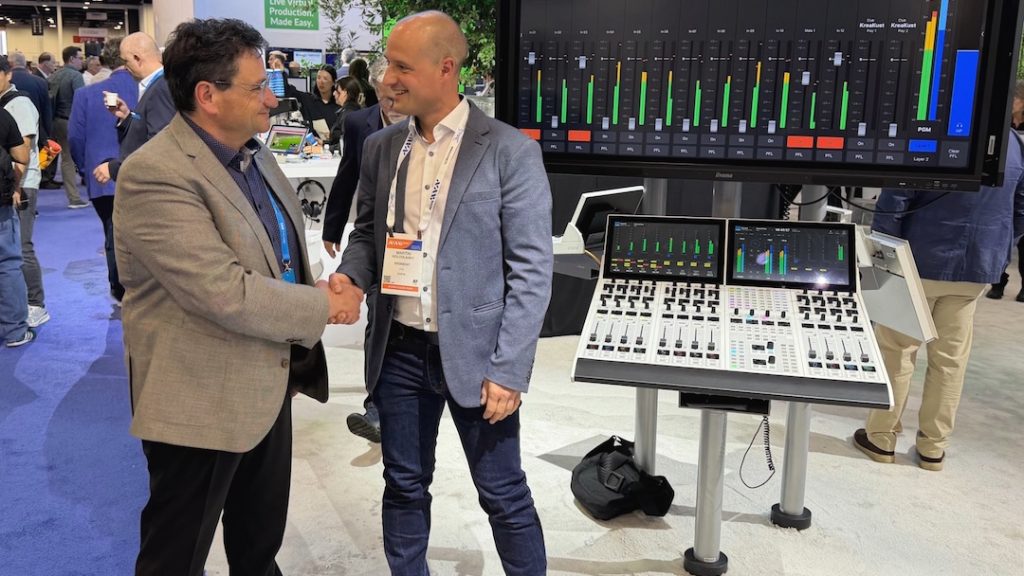
Austria (May 11, 2026)—Austrian private broadcaster kronehit has contracted longtime collaborators SLG Broadcast AG and Lawo AG to modernize its studio infrastructure.
All kronehit studios are to be equipped with Lawo diamond audio mixing consoles. SLG Broadcast, the broadcaster’s longtime technical partner, will oversee system design, configuration and overall project implementation.
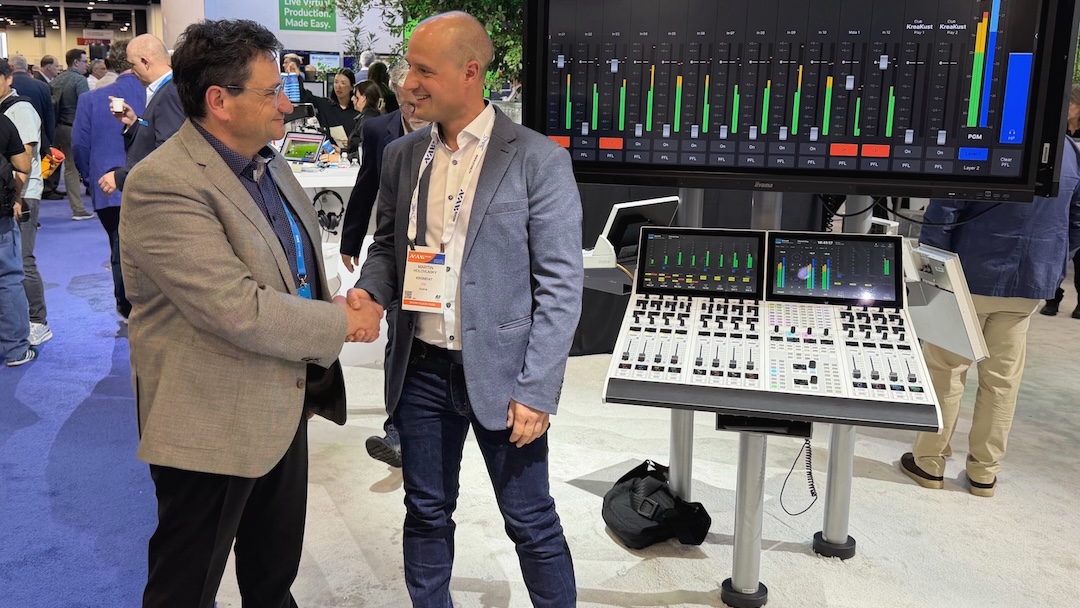
The decision was publicly sealed with a handshake between Marc Straehl, CEO of SLG Broadcast, Jamie Dunn, CEO of Lawo, and Martin Holovlasky, CTO of kronehit, at NAB 2026 in Las Vegas.
The partnership between kronehit and SLG Broadcast extends back more than a decade. As early as 2015, SLG Broadcast implemented the technical infrastructure of kronehit’s broadcast center based on Lawo sapphire mixing consoles. The broadcaster continues to operate a Lawo environment comprising sapphire consoles, IP‑based routing, centralized system management via VisTool and an AoIP network architecture.
At NAB: Audio Systems Get Boost From Cloud and AI
Going forward, kronehit will deploy five Lawo diamond consoles, paired with five Power Core audio engines. The diamond platform features a fully IP-native architecture, low latency and high processing power, aiding modern, parallel radio production workflows. The existing Lawo A__UHD Core will be expanded into a redundant setup, forming the available central backbone of the audio production environment.
Discover more great stories—get a free Mix SmartBrief subscription!
SLG Broadcast has served as a key technical partner for the broadcaster for more than a decade. In 2017, among other initiatives, an OB van was equipped with a Lawo sapphire Compact, existing studios were expanded with additional I/O capacity, and the audio platform was gradually enhanced with Power Core–based structures. Between 2018 and 2024, multiple migration and expansion phases supported the transition to IP‑based audio production. These included the integration of the Lawo A__UHD Core, the deployment of a Ravenna‑based audio‑over‑IP network and the adaptation of the infrastructure to evolving production and distribution requirements.