
Brooklyn, NY (January 13, 2026)—Few artists fit the term “musical polymath” quite like Devonte Hynes. Better known as Blood Orange, the multi-instrumentalist has spent the last 20 years working with everyone from Philip Glass to Britney Spears, composing film soundtracks, producing and co-writing with Kylie Minogue, Blondie, Carly Rae Jepsen, A$AP Rocky and The Charlatans, and doing features on tracks by acts as disparate as Turnstile and Mac Miller. Still, despite decades of old-fashioned hard work, Hynes’ career exploded in 2024 for the most modern of reasons: His song, “Champagne Coast,” recorded back in 2011, suddenly went viral on TikTok and inadvertently primed the pump for his next album.
Currently touring behind that record, Essex Honey, Hynes spent the fall opening for Lorde on her U.S. arena tour (the New Zealander guests on his new record), playing high-profile festivals like Tyler, The Creator’s Camp Flog Gnaw, and headlining his own tour, complete with unique residencies at London’s Alexandra Palace Theater and New York’s Brooklyn Steel.
Hynes’ music is a broad mélange of forceful pop beats, delay-drenched cello, Peter Hook-like bass, atmospheric keyboards and more— and squeezing it into Brooklyn Steel for six nights was no simple feat. Rather than use the 1,800-capacity venue’s stage and house P.A., the shows were played in-the-round, with Hynes, two backing vocalists and two other musicians atop a small, circular deck at the center of the room. Accommodating this approach, the production brought in its own audio equipment, using its touring control packages, provided by Britannia Row and its parent company, Clair Global, and a P.A. provided by See Factor.
A square truss above the circular stage held four L-Acoustics L2D loudspeakers—one in each corner—with two facing most of the audience and the balcony, and two facing the venue’s stage. Meanwhile, handling the sides were left-right hangs of A10 Wide and A10 Focus medium-throw loudspeakers; at ground level, subs were placed in cardioid clusters to keep low end off the stage.
“The L2Ds are spread just a little bit, so you don’t get a massive beam in the mixing position when you put them [symmetrical],” explained Nahuel Gutierrez, front-of-house engineer. “We opted for A10s because we needed the curvature and to be able to hit a little bit more, so we have a better stereo sound for the people on the sides. As a left-right experience, there’s a lot of elements like hi-hats and little things that are panning in the programming, and it’s quite important that you get a good stereo image out of it. The A10s have been doing a fantastic job.”
With the musicians playing only feet below the P.A.—the two backing vocalists’ position was close enough that they could tag a speaker with their hands if they wanted to—miking and placement was crucial. Fortunately, most instruments were direct via Radial DIs, but there were still a variety of live mics onstage, such as Shure’s new Nexadyne 8/C handhelds used for all vocals. “They’re quite good—very directional, so you have to be right on them,” said Gutierrez. “The most challenging thing is to get good level on the vocals, but it’s been working remarkably well for the situation, which is less than ideal.”
The drumkit, surrounded by Plexiglas to minimize the inevitable spillage from such close quarters, was captured with a DPA 4055 on the kick drum, Beyerdynamic M 201 on the snare top and a Neumann KM 184 on the snare bottom, Beyerdynamic M 160 double ribbon on the hi-hats and a Shure Beta 98 on the tom.
• Is Radio City Music Hall the Next Step to ‘Immersive on the Road?’
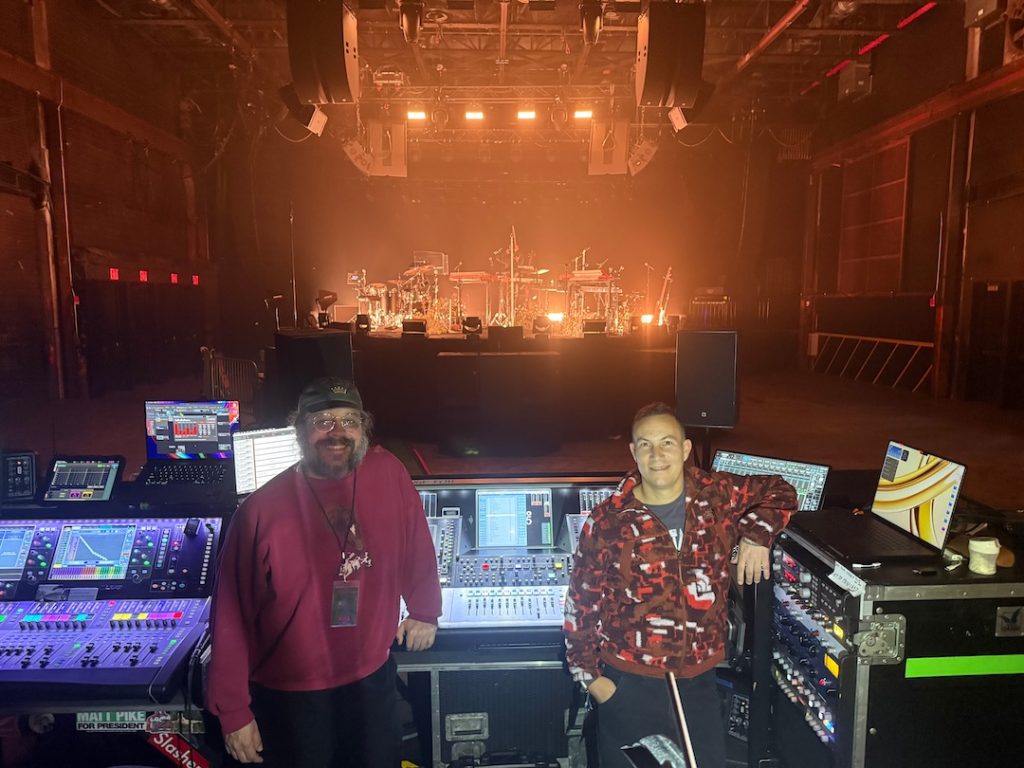
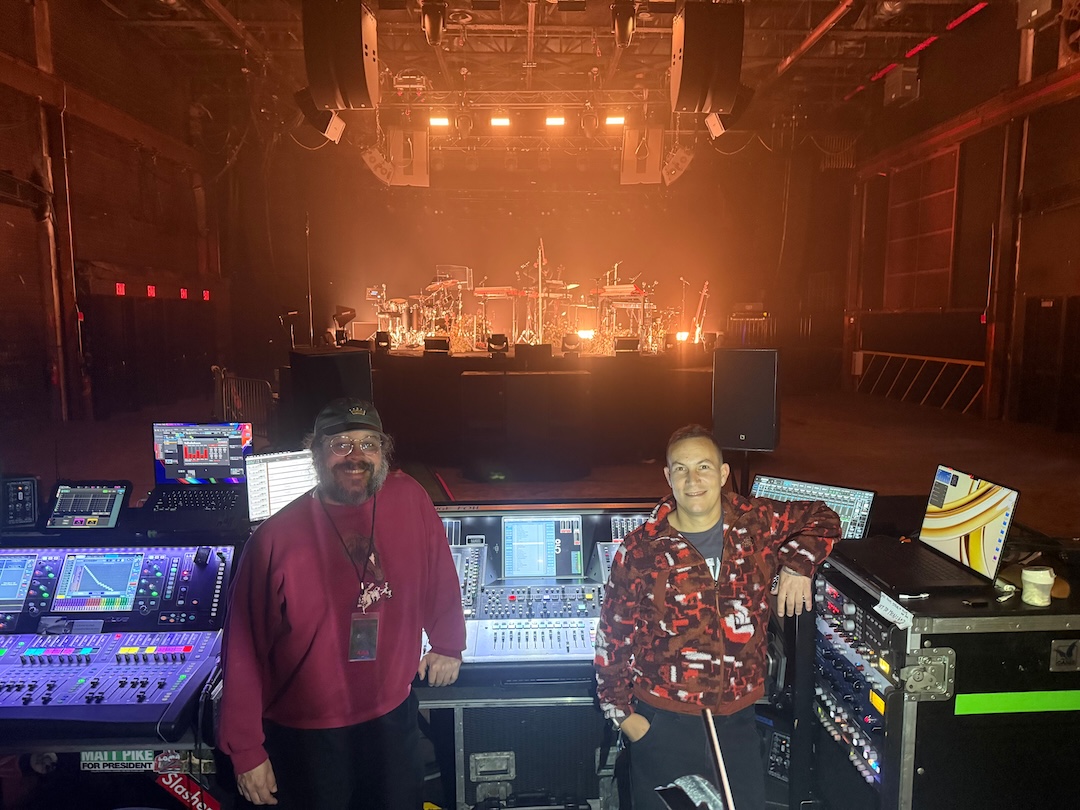
At the FOH position, Gutierrez looked after a DiGiCo Quantum 5 console, tied into a small rack of gear, a sizable Waves Superrack packed with plug-ins, and Reaper for playback and recording of shows. One of his biggest considerations, however, was a separate recording setup, as the tour was selling instant CDs of each night’s show, burned in the lobby just minutes after the last notes were played.
“For the instant CD, I’m running a Dante network,” he said. “I have Dante coming out of the console to my computer with Dante Virtual Soundcard, then I record left and right straight into Logic, and that is being sold after the show. There is another left and right backup, and then a third backup recording left and right analog. I record straight into Logic, because then I’ve got a little mastering chain with a couple of Waves SSL plug-ins, a little compressor, just a bit of EQ and a Maximizer just to get the signal.”
Multiple master copies were made at FOH, then delivered via sneakernet to the lobby where three duplication towers burned more than 200 CDs each night for patiently waiting fans.
While recording the CDs impacted Gutierrez’s house mix a bit (“I cannot touch the master bus or I’m going affect the recording,” he noted), he remained focused on creating an atmospheric house mix, goosing the drums up 3 dB when they dropped back into a song, or directing the audience’s attention to an exciting background part otherwise hidden in the mix.
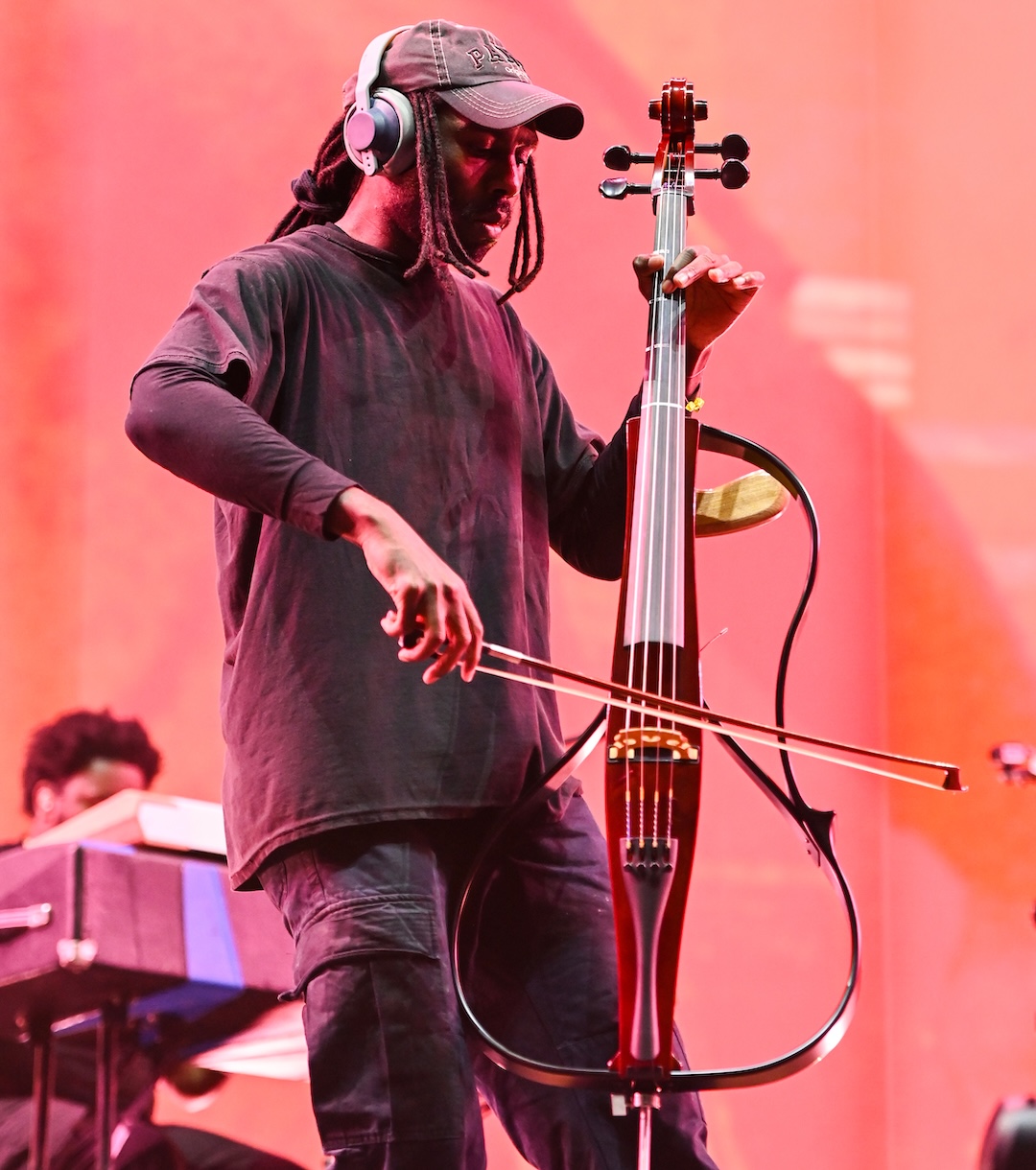
One of the highpoints was Hynes’ nightly electric cello solo, which evolved from slow, whale song-like tones into a tsunami of sound. “We run the cello through a 500-millisecond delay with maybe 40 to 50 of feedback, and he plays into that,” said Gutierrez. “Dev makes it a good moment, because he’s playing with the delay and all the repeats as well until it sounds crazy. He has a little distortion in the front of it, just to give it an edge and make it a little bit dirty, and it goes into an H Delay plug-in. It’s not inserted; it’s in two channels so I am always able to work with the balance of it, bring the light cello a little bit more.”
Discover more great stories—get a free Mix SmartBrief subscription!
With the shows presented in-the-round, the monitor position was located at front-of-house, with engineer Rafael Lazzaro using an Allen & Heath dLive S5000 surface with a DM64 MixRack. The artists heard themselves via 64 Audio A6t in-ear monitors, and the highlight of Hynes’ mix was a ValhallaRoom reverb plug-in used for spread, hosted on LiveProfessor. Lazzaro was only sitting in for the residency, however, covering for the usual monitor engineer…who was Gutierrez, himself sitting in for the tour’s FOH engineer.
“Raf’s come to fix my file,” Gutierrez joked, “and then I’ll take over and take the glory! I’m normally a monitor engineer, and I started six weeks ago; the front of house engineer could not come to the States, so I jumped. I mix front of house as well—I’m not just a monitor engineer—but I’ve never done something in the round before! It’s been good; I’m having a lot of fun, I have to say.”