
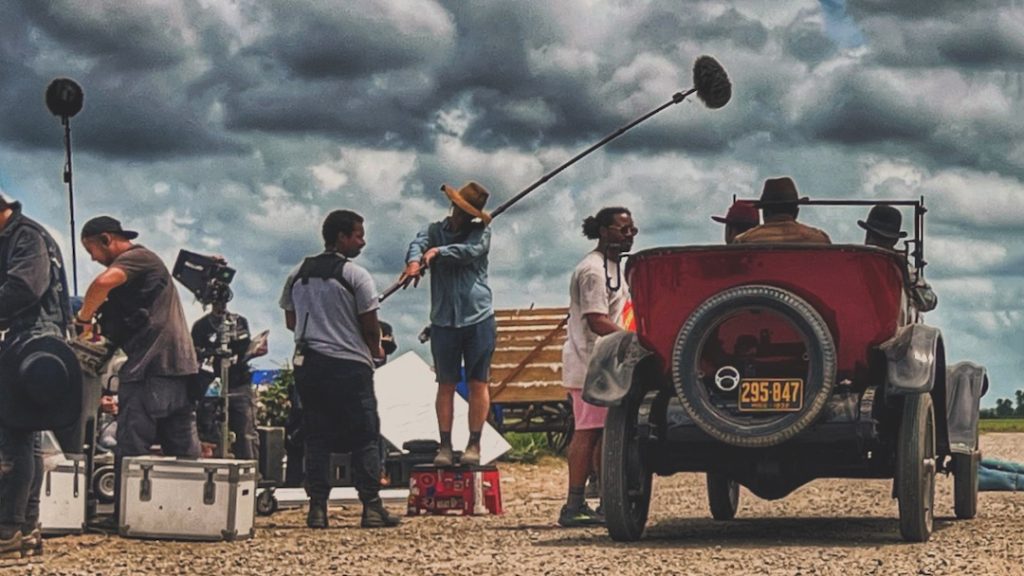
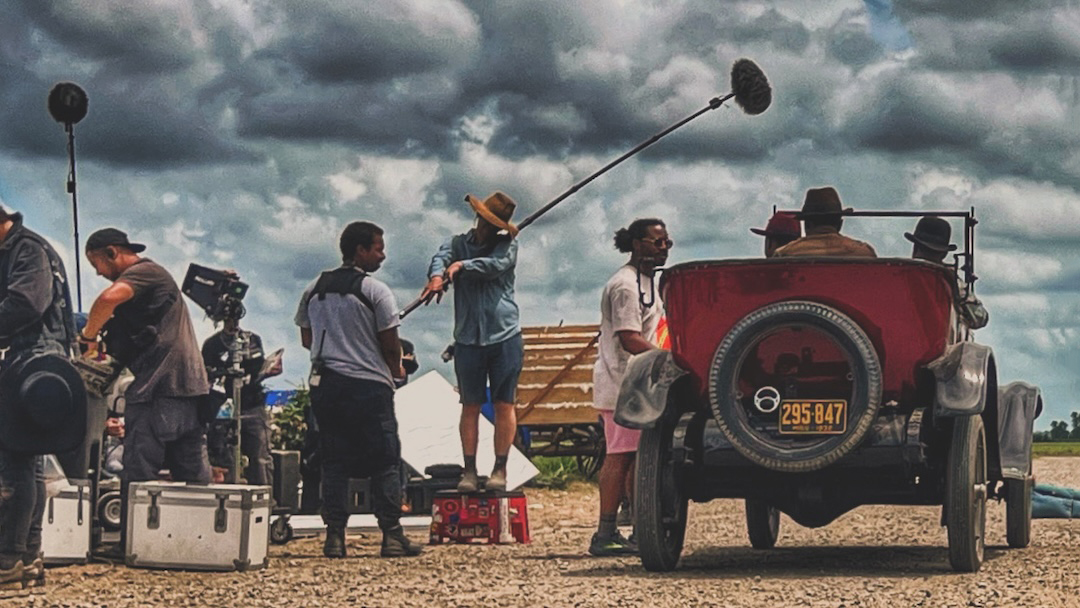
New Orleans, LA (April 9, 2026)―Sinners recently made history as the most Oscar-nominated movie ever, landing 16 nominations including Best Sound and Best Score, the latter of which it won. To capture the film’s sound—and in fact much of its score—Chris Welcker, CAS, owner of Catgut Sound, used a comprehensive DPA Microphones’ package while working as the production sound mixer.
Much of the story unfolds around unamplified, live blues performances inside and outside a rural juke joint, Welcker says. “The theme itself is kind of hard to explain—it’s a multi-genre horror film and period drama that’s very heavy on the music,” he explains. “Because of the period nature of it, everything is unamplified: acoustic guitars with resonators, harmonicas and live vocals.”
Capturing those performances authentically, and often with wide lenses that limited mic placement, required a flexible, consistent microphone ecosystem. Welcker utilized an extensive DPA package, including 4018 supercardioid and 4017 shotgun capsules with a rotation of A, B and C preamp bodies; 4097 micro shotguns for plant-miking; 4099 instrument mics; a 5100 surround microphone; and a full complement of lavaliers, including 4060, 4061, 6060 and 6061 omnidirectional models. His boom operator, Ryan Farris, also brought additional DPA options from his music studio.
• Van Halen / Doobie Brothers Engineer Donn Landee Passes at 79
“DPA was a perfect choice for us because the sonic profile of those microphones is very consistent,” Welcker notes. “When you cut together a lavalier and a boom, it’s very easy for the editors to make those sound cohesive. That consistency was huge for us.”
Unlike many music-driven films, Sinners captured performances live on set. Although pre-recorded studio tracks existed as a backup, Welcker coordinated with the film’s composer to use the same DPA microphones in the studio sessions to ensure tonal continuity. “That gave us consistency if they decided to use any prerecorded tracks,” he says. “It all blended naturally and gave us the presence of the voice and a perspective that matches what you see visually.”
Discover more great stories—get a free Mix SmartBrief subscription!
For instrument-heavy scenes featuring acoustic guitar, fiddle and banjo, Welcker deployed DPA 4099 instrument microphones using dedicated mounting solutions when instruments fell below frame. “The mounting solutions made it really easy for us to jump in and place things quickly,” he notes. “We didn’t always have a ton of time to make those decisions.”