
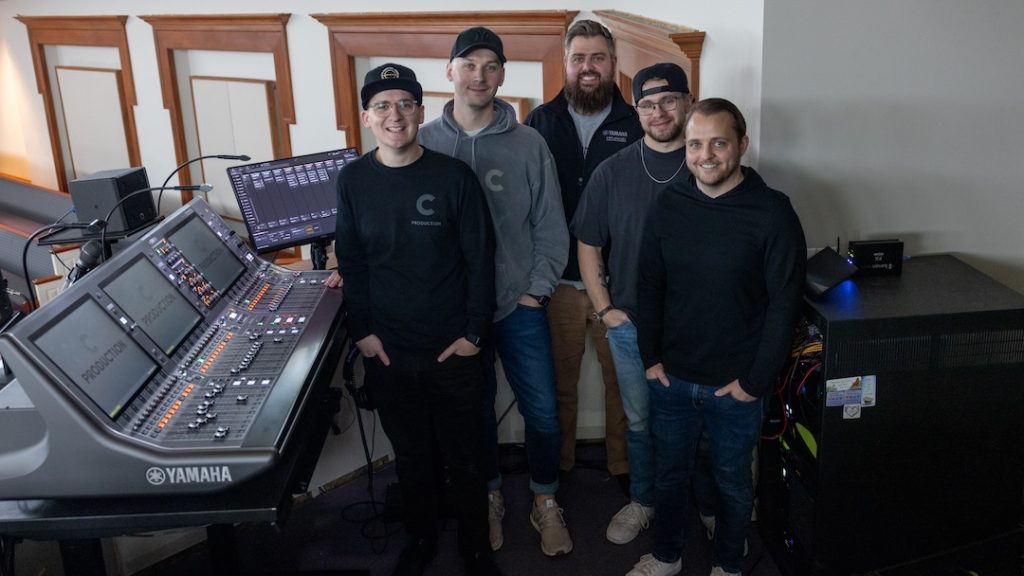
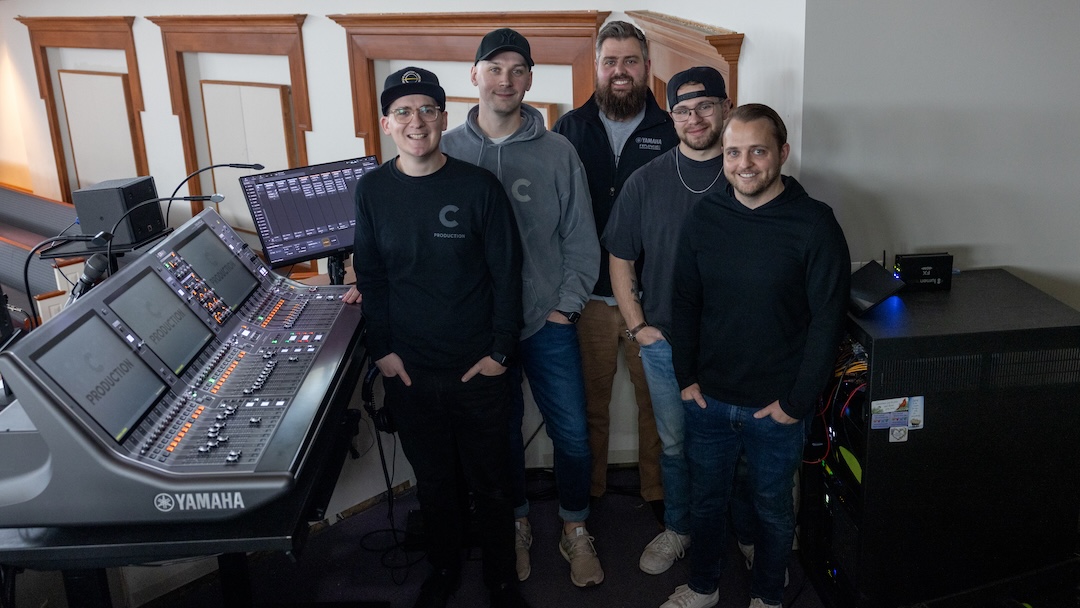
Hudson, OH (July 13, 2026)—For many houses of worship, ignoring the need for a new house console is a given. Still, the day comes when the task of finding a new console can’t be put off any longer. That’s the situation Christ Community Chapel (CCC) in Hudson, Ohio found itself in.
CCC had long relied on its Yamaha CL console, but the time had come. “We’d pushed the platform well past its intended use case,” recalls CCC’s audio director, John Merkel. “By the end, the CL was basically an expensive MIDI controller for Waves.”
CCC’s annual Christmas concert became the stress test; with roughly 90 inputs and complex routing requirements, the team found themselves operating with no margin for error. The pain points were clear: limited I/O headroom, heavy dependence on external processing, and multi-console workflows that were difficult to manage under pressure.
Given the team’s history with Yamaha, as a first step, CCC rented a Yamaha Rivage PM5 to gauge how it fit into the church’s workflows. Quickly, they discovered it allowed them to simply their patching and virtual soundchecks. Nonetheless, they also explored two other mixing systems that likewise offered flexible mixing workflows, sophisticated routing architectures, and modern user interfaces.
• Inside The Audio of the Boston Pops Fireworks Spectacular
CCC ultimately selected a Yamaha Rivage PM5, paired with RPIO and TwinLane. While there were a variety of reasons for the choice, the primary one was the sound. “I’m always chasing saturation,” Merkel notes. “With the transformer circuit, it’s already there.” The system delivered more headroom and clarity, the team reports, requiring less corrective EQ and enabling more musical gain staging. Latency was improved as well, as reportedly the IEM signal path dropped to roughly 5 ms end-to-end—a readily apparent upgrade for the church’s performers.
• Subscribe to Mix magazine and our daily SmartBrief newsletter for free!
The change has been apparent to the team, and perhaps appropriately, not to the congregation. “The goal isn’t for congregants to notice the console; it’s for them to be fully immersed in the moment,” says CCC’s FOH lead. “From spoken word clarity to the weight and warmth of full orchestra and layered vocals, everything now feels more open, more controlled, and more musical.”