
This article first appeared in the February 1997 issue of Mix.
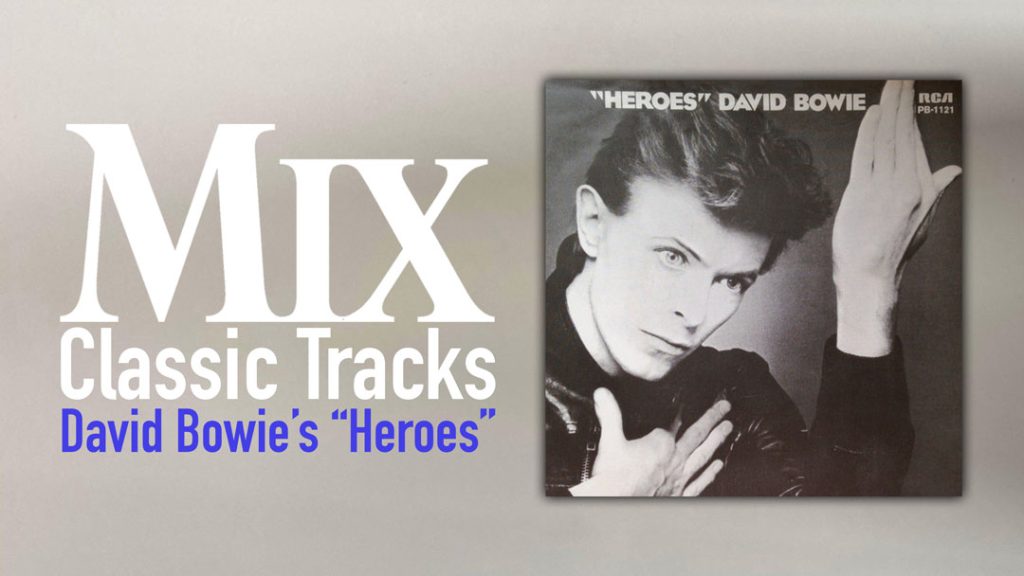
I came to like David Bowie fairly late in the game. For some reason, I never even heard his early records; they just didn’t find their way to my turntable. And the whole Ziggy Stardust/glam business was a bit much for me. Like everyone else, I dug “Young Americans” and “Fame” and parts of Station to Station, but believe it or not, the record that really drew me in was Bowie’s least commercial disc, Low (1976), made with Brian Eno. There was something darkly compelling about that record, with its strange keyboard textures and moody, disquieting instrumental passages. The follow-up record, Heroes, offered some further refinements on this intriguing artistic partnership, and introduced one of Bowie’s greatest songs, the stirring title track. The tour Bowie undertook after those records, powerfully documented on the live album Stage, produced one of the best concerts I ever attended, and I’ve considered myself a Bowie fan ever since, though I still find most of his records spotty.
What got me thinking about “Heroes” is that last October I saw a trio consisting of Bowie (who played acoustic guitar), guitarist Reeves Gabrel and bassist Gail Ann Dorsey perform an amazing version of the tune at Neil Young’s annual Bridge School benefit concert at the Shoreline Amphitheater, south of San Francisco. I was struck again by how well-constructed the song is and how it showcases Bowie’s voice so beautifully. Shortly after that show, I contacted Tony Visconti, who produced many of Bowie’s albums, including Heroes, and submitted a few questions about the recording of the title song. What follows is a narrative edited and assembled from his answers.
Take it away, Tony…
FIRST SOME BACKGROUND
“The album and title cut were recorded in West Berlin late in 1976, long before The Wall came down. Bowie and I had already made many albums together in many different styles, including Space Oddity, The Man Who Sold the World, Diamond Dogs, David Live and Young Americans. He had produced Station to Station himself, in between filming The Man Who Fell to Earth with director Nicholas Roeg. Not expecting to work with him again because of my absence on Station to Station and its chart success, I was surprised to get a phone call from David telling me he wanted to make an experimental album with Brian Eno. He wanted to break away completely from all his past styles and do something startling and new.
“He said Eno was contributing his bizarre techniques of recording, such as his deck of cards named Oblique Strategies, which offer artistic direction when you cut the deck, and his strange little EMS synthesizer built in a briefcase. He asked what I could contribute, and I told him I’d bring my Eventide digital delay and my new toy, the Harmonizer.
“I had the second Eventide Harmonizer in the UK, and I had already discovered many of its virtues in my project studio. (I had a 16-track MCI and Trident B range console in my house-very extravagant for those times; we had already mixed Diamond Dogs there.) When asked what the Harmonizer did, I replied, “It fucked with the fabric of time,” to which Bowie responded, “Holy shit! Bring it with you.” He also warned me that nothing might come of these sessions and that, at worst, I would waste a month of my life. Another aspect I provided was in the personage of Ricky Gardener, a fine left-field guitarist with whom I had been making demos.
The resulting album, Low, was not a huge commercial success. In fact, RCA tried to reject it, but it made it through and went on to change the way lots of people have made records since. Low was recorded at the Chateau D’Herouville, the “Honky Chateau” of Elton John fame. We weren’t treated too well by the seventh owners of this once-fine studio. We were served nothing but rabbit for the first three nights, until we complained. On the fourth night, we got rabbit and heads of lettuce! As soon as we got everything recorded, we upped and left to Berlin to mix it.
Why Berlin? David had already recorded Iggy Pop’s The Idiot there. The city was very decadent, yet safe due to the heavy military presence in evidence everywhere. Giant black tanks would roll through the city streets at any time of the day. At night, all sorts of clubs catered to all tastes from rock to techno to drag to porn. Artists of all types were plentiful because in an effort to populate the city, the government gave huge grants to any artists who could live and work there. David could wander the streets safely here, hardly recognized due to his crew cut (courtesy of me and my barber’s scissors), mustache and a very low-key wardrobe that included a cloth cap as worn by most Berliners. Iggy Pop, who lived in Bowie’s spacious apartment, sported the same garb.
FAST-FORWARD TO “HEROES”
Now that Low was under our belts, we were ready to do it again, this time completely in Berlin. We were all put up at the Gerhus Schlosshotel, a castle converted to a four-star hotel. The service was impeccable and the atmosphere was very traditional and reserved.
We would work very civil hours, from 11 to 7, and then spend the evening on the town. Often we’d have a very nice dinner in an expensive restaurant and then go to a club or two. There were many bizarre clubs there, but that’s another story! Suffice it to say that Berlin was a great place to be making an album in 1976!
David found Hansa Studios from advice given to him by members of Tangerine Dream and Kraftwerk. There was a more modern studio in the center of town, but we opted for this funkier complex by the Berlin Wall! The control room was of a modest size. The console was a Neve. But the big attraction was the room itself! It used to hold over 100 musicians in Hitler’s day, when it was put to “good” use recording marching music and music composed for the Fuhrer’s rallies. There was a very spacious floor, but there was also a stage, probably for a choir. The studio had a lovely, short, natural reverb-about 1.5 seconds, and very controllable with careful miking. The console (about 48 channels) faced the control room window, which faced the Berlin Wall-not 500 yards away. We asked my assistant engineer (a fine engineer in his own right) Edu Meyer if it made him nervous working so close to The Wall; after all, Red guards would often look right into our control room through powerful Soviet-made binoculars. Edu said, “Naw!” Then he took a hanging overhead light and shone it directly toward The Wall and kept sticking his tongue out. Bowie and I dived under the console and shouted, “Don’t do that!” Edu just laughed.
The album was recorded on a 24-track Studer A80 with no timecode, because it was before the days of computerized mixing or locking up two machines. So track 24 was ours to record on! The selection of microphones was mainly German/Austrian Beyers and Neumanns. They had an amazing collection of tube Neumanns and spare tubes that were no longer manufactured at the time. The studio and control room were separated by a long hallway, and the only visual communication was by way of closed-circuit TV. Drummer Dennis Davis used to delight us with his one-man comedy shows he’d do on the CCTV in between takes. The outboard gear was superb for the time, with plates and other gear from EMT and AKG. There wasn’t guitar, Dennis much American gear, but the studio had more outboard gear than most British and American studios back then. I had to bring my own Eventide Harmonizer 910H, because they were still as rare as dragon’s teeth in Europe. This album started the same way as Low and the subsequent album, The Lodger, did. All the rhythm section and Eno were there on day one. The rhythm section was Carlos Alomar on guitar, Dennis Davis on drums and George Murray on bass—a hard, funky, black section from Nu Yawk. They appeared incongruous compared to the staunchly British Bowie and Eno, but man did it work. Those guys could peel paint off the walls when they played! I never worked with a better rhythm section. A good portion of the first few hours would just be throwing ideas around. Either David or Eno would have a nice chord sequence they would want the guys to try. On this album there was no “resident” keyboard player as on Low, so although this comes off as a keyboard album, it wasn’t in its conception. No songs were rewritten: There were no words or melodies, just chord changes and grooves with working titles. I notice from the credits that “Heroes” was written by Bowie/Eno, but the guitar riff that underlies most of the song is definitely from the head of Carlos Alomar.
The song was a “sleeper” before it had melody and words. As a backing track it was kind of static; others were more exciting. But something in the form of repetition was getting under our skins, so we “parked” the song in its guitar/bass/drums form for a week or so and went on to record the other backing tracks. As with Low, the first week of recording was meant to be demos only, and then the band would replay them “for keeps.” But after the demos were all laid down, we looked at each other and realized we had gems in these rough forms. Some of Davis’ drum fills were so far out we felt he could never have been that “left-field” if we said, “Okay, this is an official take.” I remember tightening up a few of the tracks by editing some extraneous bars out of the 24-track multitrack. (I love the power of cutting across two inches of analog tape-just mute all the tracks except the kick drum. It’s easy as pie.)
So the rhythm section was sent home after 10 days or so and Bowie, Eno and I got on to the next phase-overdubbing weirdness. At this point, “Heroes” was this long, ponderous track that needed its sections defined. To perk it up, first Eno went out into the studio and played an eight-to-the-bar piano part, just banging the chords out (only five: D, G, C, Em7 and Am7). The rhythm was now even more hypnotic. Next Eno opened the EMS and started poking little colored sticks into the tiny patchbay. A few twiddles and much waving of the joystick and this shimmering, shuddering white noise started coming out. I processed it through something-maybe an Eventide. Instant flanger. Then Bowie cranked up his Chamberlain sampling keyboard, the “better” Mellotron. He clicked it to “brass” and played those little stabs from verse two, only it doesn’t sound like brass—too puny-but it created another polyrhythm. This track was growing. One of us went into the massive studio and overdubbed a tambourine. And that was it for the moment.
On the weekend, Robert Fripp, guitarist from King Crimson and collaborator with Eno on some “ambient” albums, arrived with only his guitar. (Who needs an amp when you’ve got Eno’s EMS synthesizer in a briefcase? You could see this wasn’t the first time they’d done this.) Fripp proceeded to play “processed guitar”: That high, sustained “A” in the intro of the song is the first track of processed guitar, then Fripp laid down two more tracks, bending and harmonizing with his previous track. Through the years, many people believed this was a keyboard line or Fripp playing with an E-Bow. But the E-Bow wasn’t available yet. What you actually hear is Fripp’s guitar feeding back in the studio monitors and being processed by the EMS.
Now the track had a complete personality! Still, though, no words or melody. Then it was up to Bowie to write a song to this amazing track. One sunny afternoon, he asked me to leave him completely alone in the control room for an hour or so, so he could write something. I asked Antonia Maass, the female backup singer on “Beauty and the Beast,” to take a walk with me. We were “dating.” We took a leisurely stroll by The Wall, walking hand in hand. We were in a very animated, playful mood and then stopped and kissed by The Wall. We had coffee, and then I decided it was time to check up on David. Antonia and I walked into the control room, and David and his personal assistant Coco were smiling. David had written the lyrics to “Heroes” while we were out walking. In fact, he’d seen us from the window and gotten the idea for the entire song from watching us! Our kiss is represented in the fifth verse: “I remember standing by the wall/The guns shot about our heads/ And we kissed as though nothing could fall…” I think the whole song could be summed up by that kiss! Despite this horrible wall built to imprison and separate families, we can be “heroes” in defiance by using kisses as a weapon against tyranny. The whole song is an upbeat anthem that says that mankind is capable of climbing out of any mess as an individual!
Still there was no melody! So then Bowie decided he was going to do something that blows my mind to this day: He was going to compose and put the final lead vocal on tape simultaneously. He was also going to sing in that huge studio with the 1,500 ms decay. I asked if he could wait until I set something up. I wanted to catch that ambience on tape. A close mic would destroy it, a mic about 10 feet away would not be intimate enough, and a mic about 40 feet away would be ridiculous—so why not have all three? So I set up the mics and it worked, kind of. I had a tube U47 in his face, and two other Neumanns 10 and 40 feet away. I only had a few tracks left and I knew there would be backups to sing, so I got this bright idea to put gates on the 10- and 40-foot mics.
Discover more great stories—get a free Mix SmartBrief subscription!
It worked beautifully: When David sang verses one and two, neither of the distant mics opened up. But above a certain volume, the 10-foot mic opened and you could hear some of the room. Then, on chorus four when he sang, “I will be king…” the mic at 40 feet opened up and the room exploded with “Bowie histrionics” as he jokingly referred to that verse. Mind you, this is at 3:16, when most songs begin to fade. This one kicks in big time and goes on for almost another three minutes! Every so often I had to stop the tape and David tweaked a lyric here, a melodic line there. But he was composing on mic, and the vocal sounded terrific! I never worked with anyone else who could do this, and in less than two hours, it was done. We had a song!
David loved the sound of the room and the gated mics. On the mix, we had no need for artificial reverb, the sound was so hot. Then it was time for backups. In keeping with the spontaneous feeling of the session, David and I decided to sing them ourselves and we went out and made them up on the spot. Edu Meyer engineered. Mine is the higher voice with the “Britlyn” accent—half British, half Brooklyn. This didn’t take very long either, as David and I had been doing backups since the Space Oddity days. Later, we had the song translated to French and German, and we recorded those versions a few nights later, backups and all!
For some reason, we decided to leave Berlin to mix at Mountain Studios in Montreux, Switzerland, where David was renting a house. We drove from Berlin through Communist territory to Switzerland. (Are we not heroes?) The cultural contrast was incredible. Switzerland was clean, bright and so conservative you were not allowed to bring girls up to your hotel room. Still, it was a healthy environment and I enjoyed being there.
• Classic Tracks: Talking Heads’ “Psycho Killer”
Mountain was built to serve the many musical festivals held in Montreux. The studio and control room were small and cramped. We were not allowed to use the huge hall for recording because of constant conventions. Still, like most European studios, the equipment was incredible and well-maintained. The mix was fairly straightforward, as most of the effects were already on the multitrack. We slowly panned Fripp’s guitar and Eno’s shuddering synth from left to right. (Remember, this was before automation.) I remember setting up the levels for different sections and then editing them all together, the way dance mixes are made. I am usually heavy on the kick drum, but in this case a well-defined kick drum made the track drag. So I undermixed it and let the eight-to-the-bar bass guitar chug the track along. There is so much delicate polyrhythmical information in this track, a plodding kick drum ruined the ecology.
The track is 6:07 long, and I think it stands up beautifully-then and now! For radio purposes we edited a shorter version. I have fond memories of that long period of the “Bowie-Eno triptych.” It was a time of great extremes, of tragedy and exhilaration for both Bowie and myself. (T-Rex leader Marc Bolan, with whom I had worked for many years, died in a car crash right after Heroes, and my marriage ended right after The Lodger.) These groundbreaking pieces of music came in a period I doubt will ever be re-created. Record companies weren’t telling us what to do yet; these records were made by artists, not A&R committees, and they nicely captured the spirit of those times.