
The Eagles were such a fixture on the radio in the 1970s and early ’80s, it was hard not to get sick of them, but time has been good to them and their songs—it’s no wonder so many of their tunes are regarded as rock and/or country classics. That the band looks and sounds so good after such a long layoff is testimony to the strength of the players and the brilliance of their songbook.
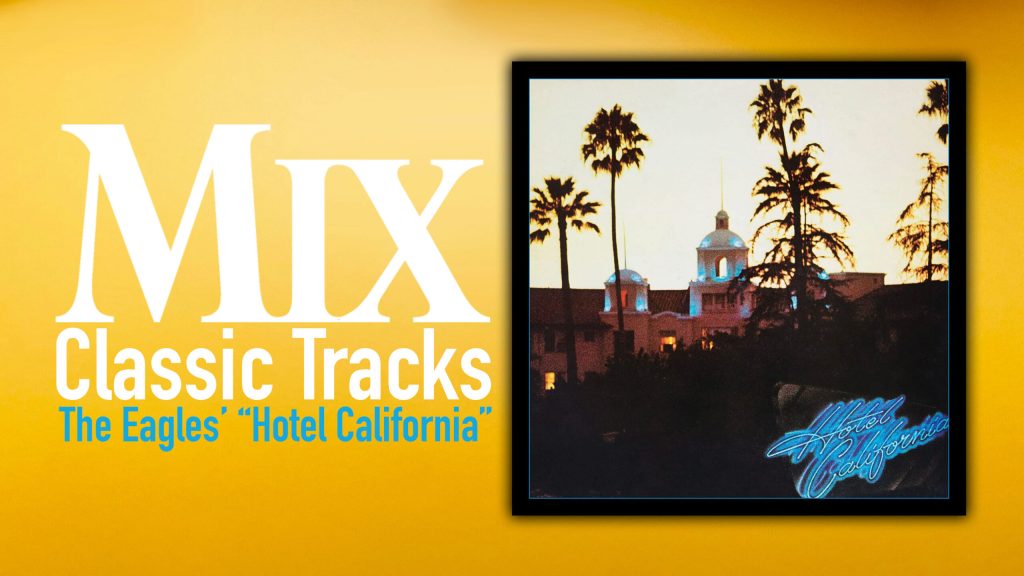
The brightest jewel in the band’s collection of original songs was, is and probably always will be “Hotel California,” the title track of the zillion-selling Eagles album cut in 1976. With its wild triple-guitar attack, tough reggae beat and brilliant, biting Don Henley lyrics that seemed to perfectly capture the dark but still glittering life in the fast lane (another great song on that album, of course), the song was a powerful, almost hallucinogenic, evocation of characters trapped in a seductive self-created hell.
In October, I managed to track down producer/engineer Bill Szymczyk, who produced On the Border, One of These Nights, Hotel California and the group’s original swan song, The Long Run, to chat about the session for the song “Hotel California.” Ironically, the night of our conversation, MTV aired its wonderful Eagles Unplugged program for the first time—and that show opened with a superb, Gipsy Kings-influenced version of “Hotel California.”
“The interesting thing about cutting ‘Hotel California,” Szymczyk says by phone from his house in the Blue Ridge Mountains in North Carolina, “is we actually cut the basic track three different times over a period, with the third being the one we used. The first one was the wrong key for Henley. Then we cut it in the right key, but it was too fast. Both of these sessions were done in L.A. at the Record Plant, and then the real version was done at Criteria [in Miami], where most of the record was done. It was cut on a beautiful afternoon in sunny Florida.”
Cutting Basics
“The basic track was [Don] Felder playing a 12-string acoustic, which was also going to a couple amps we had miked, so we had it on three tracks—stereo from the amps and the dry acoustic in the middle; that’s what the opening of the song is,” Szymczyk continues. “Obviously, it was Henley on drums, [Randy] Meisner on bass. Frey was playing the reggae guitar chinks, and I don’t really remember what Joe Walsh was playing during the song part. In that era, I very seldom did guitars direct; I’d always mike the amps. The big solo at the end was Walsh and Felder, dueling guitars, with me in the middle in the control room, which is how we liked to work. We’d have the amps miked out in the studio, and they’d be in with me unless they needed some feedback effect where they needed to be next to the amp.”
Szymczyk says the basic track didn’t feature any vocal at all: “From the time of Hotel California on, there were rarely finished lyrics by the time we cut the basics. With ‘Hotel California,’ I think there might have been a verse and a chorus and a few lines hither and yon, but mainly we were flying somewhat blind. Of course, with Henley, it was doubly hard to get rid of a scratch vocal because he’s the drummer, so his vocal would come through the overhead and hi-hat mics. But their modus operandi became to work without a completed vocal. The basic track was usually constituted of five, six or eight takes, usually with a lot of editing between the takes, I think ‘Hotel California’ had 30-some edits in the basic, before we even started overdubbing. I always had my razor blade at the ready. The Eagles’ nickname for me was The Big Lopper,” he says with a laugh.
• Classic Tracks: David Bowie’s “Heroes”
It was more than two months between the completion of the basic track and the addition of the vocal parts. According to Szymczyk, “Then, as now, Henley labored over everything to the nth degree, but when he pronounced something finished, by God, it was. He really took his lyric writing seriously, and it shows in the finished song. We always had other things to work on. We weren’t in any hurry.”
And when it finally came time to cut the vocals, the process was quite laborious: “During the course of this album, I was experimenting with comping vocals for the first time because Criteria had this great, one-of-a-kind MCI custom console that had some of the fastest—for the time—relays for switching tracks and switching channels. I would take four or five tacks on my 24, and I’d cut each one with a different take of the complete lead vocal, route them through the board and then pick and choose, going line by line, assembling one great vocal track. I’m not sure I was the first person to do that, but I’ve been cursed by people ever since: You taught those sons of bitches how to do that!”
Szymczyk notes that the vibe surrounding the making of Hotel California was “excellent from beginning to end. It was a really fun record to make. It wasn’t until the next record [The Long Run] that a lot of the tension started to come out. That was the one that did us in. But actually, I think [The Long Run] is my favorite because it was so damn hard to make and there were so many conflicts going on, that for me, personally, to get everyone through that and have them still be friendly enough to go on the road for another two years after that was a hell of an accomplishment.”
Discover more great stories—get a free Mix SmartBrief subscription!
Neither the band nor Szymczyk believed that “Hotel California” could be a successful single because “it was so damn long [six minutes], and there was no logical place to slash it.” But it was such a huge FM radio success right out of the box that radio essentially demanded it be released as the second single off the album (after the Number One hit “New Kid in Town”), and sure enough, it made it all the way to Number One in February of 1977. It’s be a staple of “classic rock” stations ever since.
Szymczyk describes himself as “semi-retired” these days, though he has continued to work with Walsh on his solo albums and taken on occasional projects here and there as it suits him. Clearly, life in the slow lane on his deck overlooking Mt. Mitchell agrees with him. And the legacy he helped create with The Eagles in the ’70s should keep him comfortable for the rest of his days.
This story originally appeared in the January 1995 issue of Mix magazine.