

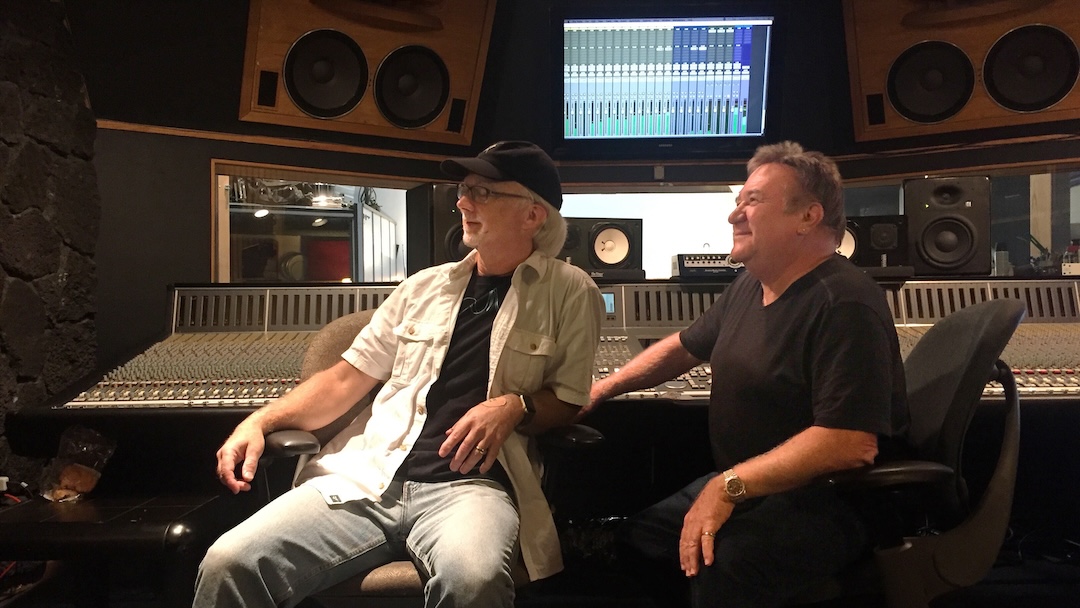
San Francisco, CA (March 6, 2026)—Keyboardist Greg Rahn’s Side Hustle—a wonderful canvas of color and an extraordinary display of musicality—is aptly titled. Over the past 25 years, the well-connected Bay Area musician had carved out a pretty successful career in composing, arranging and producing music for video games, successful enough to afford him the pleasure of a side hustle: writing and playing music, live and in the studio.
But side hustles can take time. While the album was completed in the summer of 2025 and released in mid-January 2026, the journey began nearly a decade ago, back in 2017, when Rahn spent a year writing and recording with a few Bay Area friends, including guitarist Drew Zingg, bassist Steve Evans, drummer Mick Mestek and percussionist Derek Rolando.
Then, during the mix, Rahn felt the need to step away.
“I just felt burnt out on the material. I had heard it so much,” he admits. “I was not inspired by it anymore.”
At the time, he intended on returning to it much sooner; instead, he got sidetracked recording and performing behind a solo piano album, Rent Party. It wasn’t until 2024 that he returned to Side Hustle and started the mix back up in his home studio.
“The beauty of that was when I finally did come back to it, everything was new,” he says. “And when I listened to the songs, even the arrangements were clear to me.”
The newfound clarity allowed him to go through the songs objectively and cut portions that he realized were not relevant or did not serve the music. On “Jam Night,” he deleted a whole verse. On a “Brand New Bad Idea,” he realized that as he was nearing his burnout period, he had been overthinking the track to the point that he had rewritten and recut the melody. With fresh ears, he realized that the original melody was superior, so he recalled those tracks.

THE ORIGINAL RECORDING
The majority of the album had been completed prior to its shelving, with most of the basic tracks recorded live by engineer Joel Jaffe at Sausalito’s Studio D, a room he had built specifically to capture the magic of a band playing live.
“Even though he [Rahn] was playing live with the drums and they were in the same room, the piano was isolated from the drummer,” Jaffe explains, “and the bass player had an amplifier in an iso booth so that he was isolated. But everybody was in the big room and had headphones on and were listening to each other at the same time.”
Inside the bass drum, Jaffe placed a Sennheiser MD 421, with a Neumann U47 FET on the outside, while on snare, he prefers a Sennheiser MD 431 on top and a Shure 57 on the bottom. For toms, he puts up two 421s.
“I use two mics on the low tom—one on the bottom of the tom as well as the 421 on the top,” Jaffe says. “The bottom mic on the low tom is 180 degrees out of phase, so you have to flip the phase, but when you do that, you’re capturing the low end off the tom, as well as the attack from the top end, and when you do that, you sum them and you have such an incredible-sounding tom.
“On the hi-hat, I used either a Neumann KM 84, a small condenser mic, and a smaller-capsule microphone,” he continues, “or I would use an AKG C 451, which is a small condenser mic usually used for overheads. I use it on the hi hat, facing away from the kit so that it’s fairly isolated, and that way you can really dial in how much of the hi hat you want in the mix.”
He put up a pair of C 451 condensers for overheads, as well as two Neumann UM 57s mid-room to capture the ambience.
The Hammond B3 was covered with three mics; for piano, he placed two AKG C414 TLII (C12 capsule) microphones above the keys and soundboard—one on the high end and one on the low end. “When you’re listening, you’re hearing the high end on the left and the low end on the right,” he explains. “I mike the piano so you have a really good stereo image, as opposed to a mono sound.”
Needless to say, Rahn used an array of keyboards on the record. On “Brand New Bad Idea” alone, he plays electric piano, piano and keytar.

THE NEW MIX
Rahn’s home studio is centered around a MacBook Pro running Logic Pro X and Pro Tools. His hardware input signal chain consists of the Focusrite Scarlett OctoPre through a pair of dbx 160A compressors, into a Universal Audio Apollo Twin. He may also make use of UA plug-ins in the Twin—UA 610-B, Pultec Pro Legacy, UA 1176 LN Legacy and Teletronix LA-2A—depending on what he is recording. He also owns an SSL 2+ USB interface and listens through Dynaudio BM6A monitors.
Plug-ins and virtual instruments figure heavily in Rahn’s workflow. When calling up the tracks from 2017, he realized that a couple of his favorite samples, Tenor Trombone and Tuba from Native Instruments Session Horns Pro, had been used as placeholders while writing the Professor Longhair-inspired “Slap Yo Mama.” He had always planned on recording real horn players, but while listening to the mix in 2024, he realized he was hearing sampled trombone and tuba.
• Rogét Chahayed, The Man in Demand, Part 1
“I was like, ‘Wait a minute, the whole thing sounds fine. The mix sounds fine. Even the sample horns sound okay. They work for the song,” Rahn recalls. “I struggled with myself, asking, ‘Do I want a song with samples on it? I have all these live players; I shouldn’t have any samples.’ In the end, I just left it. When the trombone player who played on ‘Brand New Bad Idea’ was listening to the album with a friend, a tuba player, they both wanted to know who played horns on ‘Slap Yo Mama’. I guess that’s the acid test right there.”
“Chillin’ at the Crawdaddy Lounge” also needed a little attention. Evans had been unable to make it to the original tracking session, leaving drummer Jeff Campitelli and Rahn to provide the foundation. Evans came in to overdub the bass at a later date, but Rahn says that when he came back to the music in 2024, he had a different vision for a portion of the drum track, so he had Phil Hawkins take a pass. Ultimately he combined half of each drummer’s performances.
Two of his favorite divergent offerings, Rahn says, are the Snarky Puppy–influenced “Brand New Bad Idea,” and his unique keyboard-centric rendition of Steely Dan’s “Josie,” with background vocals by his wife and daughter, Patricia and Katie Rahn.
Side Hustle’s eclecticism, illustrated by the performance of jazz, funk, blues, rock, zydeco, fusion and rock, concerns him just a little, as he doesn’t know whether or not audiences expect stylistic consistency. While his objective was to share all the genres he has learned and loved through the years, he’s not sure how the general public will react when they’re all on a single album.
Discover more great stories—get a free Mix SmartBrief subscription!
Jaffe believes that is a strength and will be applauded. “He’s such a great player and so musical,” the engineer says. “This album just shows how talented he is and how many different things he is able to do. I’ve always been very impressed with his musicianship—and he’s a lot of fun to work with.”
[Editor’s Note: Between 2017 and 2024, when Rahn returned to the project, guitarist Drew Zingg and bassist Steve Evans passed away. The album is dedicated to them.]