
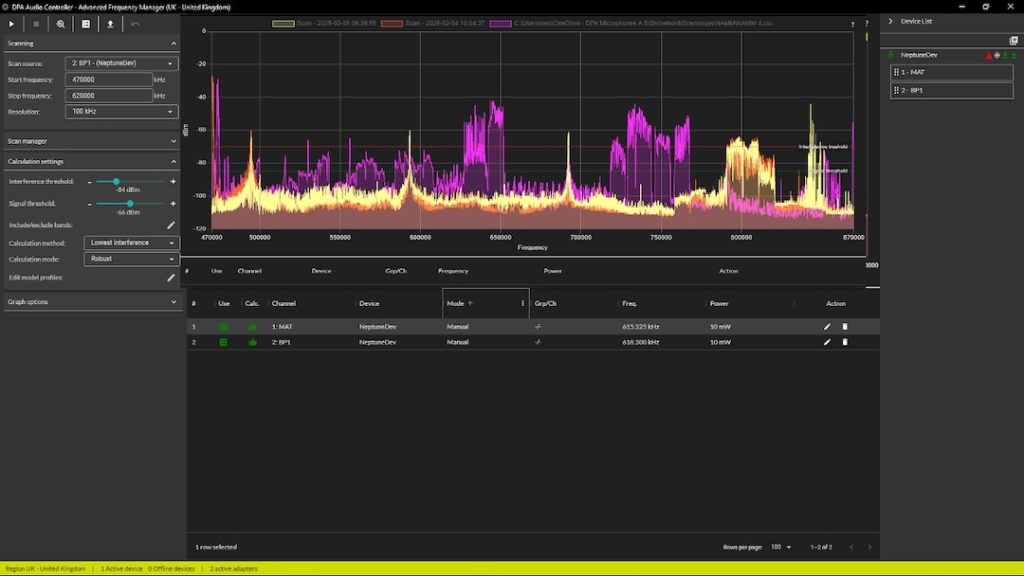
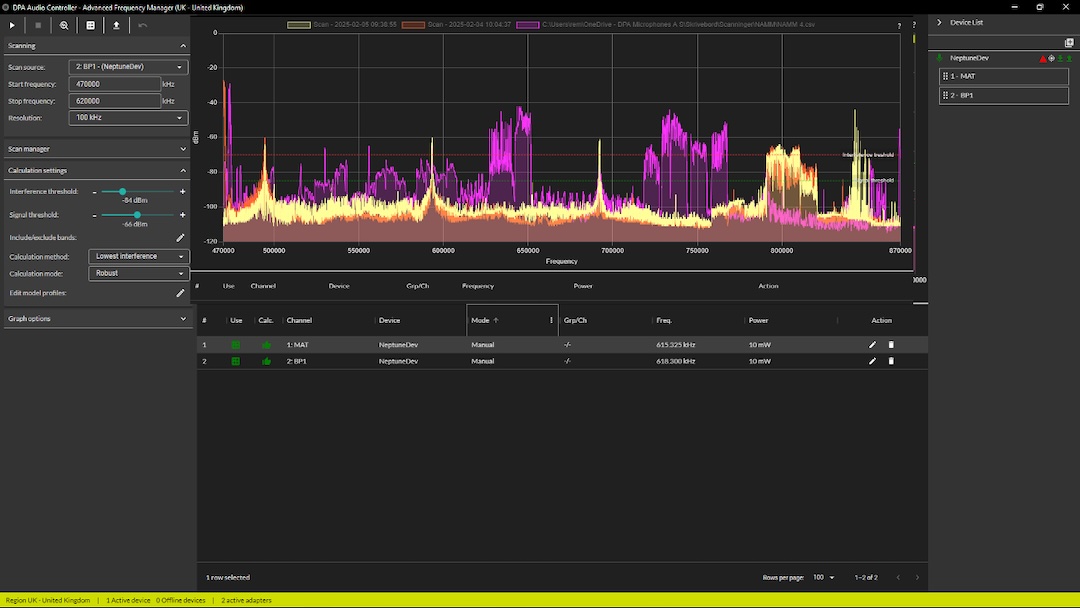
Longmont, CO (April 16, 2026)―DPA Microphones has announced new firmware for its N‑Series Digital Wireless System, allowing users in North America to take more advantage of the system’s wide tuning range. The new update will debut at NAB 2026.
Offering features such as True Radio Diversity and a 400 MHz tuning bandwidth, the new N-Series firmware provides customers in the U.S. and Canada with Duplex Gap and Guard Band access for a broader usable spectrum.
With the new firmware, all N‑Series users will gain access to the 2 MHz Guard Band as well as the 6 MHz unlicensed portion of the Duplex Gap. Owing to the linear RF design and low intermodulation characteristics of the N-Series, the increased space can accommodate up to 16 additional wireless channels, making it appropriate for use in houses of worship, regional theaters, corporate AV environments and other multi‑channel applications.
Following the North American spectrum repack roughly eight years ago, two ‘safe’ operating areas were created within the 600 MHz range to protect new mobile broadband services. These areas are known as the Guard Band (614–616 MHz) and the Duplex Gap (653–663 MHz).
• Capturing the Live Music of Sinners
The Guard Band is a 2 MHz segment between UHF Channel 37 and the start of mobile phone downlink spectrum. Any wireless system may operate here at up to 20 mW EIRP without an FCC license. Additionally, the Duplex Gap is a 10 MHz separation between mobile downlink and uplink frequencies, divided into two segments: 653–657 MHz, where operation is permitted for licensed wireless systems up to 20 mW EIRP, and 657–663 MHz, where operation is permitted for licensed or unlicensed systems, also up to 20 mW EIRP.
Discover more great stories—get a free Mix SmartBrief subscription!
Users holding the appropriate FCC license can take advantage of the full 12 MHz of available spectrum.