
It has been said—and it bears repeating— that for immersive music to enjoy longterm success and not fizzle out like, say, 5.1 surround, artists must start producing projects conceived and recorded expressly for the format, not as a marketing necessity or an afterthought.
Remixing catalog and current stereo tracks for spatial streaming is all well and good, and some producers have certainly had success capturing acoustic ensembles performing together in a room for immersive release. But imagine if someone developed an immersive recording workflow akin to a stereo production, where you could lay down the bed tracks and then overdub to your heart’s content, without introducing any of the phase issues or other gotchas associated with wrangling large numbers of sources and microphones in a spatial environment.
“The key is to make it three-dimensional at the source,” says Justin Gray, a musician, producer, engineer and mixer. In February, he became the first Canadian to win a Grammy Award in the Best Immersive Audio Album category for his most recent release, Immersed. The project was conceived, composed, engineered, recorded, edited, produced (with musician/arranger Drew Jurecka and immersive producer and engineer Morten Lindberg) and mixed by Gray, with support from recording engineers at Humber Polytechnic’s Gordon Wragg Studios and rerecording mixers at Company 3. It was mastered by Michael Romanowski at Coast Mastering.
Four years in the making, Immersed features 38 musicians and is jazz at its core, Gray says, fused with elements of Indian, orchestral and electronic music.
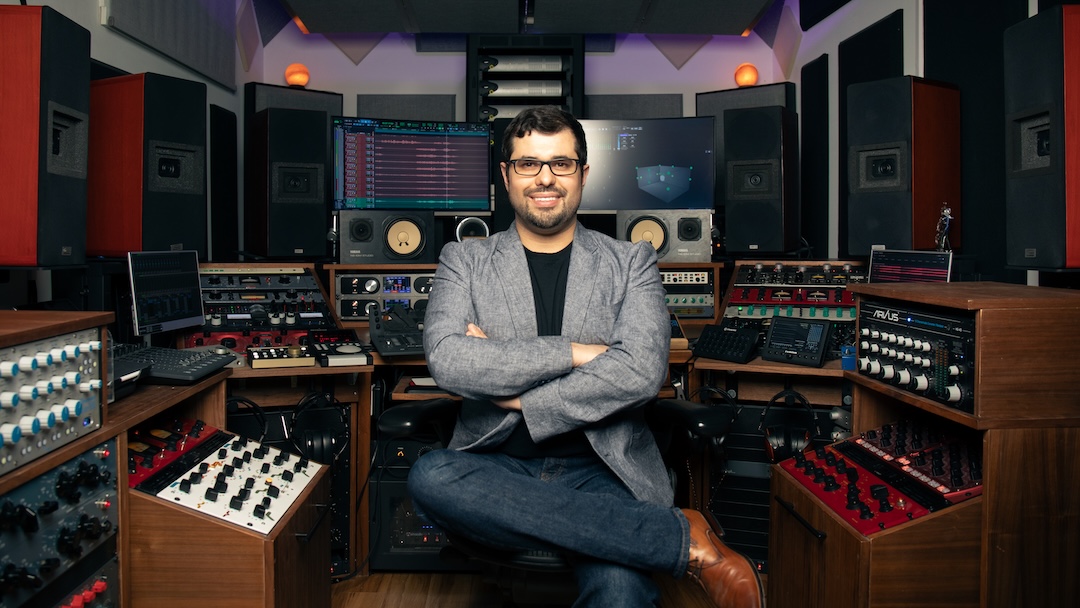
Gray can speak with some sense of authority when it comes to spatial music. He started out as a musician—he plays bass and percussion on the album—and, over the years, has immersed himself in all aspects of music production and film post-production. “I was one of the early mixers dedicated to the music side of this,” he reports, building out an immersive mixing and mastering room in Toronto nearly 10 years ago. The major labels came calling when spatial streaming started to ramp up. “I’ve mixed about 3,000 songs in the immersive formats. I also have a wicked collection of SACDs and DVDs, so I have studied the aesthetics of surround music.”
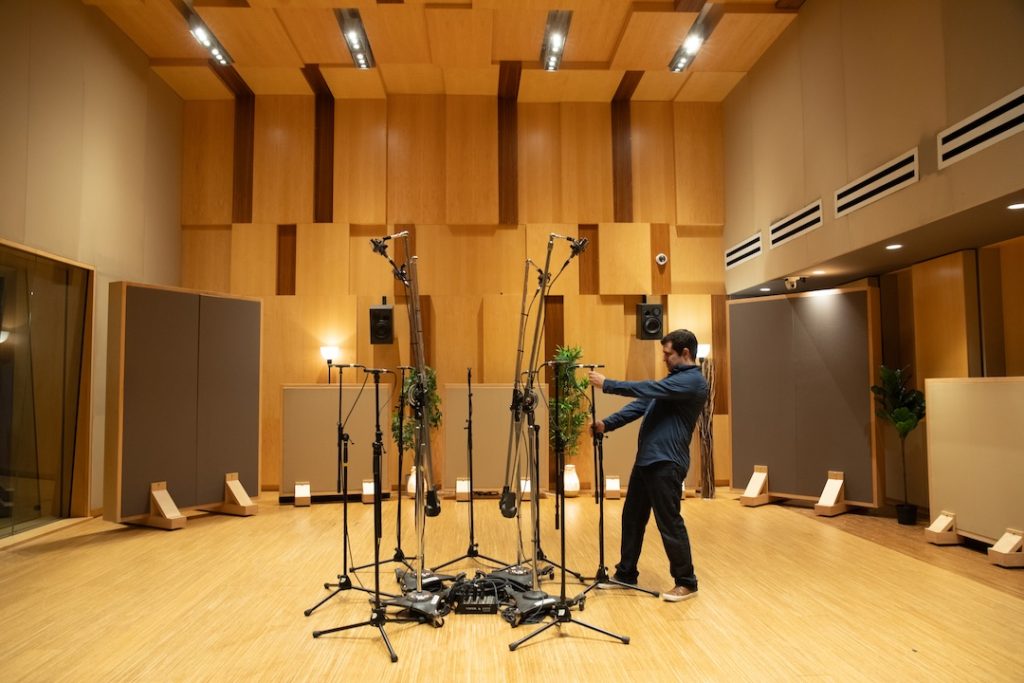
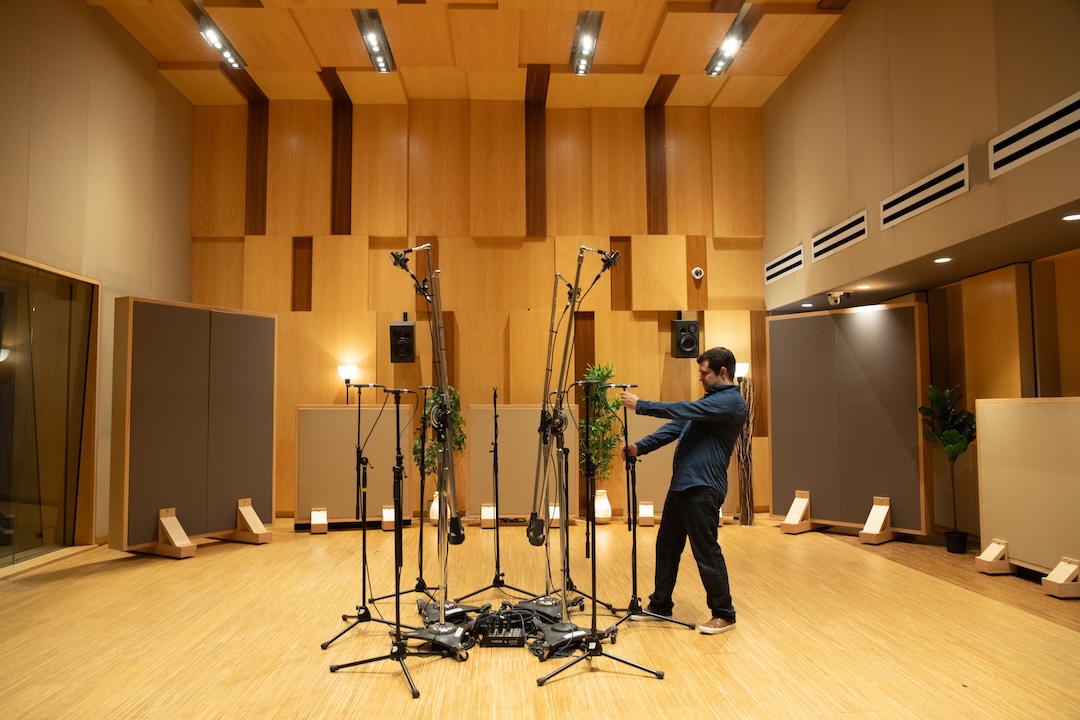
Gray, who is also nominated for a Juno Award for Immersed, is also an educator, a professor in Humber’s Bachelor of Music program, and it’s a position that afforded him the resources to research the immersive recording techniques he used on the project. Through listening tests, he developed what one colleague dubbed the “Gray Array”—seven microphones on a lower plane with four on an upper plane. Unlike some other immersive schemes, every mic is measured and positioned equidistant from a central point representing the listener’s head. “It’s a perfect hemisphere,” says Gray of the setup, which comprises 11 Schoeps CMC 6U bodies with MK4 capsules from Humber’s extensive mic locker, supported by his own collection.
TRACKING WITH AN 11-MIC ARRAY
In a larger hall, Gray would typically reach for omni mics, but when he tried an omni array in Humber’s live space, he says, “The low end and low-mid build-up became very overwhelming very quickly,” so he opted for cardioids instead. He also positioned a Neumann M 150 at the center point as a dedicated LFE channel (for certain instruments), a technique borrowed from Grammy-winning scoring engineer Leslie Ann Jones.
Individual instruments and small ensembles—brass, woodwinds, strings—plus drum kits were also close-miked, and in some cases tracked at other studios with various room mic configurations deployed, including Decca trees. For most of the soloists and voices, however, overdubs were tracked around the 11-mic array in Humber’s live room, in the specific locations Gray envisioned.
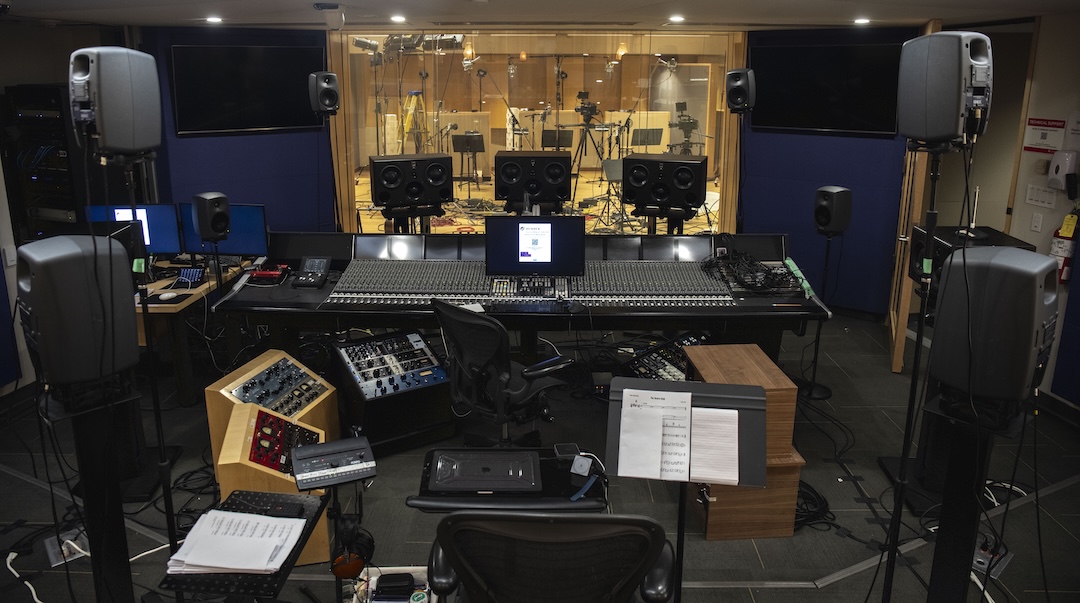
“The real key is that I was able to go in with compositional clarity,” he explains. “I designed the arrays to position everything in the mix at the source, as though we put the musicians all around the room—just one at a time.” If a composition called for the horns to be in the rear channels, for example, the players stood to the rear of the array. Gray even climbed a step ladder to record percussion in the overheads. At the same time, a temporary immersive monitor rig was set up in the control room.
“I wrote this music specifically for 16 channels, as 9.1.6,” he says, so discrete channels were simply mapped one-to-one to the speakers. That way, Dolby Atmos latency was a non-issue, and fold-down, phase and timing checks could be streamlined. “Alex Gamble, the assistant engineer, and I wanted the technology to fade away very quickly. We needed to be lightning fast.”
The tracking process was similar to a film scoring session session, with Gray on bass, his brother Derek on drums, and pianist Noam Lemish recording the beds for most of the eight compositions (a couple of songs needed different starting points, he says), playing to temp tracks and a click.
Discover more recording stories—get a free Mix SmartBrief subscription!
“Then I brought in the horns to replace the MIDI tracks, then guitar and keyboards,” he explains. “I brought in the soloists, then we came back and replaced all the beds. Now Noam could be much more expressive and leave more space, the way that he would if we were on stage. Then Derek played drums and got to push and pull and react to the soloist as though they were playing together. We tracked a bunch more layers, then I went last.”
Of course, track counts can quickly go through the roof using such a multi-mic approach. “One of the most beautiful things about being in the studio with great musicians is that you record the parts you wrote, then you record the parts you didn’t write. Having that speaker array meant we tracked the things that I wanted, then the musician would come in the room, listen, and their head would just explode,” he laughs, adding that it would often inspire new parts, even a different mic setup. “I would say the smallest song had 500 tracks and the largest had over 1,000. Because even one guitar overdub is three amps, two close mics on each amp, an immersive array and additional ambient mics.”