
New York, NY (April 23, 2026)—FabFilter has released a major update to its plug-in compressor Pro-C2, first introduced back in 2015. The new Pro-C3 is a compressor/ limiter workstation, a complete dynamics processor for individual audio tracks or stereo mixes, and it will automatically adapt to operate in most surround/immersive audio systems, including 9.1.6. Dolby Atmos.
Fab Filter’s Pro-Q 4.1 equalizer plug-in (reviewed in the February 2025 issue of Mix) introduced Instance List technology, and Pro-C3 is the company’s fourth plug-in to use it, joining Pro-G and Pro- DS. As an overview in a single window, these four plug-ins have miniature GUIs of all their instances running in your mix, ready for viewing and adjusting settings.
Other significant additions and upgrades in Pro-C3 include: Host Tempo gain reduction triggering; adjustable Lookahead; up to 32x oversampling; and Auto Threshold.
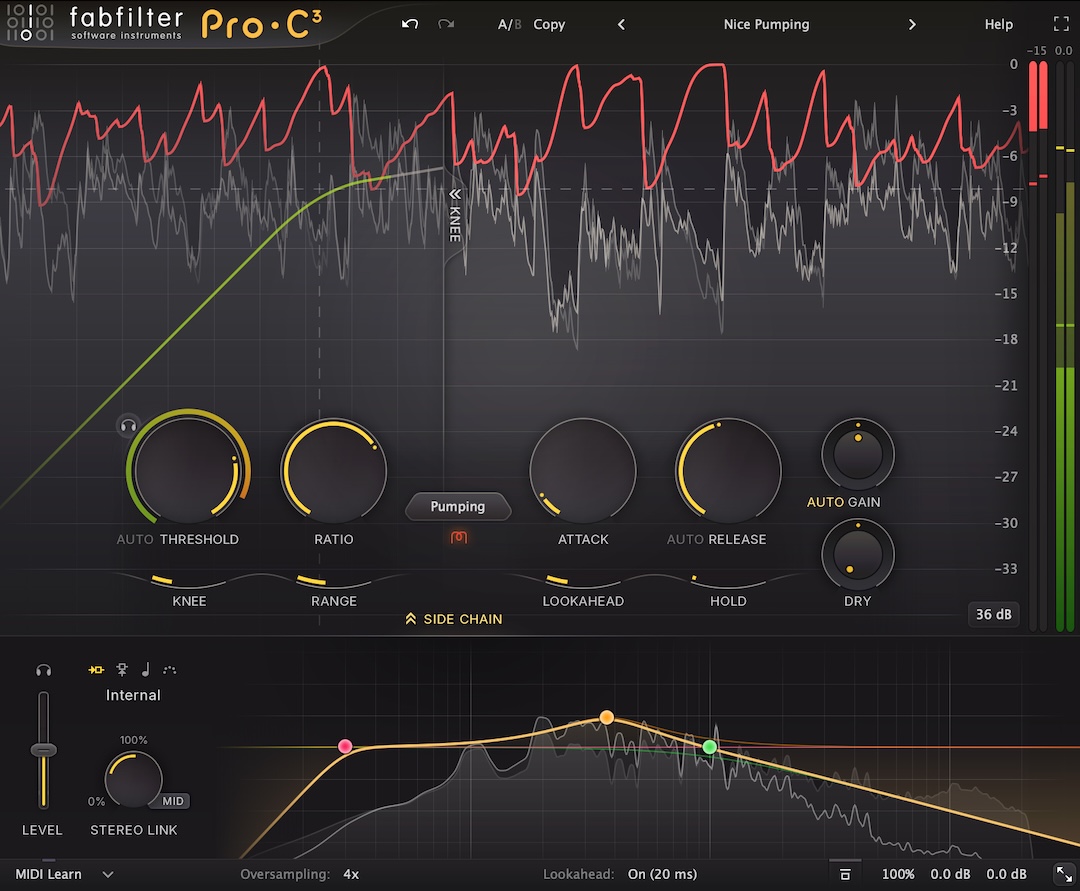
Pro-C3 retains FF’s artistic and colorful GUI with its real-time waveform/gain reduction histogram parading across its resizable screen. The display’s Output and Gain reduction meters expand to show the levels of all channel instances in an immersive mix. There is also the Compact GUI, which I liked for individual tracks across the mixer in Pro Tools.
STYLE AND CHARACTERISTICS
A Style is a generalized model of a compressor that includes emulations of analog distortion, artifacts, transformer saturation, coloration treatments and more. Pro-C3 adds six new Styles to Pro-C2’s eight, and its versatility and malleability are the result of its Style hierarchical design.
The GUI’s Style button allows you to select one of three styles of compression: Modern, Classic and Utility. Each of these styles is further defined by using a selection of algorithmic variations— unique characteristics and operational quirks that are available for all the compressors in that Style.
I liked the descriptive names of the styles, characteristics and algorithms, which will be familiar to anyone who has ever used a hardware or software compressor. However, some users may need a refresher tutorial on the internal workings of audio compressors, terminology and types. The included manual does a good job of explaining how and why each might be used.
First is the Modern style, with a choice of six compressor algorithms or variations of late-model compressors. In Pro-C, there are Clean (with low distortion) and Punchy (analog model). The four new ones are Versatile (general purpose), Smooth (like a Leveling amp), Upward (negative compression ratio), and TTM, for “To The Max” (a berserk-sounding, multi-band special effect).
The Classic style emulates compressor technologies of yesteryear. Modifiers include: Classic and Opto, and, new for C3, are Op-El (optical tube) and Vari-Mu. These algorithms add the secret sauce—the interaction of transformers, tubes, saturation, circuit component variation, different detectors, and even/odd harmonic distortion typical of vintage compressors.
The Utility style has the Vocal algorithm with its auto knee ratio. In this mode, I noticed the Ratio control goes dark because Vocal is modeling a compressor without a ratio control, such as a Teletronix LA-2A Leveling Amp. The Mastering algorithm offers super clean and transparent control, while Bus is more colorful for stereo mixes or drum buses. Finally, Pumping works well for tempo-synced level effects.
Below the Style button is the new Character Menu, with selectable analog saturation and harmonic distortion. There are Tube, Diode and Bright. The Drive control fader and Post button sets how much character and whether these additional “spices” are added pre/post the compressor itself.
SIDE CHAIN AND GR
The Side Chain section drops down under the main window and uses a Pro-Q4 equalizer, but now with six EQ bands plus Brickwall high- and low-pass filters. In addition, each EQ band can be used individually for Mid/Side processing of stereo tracks. Stereo linking and M/S processing can also be used for immersive processing.
In immersive mixing, a single Threshold control is used for all channels, and stereo linking is across pairs of tracks: L/R, Ls/Rs, Lc/Rc or Lts/Rts. You can also unlink and use them independently. The Stereo Link control varies from the All mode, where all channels are triggered together with the C button to add the center channel. Default mode for the center channel is to not be linked. The All mode opens a menu where groups of channels—Sides and Tops and LFE—can be included or excluded from linking.
• Sennheiser HD 480 PRO Closed-Back Headphones – A Mix Real-World Review
Besides the incoming signal (default), there are several ways to trigger gain reduction. I used the External side-chain input to lower a music bed whenever the narrator spoke, and I found it worked flawlessly after getting both the Threshold and Ratio properly set. There is also improved MIDI triggering, and, new to C3, is Host Sync, which generates a pulse signal locked to the song’s tempo.
I liked Host Sync’s Offset slider for adjusting sync speed from 50% to 200% for generating dotted or triplet pulses. The Length control to set pulse duration (width) as a percentage of the current sync setting is great for those who work with sound design.
In addition to gain reduction, this animated line precisely shows the actions of attack/ release timings and compressor knee shapes. Notably, when switching to Side Chain mode, all compressor settings are maintained, but I did not like that there is no side-chain bypass button. My hack was to switch to the MIDI side-chain input (if there were no MIDI signals coming in).
PRO-C3 IN THE STUDIO
Initially, I cycled through the three top-level styles and quickly found what I needed with Modern. One note: I’d recommend Pro-C3’s gigantic onboard preset list with its precise descriptions and uses for each. There is also an extensive manual included, with external Web links. It’s worth reading. Same for the Help pop-ups when mousing over any control. I have learned more about compressors in general, and Pro-C3 in particular, with these tools.
Using 32x oversampling, my first use was for mastering a stereo mix with an overly loud lead vocal. I used Vari-Mu in the Vintage style, a 2:1 ratio, 490 ms release and 30 ms attack time.
Discover more great reviews—get a free Mix SmartBrief subscription!
Using the EQ’s spectrum analyzer, I focused on the vocal’s dominant spectra energy. I found a lot of energy centered at 1.2 kHz and another peaky frequency area an octave lower. I built two peaking curves with Qs of 2.0. By boosting or cutting at these two bands not more than 3 dB, I was able to easily lower or raise the vocal level within a finished mix and not cause too much collateral damage to the overall sound.
I also used Pro-C3 for a special effect by using an eighth-note pattern to modulate a string pad. The smooth-working timing controls work like a synth’s ADSR (attack, decay, sustain, release) envelope generator. Loved it!
I think Fab Filter has another hit with Pro-C3. It is an organized system for applying compression or limiting in a nearly scientific and precise way, or it can be used conventionally if that suits you. Its genius is its well-thought-out design, with a set of intuitive controls and monitoring for achieving expert results.
| MIX VERDICT: FABFILTER PRO-C3 COMPRESSOR |
| THE TAKEAWAY: “Fab Filter has another hit with Pro-C3. It is an organized system for applying compression or limiting in a nearly scientific and precise way, or it can be used conventionally if that suits you.” |
| COMPANY: FabFilter • www.fabfilter.com PRICE: $199 MSRP PROS: • A complete and organized system for dynamic control. CONS: • This much flexibility can be intimidating to newcomers. • No side-chain bypass button. |