
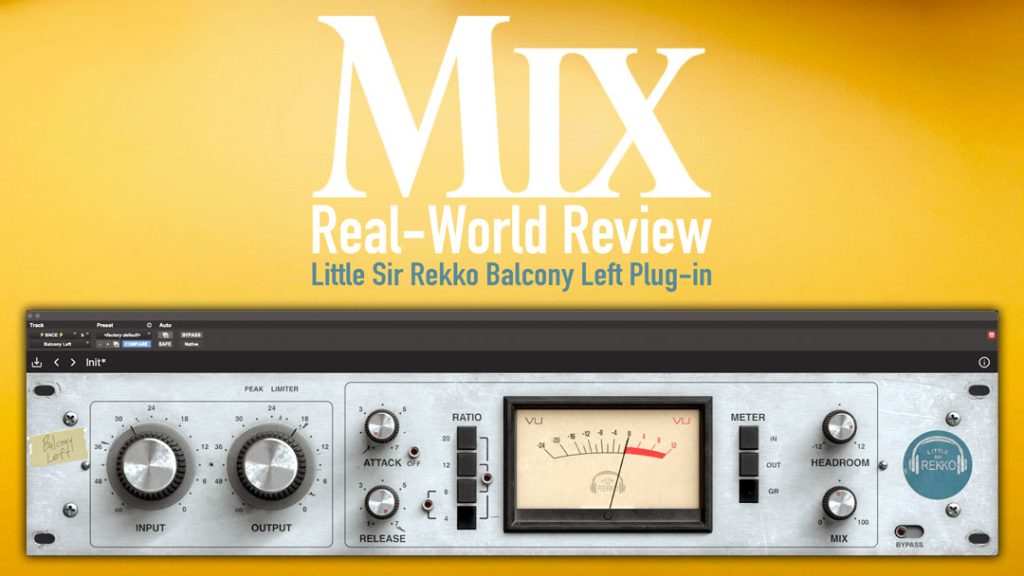
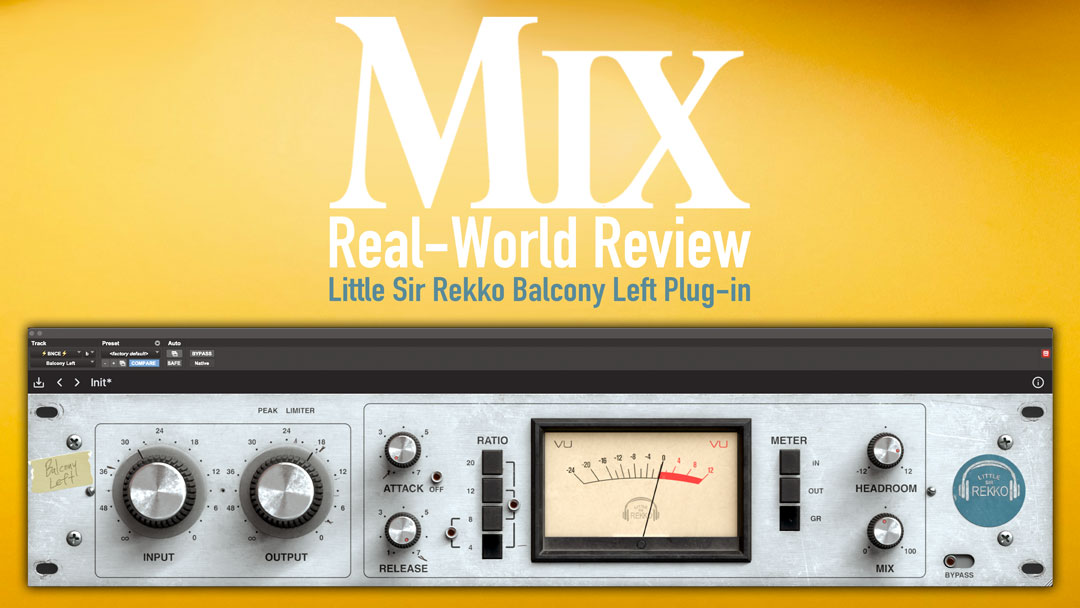
New York, NY (April 24, 2026)—For more than two decades, the professional audio world has been awash in emulation plug-ins that mimic everything from coveted LA-2As to Neve channel strips to SSL mix bus compressors and beyond. Most producers and engineers have somewhere between a handful and a hundred of these products in their arsenal of “analog warmth” miracle machines.
So, it’s understandable that any new entrant into this already crowded market is likely to be met with a tinge of skepticism. Did we need another one of these? Well, you might want this one.
Grammy- and Oscar-winning producer/engineer Greg Wells is working to create something very different with his new company, Little Sir Rekko, and its first release is Balcony Left. Unlike most hardware emulation products that aim to produce a perfect “patient zero” by presenting an idealized average across multiple units, Balcony Left takes a different approach. It is a one-to-one re-creation of Wells’ vintage 1176LN hardware that he has used on countless hit productions.
According to Wells, the original unit was sourced from a church in St. Louis in the mid-1990s, with a piece of tape on it labeled “Balcony Left” that ultimately inspired the plug-in’s name. He says the compressor shaped much of his career, particularly his vocal recordings, and describes it as a key part of the sound chain that has consistently helped singers feel inspired and perform at their best.
What further separates the plug-in from typical 1176 emulations is its distinct sonic personality. Rather than aiming for transparent compression, it delivers a strong tonal footprint, adding life, harmonic character and subtle EQ-like shaping, alongside dynamic control. He describes it as a “magic record-making box” that can be driven hard without sounding choked, retaining size and musicality even under heavy compression. It also introduces modern workflow features such as a mix control for parallel blending, allowing users to dial in an aggressive tone while maintaining balance.
Balcony Left is suited to virtually any source, including vocals, drums, bass, piano and even mix bus processing. He emphasizes its ability to make sounds feel bigger, more focused and more energetic, making it a tool for adding character and cohesion across an entire mix.
SOME FAMILIAR, SOME NEW
Balcony Left is available from the Little Sir Rekko online store. The purchase and installation process is totally seamless and pretty much an afterthought. The software is compatible with all common plug-in formats (AU, AAX and VST3) for both MacOS and Windows. When launching the plug-in for the first time, you go through a one-time authorization process, and then you’re ready to go.
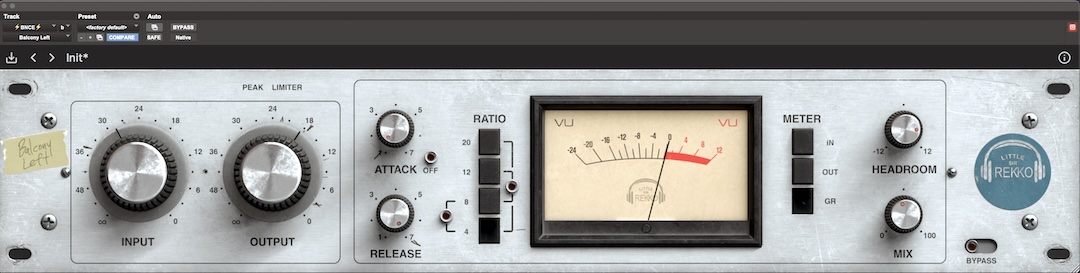
Once launched, you’ll be presented with some common and notso- common control options for an 1176LN. The direct carryovers from the hardware include the classic input and output knobs, attack and release, four ratio buttons (ranging from 4:1 to 20:1), and the standard metering options.
• Mix Review: FabFilter Pro-C3 Compressor
From there, the software version offers a few additional controls. Moving from left to right, there is the option to turn the attack mostly off, as well as the classic “all buttons mode” and a less aggressive inbetween mode. You get ±12 dB of headroom control, enabling you to either completely squash and saturate a signal or let it breathe. Finally, there’s a wet/dry mix control and a simple bypass switch.
The only slightly quirky aspect of Balcony Left is how it manages presets (which, by the way, are excellent). Instead of saving the files in your DAW’s standard plug-in folder, the presets are accessible directly within the software, in the upper-left corner above the controls. Users can save their own presets in the software or use the default options available in their DAW.
TRY IT ON EVERYTHING
Likely the most common use for an 1176-style compressor is across a drum bus, and here the Balcony Left excels. As just a jumping-off point, Wells’ own “Drum Bus Cold Brew” preset is a great first taste and an indication of what’s possible. Instantly, drum tracks have more punch and character, and the wet/dry controls deliver some nice parallel-style transient blending.
On vocals, it excels wherever you place it in the signal chain. You can place it at the top to start immediately dialing in some aggression and grit, or, if you prefer more transparent dynamic control at the top of your plug-in stack, you can drop it at the bottom and add just a bit of the Balcony Left subtle EQ characteristics.
Where this plug-in will probably surprise folks is on the stereo bus. After achieving that “glue it together,” -4 dB sweet spot, the software delivers an intriguing alternative to the “classic” SSL and Neve emulations.
Discover more recording stories—get a free Mix SmartBrief subscription!
At the end of the day, Balcony Left is one of those products that is easy to justify adding to a modern mix toolkit. It’s not particularly intense from a CPU standpoint, so you can use a bunch of them at once. and it absolutely brings a certain “expensive” sound to vocals and acoustic guitars. And the very reasonable, if not cheeky, $117.60 price point makes it pretty much a no-brainer.
It will be exciting to see what Wells and his development team decide to work on next.
| MIX VERDICT: LITTLE SIR REKKO BALCONY LEFT PLUG-IN |
| THE TAKEAWAY: “Balcony Left is one of those products that is easy to justify adding to a modern mix toolkit and it absolutely brings a certain ‘expensive’ sound to vocals and acoustic guitars.” |
| COMPANY: Little Sir Rekko • www.littlesirrekko.com PRICE: $117.60 (full license); or $11.76 per Month PROS: • Beautifully captured 1176LN compressor emulation. • custom tone shaping options. • distinctive and unique analog character |