
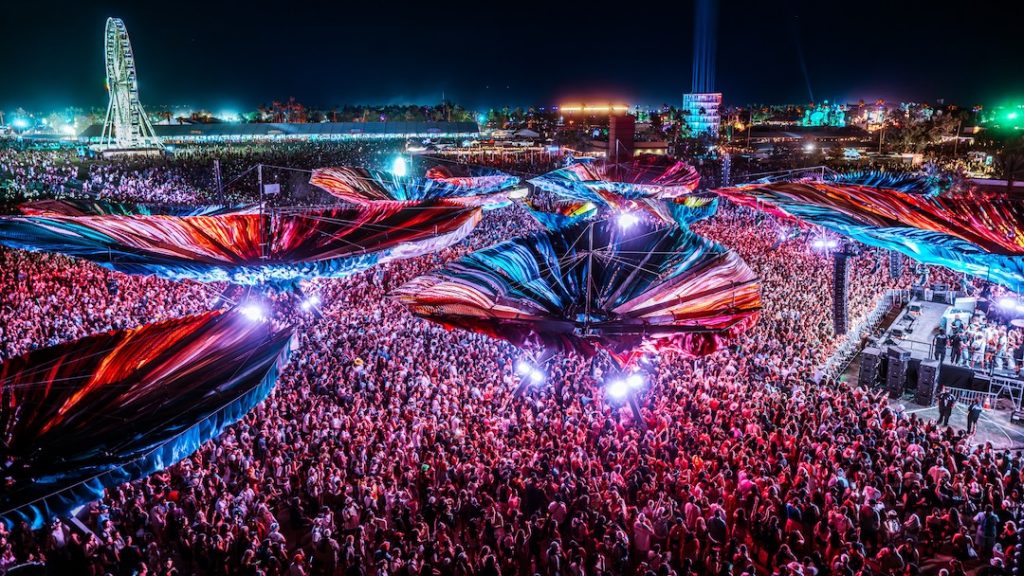
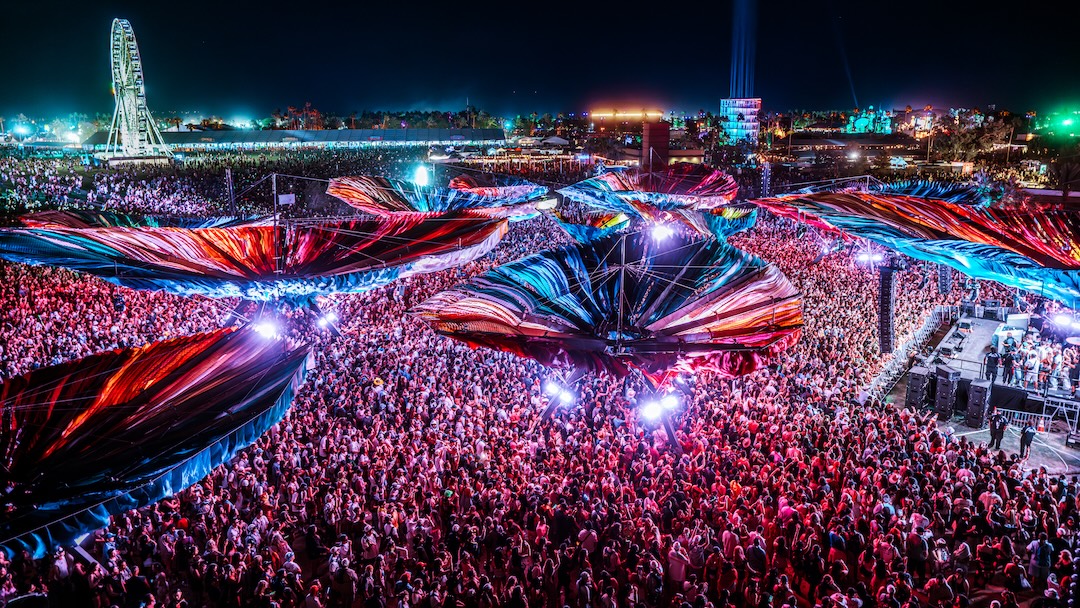
Indio, CA (May 5, 2026)—Last month’s Coachella was a return to form for the long-running festival, with top artists headlining and strong draws in its returning stages, including the Do LaB MACROdose electronic music stage, which was back for its third year. Sporting a top lineup with Tinashe, Seth Troxler, SBTRKT and After Midnight among others. The 2025 edition drew upwards of 30,000 people, so when Los Angeles-based integrator Launch prepared to handle audio for this year’s stage, it fielded a sizable Meyer Sound rig to cover the masses.
With the Do LaB sound system well established, the team worked within a familiar framework. “We took the best of the last two years and applied it to this year,” said audio crew chief and systems engineer Ian Ingram.
Launch’s Meyer Sound Panther system anchored the interior of Do LaB’s MACROdose canopy: Dual hangs comprised eight Panther-L and two Panther‑W loudspeakers per side, supported by 18 2100-LFC low-frequency control elements, with two Panther‑W front fills and two Panther-W outfills. Leopard compact linear line array loudspeakers and 900-LFC compact low-frequency control elements covered the DJ booth. Flown UPQ-1P loudspeakers covered a new upstage area, and Ultra-X20 loudspeakers extended to the backstage VIP lounge. Ultra-X80 outfills and delays extended sound to the edges of the tent, and 10 Ultra-X40 compact point source loudspeakers delivered a surround experience designed to give the space the feel of a reverberant hall.
• Integrator Audio & Light Outfits Greensboro’s The Pyrle
From there, the system expanded outward. Four Ultra-X80 loudspeakers, mounted on the outer ring and aimed outward, pushed sound beyond the canopy’s edge and blended with the main Panther arrays. “The structure has a lot of hanging fabric,” said Ingram. “Low end covers, no problem—low mids cover. That fabric tends to eat up some of the high frequencies. That’s where we use the Ultra-X80 loudspeakers, to cover the acoustic shadows.”
Discover more great stories—get a free Mix SmartBrief subscription!
Ingram noted that Meyer Sound’s MAPP 3D system design and prediction tool came in handy for prepping the system. “You do your homework and you know what the coverage is going to be,” he says. “You don’t want to get the system up and realize it’s not working the way you thought.”