
Nashville, TN (February 17, 2026)—Can an entire album qualify as an anthem? Perhaps so. Just look at the titles on Lucinda Williams’ new album World’s Gone Wrong (Highway 20 Records) to find a complete musical essay on the State of the Union—from the overview of the title track to the confrontational “How Much Did You Get for Your Soul” to the raw outpouring of “Something’s Gotta Give.” The final selection, “We’ve Come Too Far to Turn Around,” offers a speck of hope, Williams concedes, to keep us all from driving off a cliff.
Most of the songs on the album were written by Williams, Tom Overby and Doug Pettibone, a guitarist and longtime bandmember. Overby, the multi-Grammy-winning artist’s husband and manager, collaborated heavily on the songwriting for the first time in their 20-year relationship.
“He was kind of shy and modest about it, but I would look at his lyrics and think, ‘There’s some really good stuff here,’” Williams says. “I would take his lyrics and mess around with them and come up with an arrangement and melody. Lo and behold, we ended up with a handful of songs that were really good. It was a new thing for us.”
Long recognized as one of America’s great songwriters (including a 2025 nomination to the Nashville Songwriters Hall of Fame), Williams has faced numerous new challenges since suffering a stroke in 2020, one of the most life-changing being her inability to play guitar.
In addition to the difficulty that presents in her compositional process, where the guitar has always been interrelated to her voice and the manner in which she leads the band, the lack of an instrument has also changed the way she records.
“I would start playing the guitar and the band guys would pick up on my vibe, my tempo, my cadence; they would start following me until it all jelled,” Williams says. “I haven’t been able to do that, so I have had to have one of the guitar players in the band substitute on acoustic rhythm guitar. But it’s hard because I have my own way of playing, and [now] I have to explain the feel of how I want the song to be because now I can’t show them. Fortunately, I have a great band, and I can get up and sing and they play and we can still put on a good show doing that.”
PROVIDING ROOM & BOARD
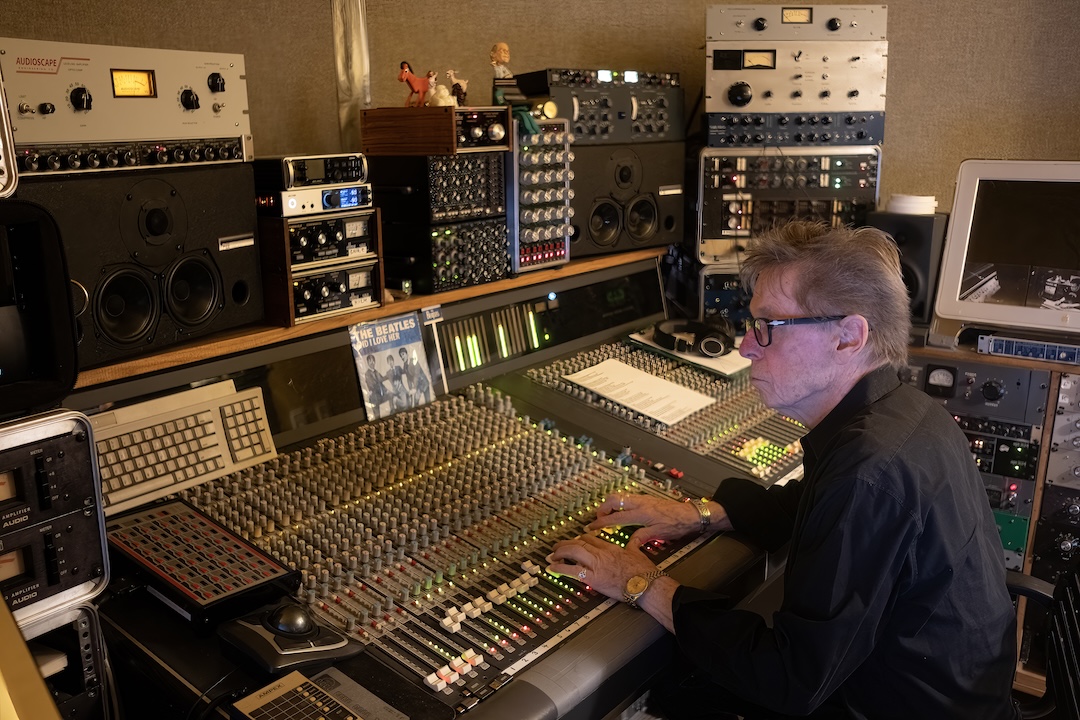
While the content on World’s Gone Wrong may seem a departure for Williams, her longtime engineer Ray Kennedy assures that the sonics are familiar. He records through a 1962 Telefunken tube console at his Nashville studio, Room & Board. Williams’ band—Brady Blade (drums), Dave Sutton (bass), Marc Ford and Pettibone (guitars)—was recorded live in the big room.
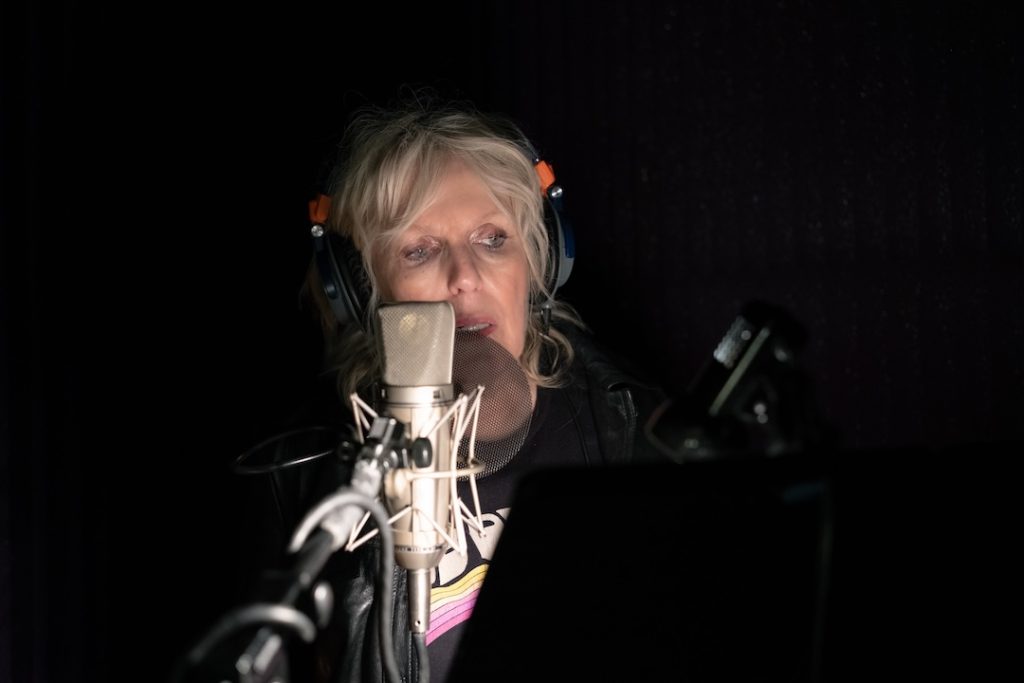
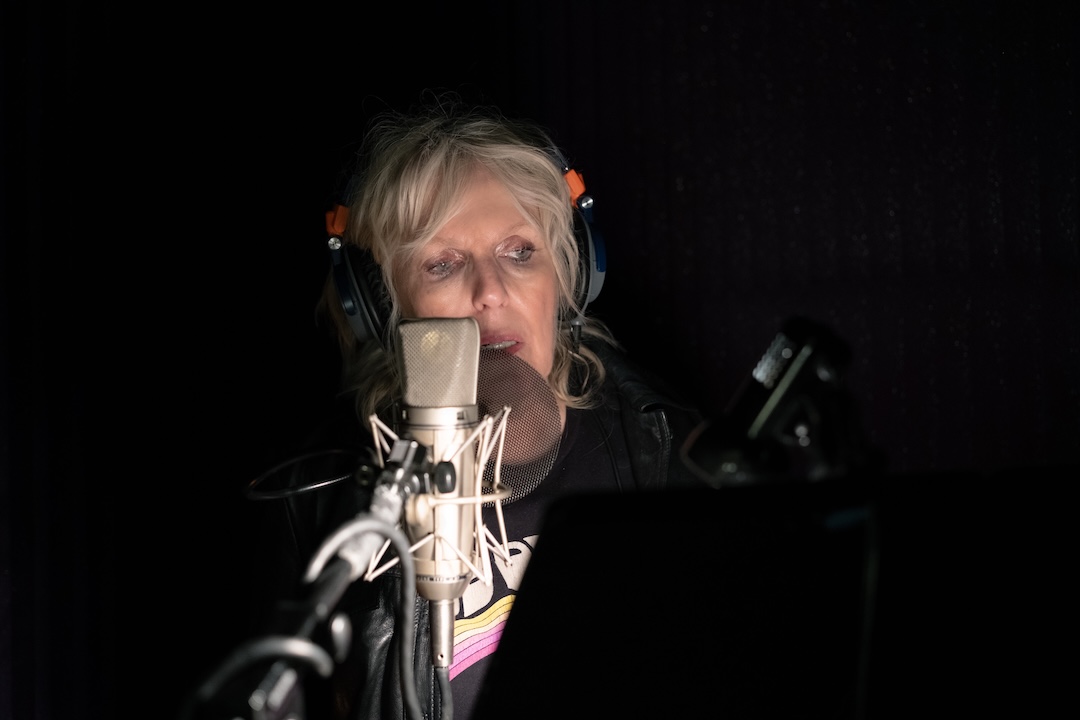
Williams, meanwhile, was made comfortable in an iso booth, singing into a Neumann U 67. “That’s the same mic she used on Car Wheels on a Gravel Road,” Kennedy says. “I’ve put other mics in front of her that sound really good, but there’s an essence, a quality, that this mic captures—the phlegm bouncing around her vocal cords, and the grit and all the beautiful characteristics and the other stuff that is unique to her.
“There’s drum bleed [out in the studio], of course,” Kennedy continues. “I use a lot of ribbon mics on the electric guitar amps, so there’s not really that much bleed, but there’s enough that we need to do everything live.”
• Capturing The Vibe of Lily Allen’s West End Girl
A big part of that live feel comes from the live drums, and Kennedy has found a “secret sauce” drum mic that he takes with him wherever he records. It’s a 1950s dynamic, large-diaphragm auctioneer mic called “a Phillips,” connected to a stand.
“Some of them have an on/off switch or a lever that you can pull to turn it on and off, and that’s why they were used as auctioneer mics,” the engineer explains. “I put it about eight feet out in front of the kit, kind of pointed at the middle of the drums, and I hit it pretty hard. I run it through a compressor and squash it a little bit, and it’s a really interesting sound. It’s got some distortion on it, but it’s a vibe thing.”
Kennedy runs Pettibone’s electric guitar through a Flickinger compressor, which he says is “identical to a Fairchild.” Ford’s guitar goes through an 1176.
Another part of that unique, live feel on the record, and on countless records by other artists Kennedy has worked with comes from the very walls of the 2,500 square-foot recording space at Room & Board, which is ringed by an assortment of mounted stringed instruments. They can be tuned in various ways, if desired, or left alone. It all adds to the sound of the final record, he asserts, which is defined by his admittedly unconventional mix.
MINIMAL TRACKS, FEW EFFECTS
The only track not cut live was “We’ve Come Too Far to Turn Around,” which had been written for Williams’ previous record. The 6/8 time signature made it tricky for her former band, so they shelved it, but Kennedy knew they’d end up pulling it out again one day, and they did for this record. He exported Williams’ vocals and guitar, and her new band (now with a couple of new members) nailed it in one take.
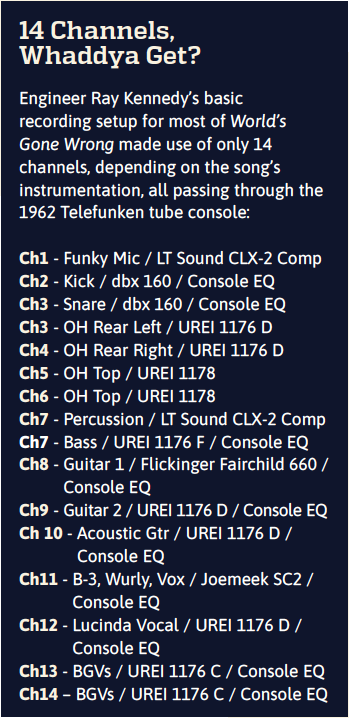 “Most people spend a lot of time doing a lot of overdubs, a lot of tweaking, comping and tuning and all the different kinds of manipulation that you can do to audio,” he says. “I don’t, really. I try to record in a manner that I don’t have to do any of that.” Guest parts were added later. Mavis Staples and Norah Jones, who also contributed piano, sent their tracks from various parts of the country, and Brittney Spencer overdubbed hers at Room & Board.
Kennedy also has a modified Maxcon 11 custom-built console, with constant-power EQ. He does all his minimalistic mixes sans automation—all hands-on faders in real time.
“Everything’s recorded in a way that when I just pull the channel up, everything sounds pretty much the way I intended it to sound and everybody’s hearing something that sounds close to what the record’s gonna sound like,” he says. “I think it’s inspiring for all the musicians to hear themselves not compromised in any way.”
Summing up the effects he used on the record, Kennedy details: “Roland SRV-330 Dimensional Space Reverb on vocals, Korg SDD-2000 Digital Delay on vocals and some guitars. Mix Summing Buss: Light Compression. UREI first-generation 1178/Neve 2254/A with fast release mod/AMS Neve 33609 (metal knob) to RME ADI-2-Pro FS into Stereo Capture in Pro Tools.”
After roughly 25 years recording and working with Williams, Kennedy knows what works— and he says that this album worked.
Discover more great stories—get a free Mix SmartBrief subscription!
For Williams, while the songs on World’s Gone Wrong are not about her usual subjects of love or personal loss, they are passionate nonetheless, and they’re about our place in the world. She says listening to the news every day gets her down, and she hopes that her listeners feel a little less alone after hearing these songs.
“It helps me a lot when I feel like I’m part of a movement, a part of the tribe, that we’re all fighting it together,” she says in summary. “That’s a good feeling and helps me deal with a lot of this stuff.”