
Don’t Pass Up Part One!
THE ALWAYS-ON STUDIO
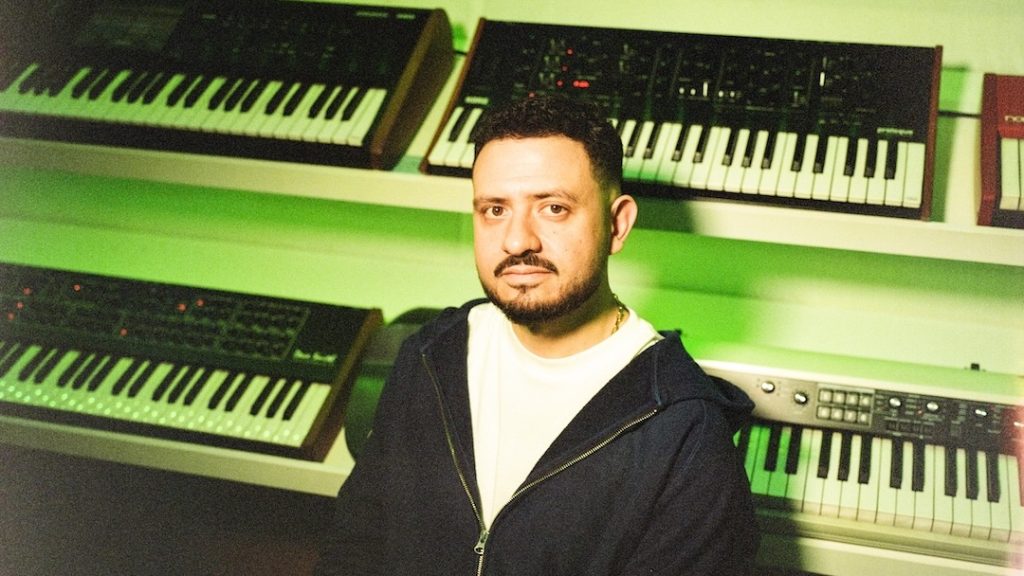
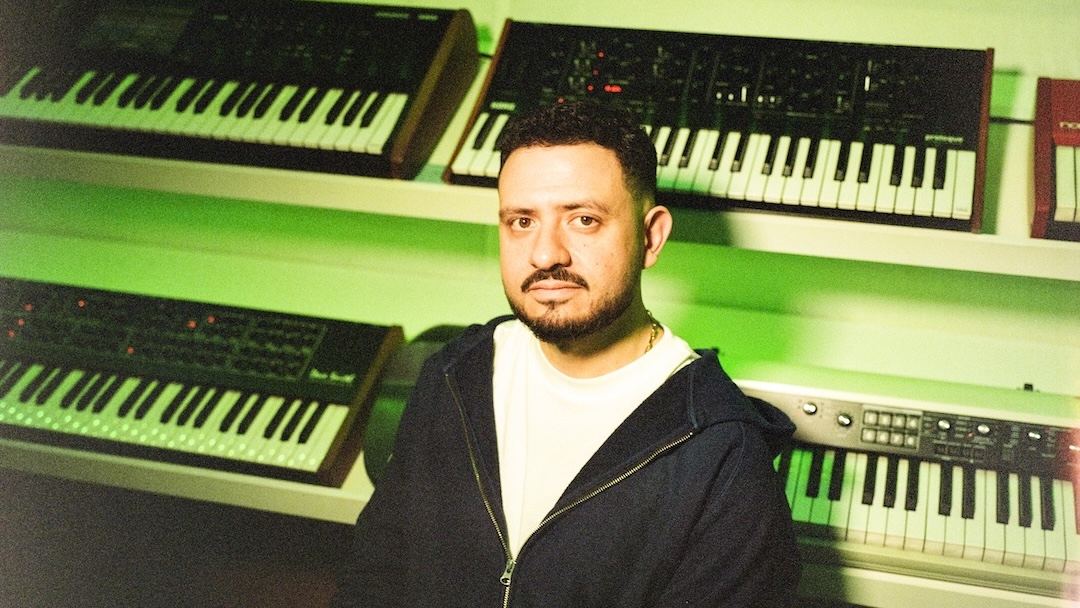
Solid-sounding instruments are Chahayed’s default. Piano, synths and other polyphonic tools that allow him to play chords. He’ll often turn to his Prophets when looking for something unexpected or new. The Rev2 is among his more recent additions, an instrument on which he’s found some “wild sounds.” He also points to the Kodamo Mask1, which he describes as “a new age [Yamaha] DX7, very cool, very interesting sounds.” Alongside the hardware, he has an extensive collection of NI Kontakt libraries on his laptop, many of which he’s still discovering.
“When I was a kid, I used to go to Tower Records and I would buy music because I thought the artwork was interesting,” he says. “In that same manner, I will look through the Kontakt library and see the artwork and be like, ‘What is that? It looks cool.’ I let natural curiosities take me to where I don’t know.”
Everything runs through a central Mac computer, with each keyboard permanently routed to its own input in Logic, which is recording continuously through a system set up by his full-time engineer, Julian Vasquez. The same always-on approach applies to the drum kit and other instruments in the live room. The goal is to never miss a moment, matching Chahayed’s playing style, which often finds him moving between two keyboards at once—the right hand laying down chords, the left triggering, for example, an 808, a bass patch, or some other sound to introduce a different groove or feel.
If an artist casually lands on something usable while tinkering on an instrument, it’s already been captured, without interrupting the moment. When Chahayed is working alongside another producer, Vasquez can immediately edit what he’s just recorded, prepping it for the other producer’s input while Chahayed moves on to the next idea, or layer, effectively doubling the pace of the session. For arranging and editing, Vasquez works in Ableton, switching to Pro Tools when it’s time to record vocals.
“It didn’t happen overnight,” Chahayed says of this efficient workflow. “In 2022, when I got asked to executive produce Jennifer Lopez’s album, which also became the soundtrack for her film, she wanted to work in her home movie theater and turn it into a studio. I wanted to bring what I have here, so we came up with a system where we can bring this setup anywhere in the world, a mini-mobile version of my studio where Julian brings his laptop, I select three or four keyboards to go through his rig, and he’s recording any and everything going on with the track.”
Lopez’s This Is Me… Now is the second album that Chahayed executive-produced, the first being Harlow’s Come Home the Kids Miss You. For these projects, he was involved in every aspect: producing and songwriting, sourcing talent, tapping his network to bring in marquee collaborators, overseeing the budget, supervising the mix, and serving as a sounding board for nearly every decision. In both cases, the artists came to him, Harlow via Instagram DMs, and Lopez after hearing Harlow’s “First Class” and wanting to work with whoever made the record.
Discover more great stories—get a free Mix SmartBrief subscription!
“I love it,” he says of the EP process. “You form a bond with the artist, there’s a lot of memories and you’re never going to forget each other. But what I don’t like about it is, you’re limited to that artist. You can’t spread yourself too thin. I am completely immersed in it all the way. And now, I feel like I’m in an even better position to do it, because I have even stronger relationships.”