
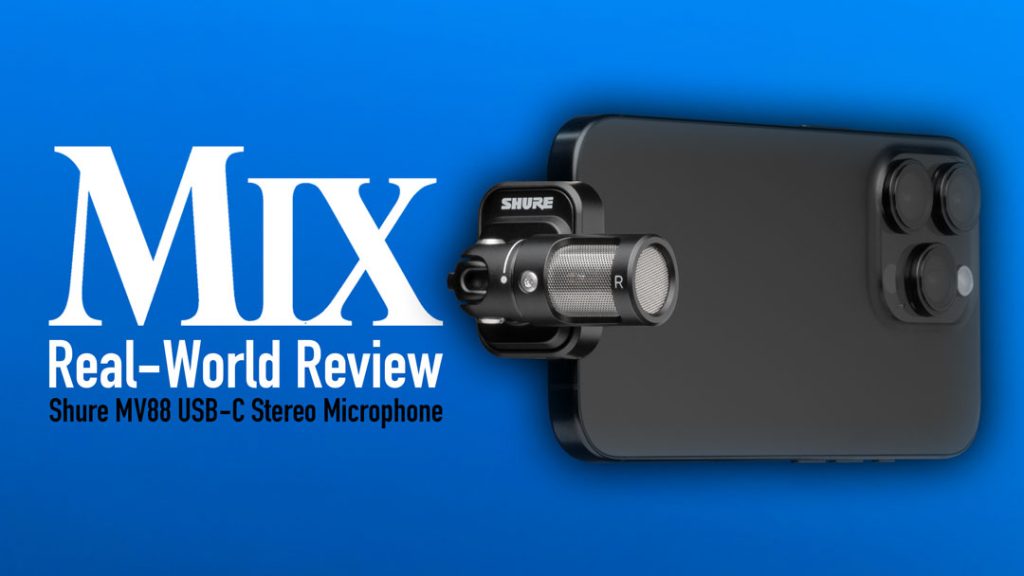
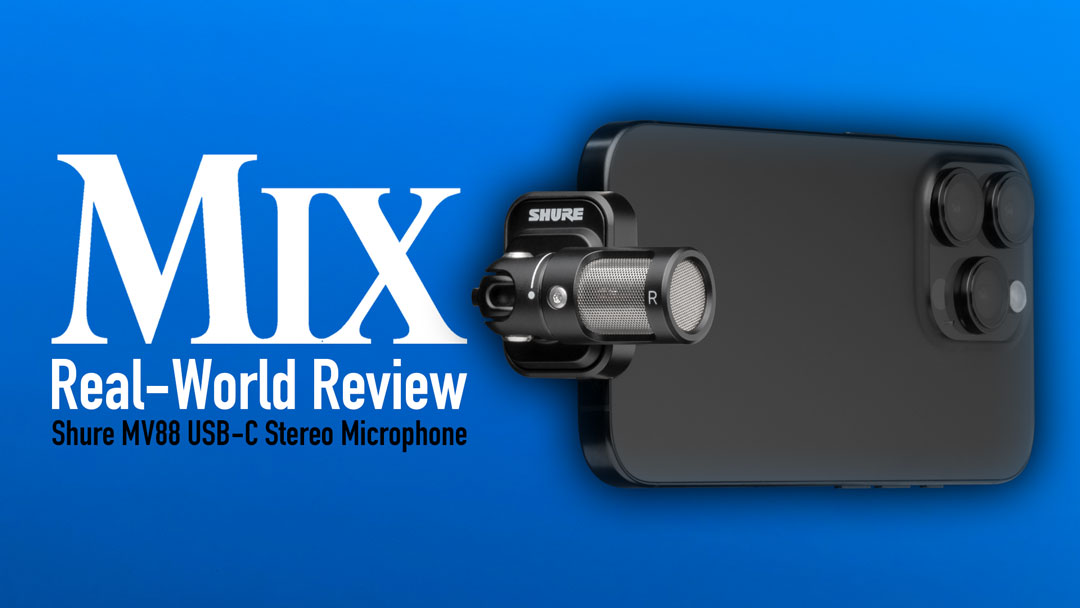
| MIX VERDICT: SHURE MV88 USB-C STEREO MICROPHONE |
| THE TAKEAWAY: “If you want to up your digital content game, this is an excellent place to start.” |
| COMPANY: Shure • www.shure.com PRICE: $159 PROS: • Captures clear, defined sound in a variety of applications. • Mic settings apply to use with other, non-Shure audio apps, too. CONS: • Removable windscreen is fragile. |
New York, NY (April 15, 2026)—Shure has catered to content creators for a decade with its growing MV88 mic line, and the latest addition is the MV88 USB-C, designed for anyone who captures media using a mobile device with a USB-C port.
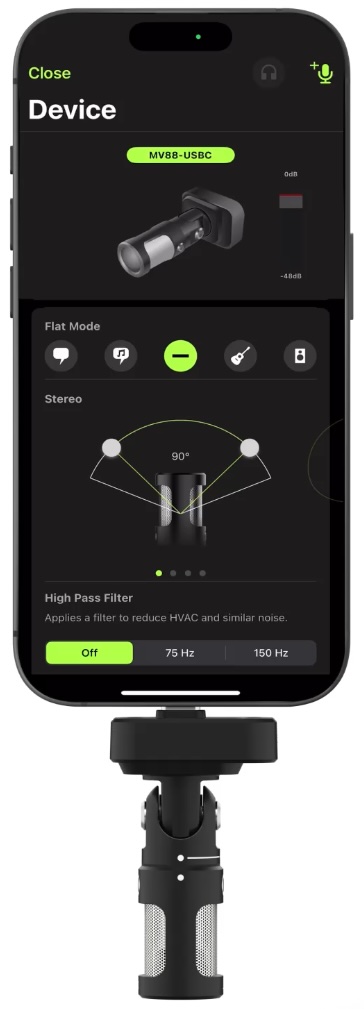
The MV88 USB-C—essentially Shure’s MoveMic 88+ without the wireless capabilities—comes with a carry case and removable windscreen, and is built around two capsules in a mid-side configuration: a center cardioid for directional use, like speaking directly to a phone’s camera, and a bi-directional capsule, for interviews and so on. The capsules live inside a hinged barrel that is the circumference of a dime, and the mic is powered by the host device.
The mic is configured using Shure’s MOTIV Audio and Video apps, which let you switch between four polar patterns—stereo, where you can adjust the image width between 60 and 135 degrees; mono cardioid; mono bi-directional; and raw mid-side, which records a two-channel signal with a stereo image that can be adjusted later in a DAW. Other settings include auto level control, a 75 Hz / 150 Hz high-pass filter, five-band EQ and a real-time denoiser.
While the two MOTIV apps can be used for recording audio and video respectively, the audio settings you choose in them are implemented and stored inside the mic itself, so the settings remain in effect even if you switch to a different app (Voice Memos, Blackmagic Camera and so on). Cool!
At Mix, most of our content creation involves typing, but I put the MV88 USB-C to work in some typical digital creator situations to test it.
First up was an afternoon of interviews for an upcoming tour sound article; sitting down with the FOH engineer at his mix position in a cavernous theater, I set the MOTIV Audio app to mono bi-directional and turned on auto level. The results were okay but marred by “user error,” as we sat 8 to 10 feet apart and I put the phone too far off to the side, placing both of us on the periphery of the figure-8 polar pattern. While our conversation was clear, it was sometimes low, though I was able to improve its volume and definition later in the MOTIV Audio app using its “Enhance” DSP setting before exporting the 48 kHz / 24-bit WAV file. I understandably got far better results when I interviewed the monitor engineer at stageside, as the phone was directly between us and we were only 4 to 5 feet apart.
• AMS Neve 88R LBC Compressor – A Mix Real-World Review
That night, I recorded some of the concert with the MV88 USB-C set on Stereo, and it captured an enjoyable, detailed audience recording with tight low end and a pleasant sense of depth. I also recorded some just using the iPhone’s onboard mic, and the results were comparatively boomy and undefined, swamped by the sound of the room.
Days later, my town was hit by a blizzard with high wind gusts and 24 inches of snow, so I bundled up and shot some selfie-style video outside using the mic on its mono cardioid setting. Despite the blizzard, the recording was clear when I spoke at conversational levels while holding the phone at arm’s length. The harsh winds overpowered the foam windscreen at times—to be expected given the conditions—but I was still audible despite the rumble.
Discover more reviews—get a free Mix SmartBrief subscription!
Running $159, the MV88 USB-C provides users with lots of options to capture clear, defined sound in a variety of applications, from creator work to band rehearsals to lecture halls. The mic is well-constructed (though the base of the detachable foam windscreen is a bit fragile) and is a good find for its price. If you want to up your digital content game, this is an excellent place to start.